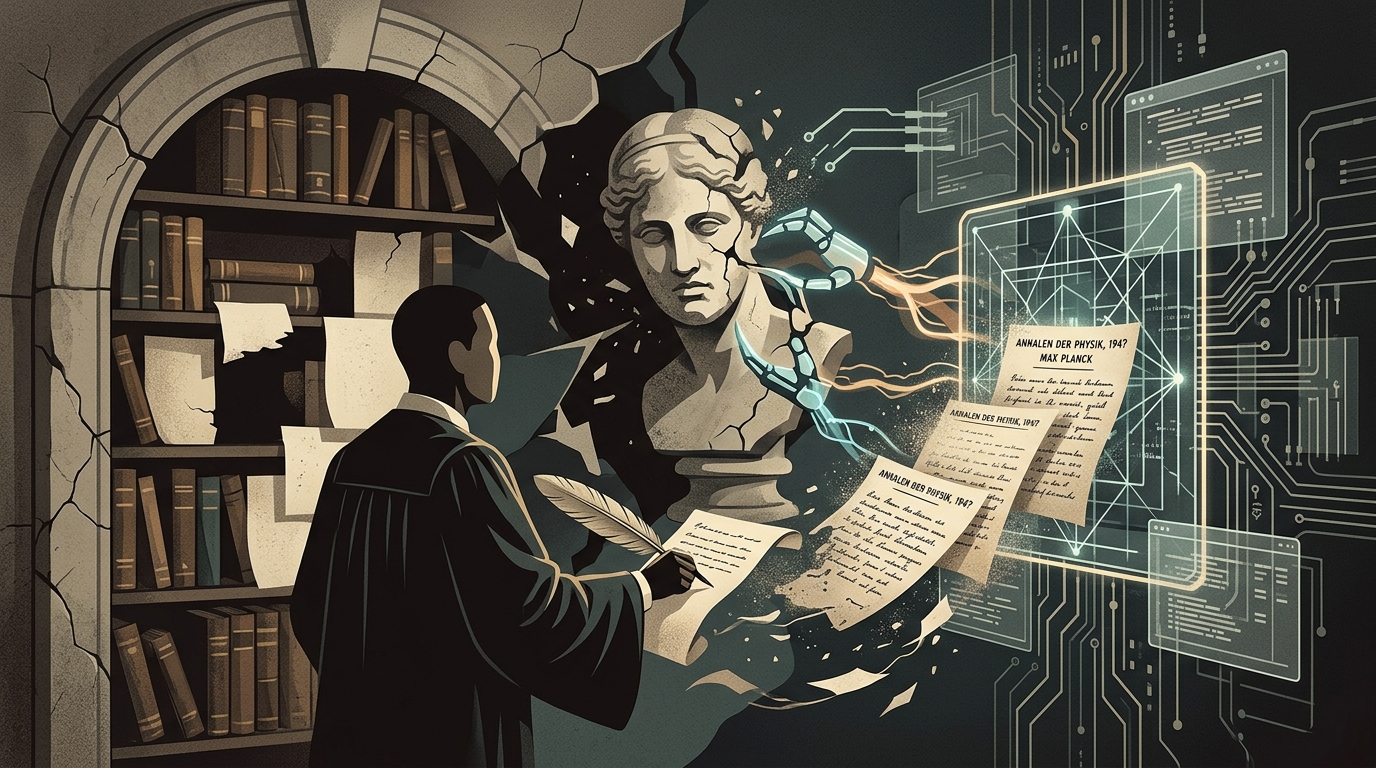
In a move that has sent shockwaves through the global scientific community, a prominent academic journal recently proceeded to retract two research papers published in the early 1940s by Max Planck, the founder of quantum physics and one of the most influential scientists of the 20th century. This decision, which left behind blank pages and dead PDF links, has opened a 'Pandora's box' regarding the ethics of scientific publishing, historical memory, and the boundaries of retrospective censorship.
The Timeline of a Controversial Decision
The papers in question, published during the darkest period of World War II, dealt with theoretical aspects of thermodynamics and statistical mechanics. For decades, they were part of the official record of physics, accessible to researchers and historians alike. However, their recent replacement with 'blank files' without sufficient explanation from the publishing house has raised serious questions. According to sources close to the journal, the retraction is not due to scientific errors or plagiarism—the usual reasons for a withdrawal—but rather due to 'ethical concerns regarding the context of the research's production' at that time.
Max Planck, although never a member of the Nazi Party, remained in Germany during the Third Reich, serving as the president of the Kaiser Wilhelm Society (now the Max Planck Institute). His position was tragic and complex: he attempted to protect Jewish colleagues while simultaneously being forced to make compromises to ensure his institution's survival. His personal life was marked by the execution of his son, Erwin, by the Nazis in 1945 for his involvement in the plot against Hitler. Despite this heavy historical burden, his scientific contribution was considered, until now, beyond the reach of political purges.
Ethical Cleansing or Historical Erasure?
This move brings to the fore the debate over 'cancel culture' in the field of science. Proponents of the retraction argue that scientific journals have a responsibility not to 'host' research produced under regimes that violated fundamental human rights, even if the research itself is theoretical. They claim that keeping these papers on digital shelves constitutes a form of implicit legitimization of the context in which they were created.
On the other hand, the vast majority of science historians are expressing their dismay. 'It is intellectually unacceptable,' many state, emphasizing that the retraction of historical texts is equivalent to digital book burning. Science, they argue, must confront its past with honesty and critical thinking, not disappear it. If we begin retracting papers based on the political climate of their era, where do we stop? Will we retract Aristotle's works due to his acceptance of slavery, or Newton's discoveries because of his investments in slave-trading companies?
The Role of AI and Digital Archives
There is another, more technical dimension to the issue. With the advent of Artificial Intelligence, publishing houses now use algorithms to scan vast archives spanning decades, looking for 'problematic content.' It is possible that the retraction of Planck's papers was the result of an automated process that flagged keywords or associations with the Nazi state, leading to a hasty decision by the journal's management to avoid 'PR risks.'
This incident highlights the fragility of our digital knowledge. In the age of printed paper, a retraction meant the publication of a corrective note. In the digital age, it means the complete disappearance of the record at the click of a button. Planck's 'blank page' is not just a gap in data; it is a warning of how modern ethics can be used as a tool for revising history, depriving future generations of the ability to understand the full scope of the human journey—with its brilliant achievements and its dark mistakes.
Conclusion
The case of Max Planck is not just about physics. It is about how our society chooses to manage memory. Scientific integrity requires transparency. Instead of retraction, the journal could have added an introductory note explaining the historical context, turning the paper into a lesson in ethics and history. The choice of erasure is a choice of weakness, a refusal to confront the complexity of human nature and historical reality.