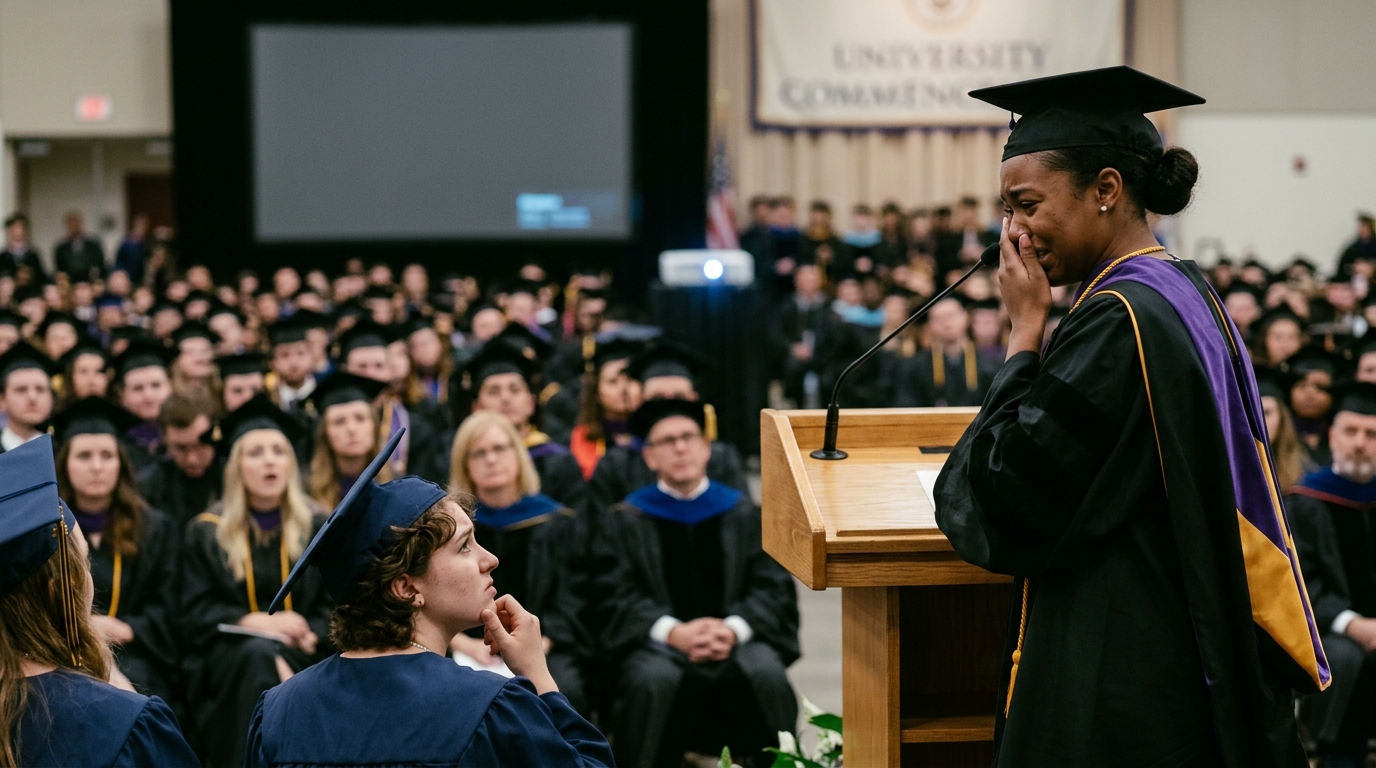
The graduation ceremony is traditionally a sacred rite of passage. It is the moment where years of academic rigor culminate in a shared hope for the future, anchored by the "commencement speech"—an address intended to inspire, comfort, and guide. However, in 2024 and 2025, this tradition has collided with a controversial new reality: Artificial Intelligence. The recent visceral reaction at Ohio State University (OSU), where entrepreneur Chris Pan was loudly booed after admitting he used ChatGPT to draft his speech, was not an isolated incident. It was the eruption of a deep-seated generational resentment.
The Desecration of the Word
The core of the issue is not the technology itself, but a profound sense of betrayal. When a speaker takes the stage to address thousands of young people who have invested fortunes and years of effort, using an algorithm to generate their message is perceived as a total lack of respect. Graduates are not looking for perfection; they are looking for authenticity. Pan’s revelation that he was "assisted" by AI to speak about the importance of connection and humanity created a paradox that the audience flatly refused to accept.
Sociologists of technology argue that the booing represents a form of resistance against the automation of sentiment. As Dr. Elena Papadopoulos, an expert in digital ethics, notes:
"Graduation is one of the few rituals we have left. When you outsource it to a machine, you are telling graduates that their hard work isn't worth even ten minutes of genuine human thought."
Economic Anxiety and the Job Market
Beyond the moral and emotional aspects, there is a profound economic driver behind this anger. Today’s graduates are entering a labor market being violently reshaped by AI. Many of the fields they studied for—from copywriting and graphic design to junior programming and legal analysis—are under direct threat of contraction due to Large Language Models (LLMs).
- Precarity: The feeling that their degree might be obsolete before the ink is even dry.
- Inequality: While elites use AI to save time on their obligations, workers fear being replaced by it.
- Cynicism: Using AI in graduation ceremonies confirms to young people that the adult world prizes speed over substance.
The Failure of "Tech Evangelism"
Speakers who choose to praise AI or use it performatively often misread the room entirely. They believe they are appearing "progressive" or "tech-savvy," when in reality, they appear disconnected from the ground-level anxieties of the youth. In the Ohio State case, Pan’s references to Bitcoin and AI acted as a spark in a powder keg. The graduates didn't want an investment lecture or a demonstration of productivity tools; they wanted a recognition of their human struggle.
This phenomenon highlights a broader crisis of trust in institutions and technological leadership. If the university, the temple of knowledge, allows discourse to degenerate into algorithmic noise, then what is the purpose of higher education? The students' reaction is a cry for the return of "Logos"—not as a statistical probability of the next word, but as reason derived from soul and lived experience.
Conclusion: The Future of Authenticity
Artificial Intelligence is a tool, but like any tool, it has its time and place. Its use in moments of high emotional stakes is proving to be risky, if not disastrous. Future speakers must learn from this year’s backlashes: in an age of total automation, the greatest value you can offer is your unmediated, imperfect, and entirely human presence. The message from the Class of 2024 is clear: if you can't be bothered to think for us, don't expect us to listen.