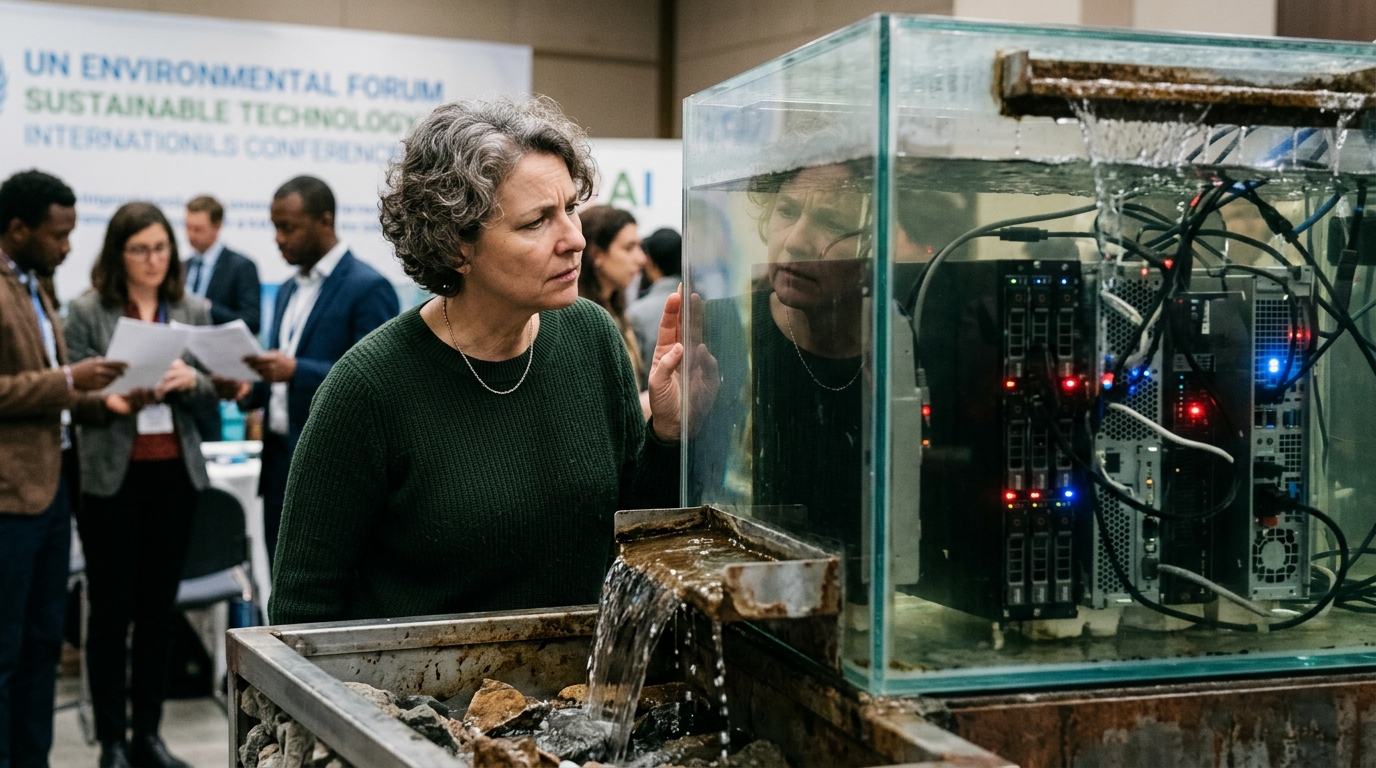
The digital revolution, once hailed as the "weightless" escape from the grime of heavy industry, is proving to be one of the most resource-intensive chapters of human history. According to a landmark report by the United Nations, the meteoric rise of Generative AI is not merely an ethical or economic challenge; it is a direct threat to the planet's ecological stability. The proliferation of massive data centers, the unceasing operation of high-performance processors, and the critical need for cooling systems are consuming energy, water, and land at a pace that outstrips the regulatory capacity of most nations.
The Thirst of the Machine: Water as a Silent Coolant
Perhaps the most overlooked dimension of the AI boom is its staggering water footprint. Data centers require millions of gallons of fresh water daily to prevent servers from overheating. The UN report highlights a startling statistic: for every 10 to 50 queries posed to a large language model (LLM), roughly half a liter of water is "consumed" through evaporation and cooling processes. In regions already grappling with water scarcity, the construction of these facilities is sparking social unrest, as local communities see their aquifers depleted to fuel the computational needs of Silicon Valley giants.
- Tech titans like Microsoft and Google have reported water consumption spikes of over 20% in the last two fiscal years.
- Many data centers are strategically located in arid regions of the US or Asia, exacerbating local droughts.
- The transition to recycled water remains sluggish due to high infrastructure costs and technical limitations.
Energy Grids Under Siege
While global powers advocate for a "green transition," the AI industry appears to be moving in the opposite direction. Training a single large-scale AI model can consume more electricity than hundreds of households use in an entire year. The problem is compounded by the 24/7 nature of AI services; unlike solar or wind power which can be intermittent, AI requires a constant, stable flow of electricity. This has led many tech firms to rely on natural gas or even coal-fired plants when renewable sources fail to meet the surge in demand.
"We are facing a profound paradox: we are deploying AI to solve the climate crisis, yet the technology itself is accelerating environmental degradation through an unprecedented demand for resources," the report notes.
The strain on national grids is becoming a geopolitical flashpoint. In Ireland, data centers now account for nearly 20% of the country’s total electricity consumption, leading to fears of blackouts and rising utility costs for citizens. While some companies are pivoting toward Small Modular Reactors (SMRs) and nuclear energy, these solutions are years, if not decades, away from being scalable.
Land Use and the E-Waste Tsunami
Beyond the intangible elements of power and water, AI has a very physical footprint. The mining of rare earth minerals—lithium, cobalt, and copper—needed for high-end GPUs (Graphics Processing Units) carries a heavy environmental and human cost, particularly in the Global South. Furthermore, the lifecycle of AI hardware is notoriously short. To stay competitive, companies must upgrade their hardware every 24 to 36 months, resulting in a mountain of electronic waste that is often difficult to process or recycle safely.
The UN is calling for urgent international standards and mandatory transparency reports. Governments are urged to mandate "green coding" practices and penalize inefficient resource management. As we hurtle toward an AI-integrated society, the question remains: can we afford the environmental price of our digital intelligence? Without a global consensus on sustainable compute, the very tools meant to usher in a new era of prosperity may instead deplete the foundations of our survival.