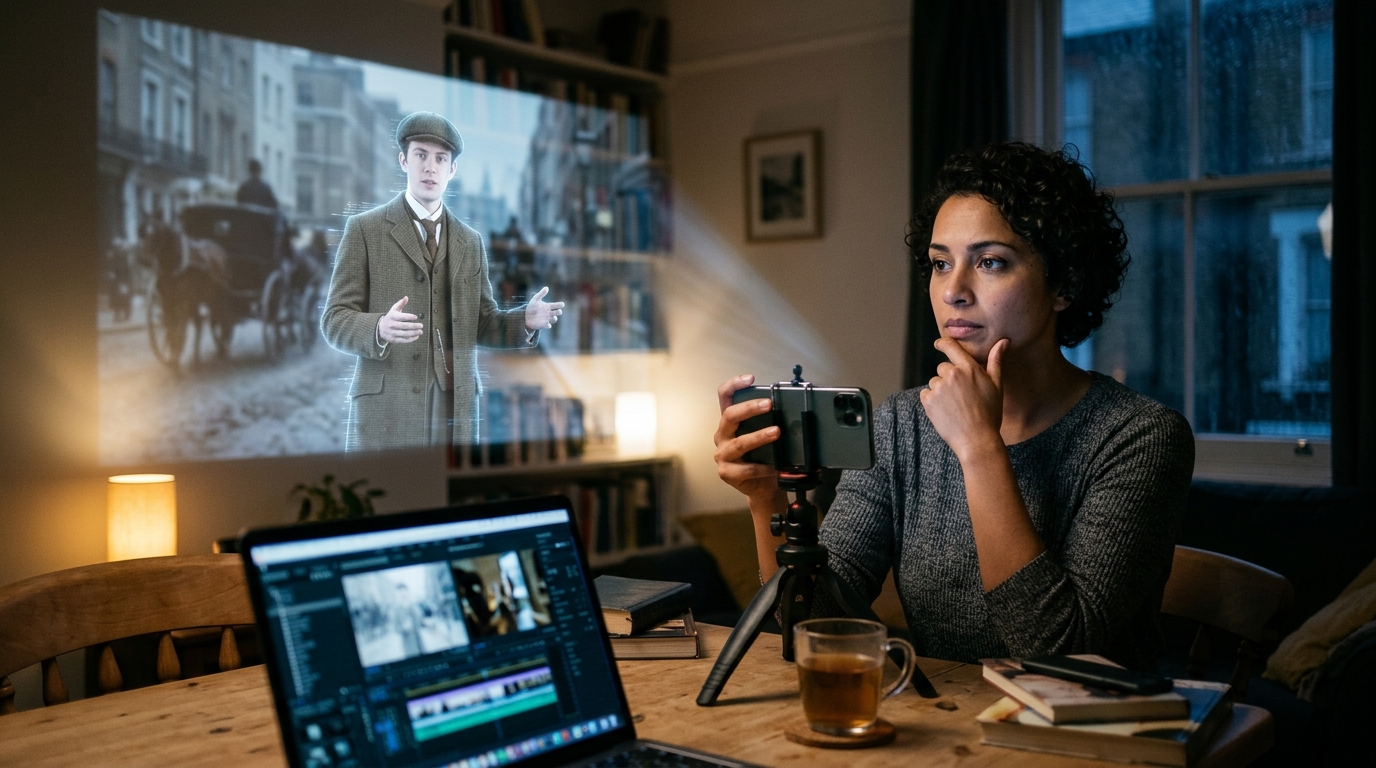
Imagine a Roman legionnaire from Julius Caesar’s era describing the grueling fatigue of a march through Gaul via a short TikTok video. Or a young woman in Victorian London complaining about the smog, looking directly into the camera of a smartphone that didn’t exist then. What was once a science fiction trope has become one of the most popular and controversial trends on social media: AI-generated 'time-travelers.'
As a recent report in The Guardian highlights, the use of generative AI tools allows content creators to 'stitch together' our past, creating hyper-realistic avatars of historical figures or anonymous people from bygone eras. These digital characters speak, move, and interact with the audience, transforming history from a static set of dates into a living, albeit often fabricated, experience. However, this technological 'resurrection' brings with it a heavy burden of ethical and moral questions.
The Technological Alchemy of Digital Memory
The process of creating these videos is now frighteningly simple. Tools like Midjourney generate the image, ElevenLabs synthesizes the voice based on historical accents, and platforms like HeyGen or Runway animate the face and body. The result is a form of 'synthetic history' that collapses centuries of distance. For proponents of the trend, it is a powerful educational tool. History ceases to be a dry textbook and becomes something relatable, something you can consume during your daily scroll.
Of particular interest is the use of technology to amplify voices that official historiography has silenced. Creators are using AI to give a face and voice to enslaved people, to women whose names were lost to time, or to victims of great disasters. In these cases, AI acts as a mechanism for 'restoring' memory, allowing modern humans to connect emotionally with the trauma and experience of their ancestors in a way that text alone fails to achieve.
The Ethical Minefield: Accuracy vs. Entertainment
Despite good intentions, the risks are obvious. History is not just about 'vibes'; it is a rigorous field of research. When an AI vlogger from ancient Greece uses modern slang or expresses ideas that are anachronistic, the line between education and misinformation blurs. There is a fear of the 'Disneyfication' of the past, where the dark and complex aspects of history are smoothed over to make them more palatable for social media algorithms.
"The problem isn't the technology, but the lack of context. An AI video can make us feel something, but it can also make us believe lies about who we were," note digital ethics experts.
Furthermore, the issue of consent arises. Although historical figures are not covered by data protection laws in the same way the living are, the ethical side of 'using' a deceased person to produce content that generates profit or views remains a gray area. Who has the right to decide how a Holocaust survivor or a World War I soldier would speak or what they would say?
The Politics of Representation and the Future
On a deeper level, AI historiography risks reproducing the biases of the data it was trained on. If AI models are primarily trained on Western-centric sources, then 'time-travelers' from Asia or Africa may end up being mere caricatures based on stereotypes. 'Stitching together the past' requires a deep understanding of archaeology and sociology, which AI often lacks, favoring visual sensationalism instead.
As we move into 2026, the need for an ethical protocol in the use of AI for historical purposes is becoming imperative. There must be clear labeling that the content is synthetic, as well as citations for the sources used to create the script. Technology gives us the ability to 'talk' to our ancestors, but we must ensure we are not putting words in their mouths that they would never have said, just to gain a few more likes.