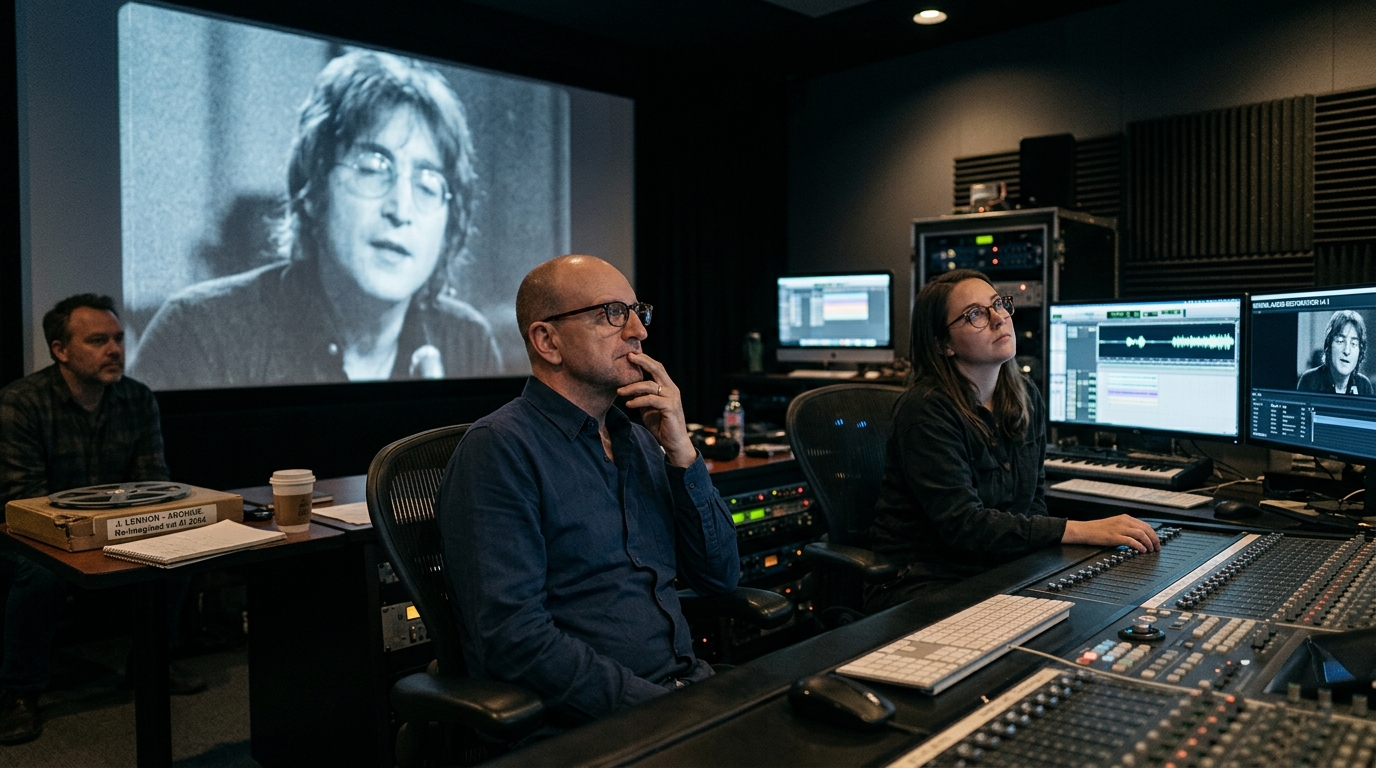
The relationship between cinema and technology has always been symbiotic, but the latest move by Steven Soderbergh, one of Hollywood's most restless innovators, appears to push the boundaries of mere technical enhancement. In his new documentary focused on John Lennon, Soderbergh is deploying Artificial Intelligence (AI) not just to clean up archival audio, but to evoke a sense of "live" presence that was previously unattainable. This development arrives at a pivotal moment as the entertainment industry struggles to define the ethical borders between historical preservation and digital necromancy.
The Technological Leap: From 'Get Back' to Now
The use of AI in music and film is not entirely unprecedented. Peter Jackson set the stage with "The Beatles: Get Back," utilizing machine learning technology (MAL) to de-mix audio tracks from old, low-quality mono recordings. However, Soderbergh seems to be taking the concept a step further. While Jackson used AI as a restoration tool, reports surrounding Soderbergh’s project suggest a more active use of technology to reconstruct Lennon’s voice and potentially his likeness, aiming for a more immersive experience.
Soderbergh, known for his experimentation with mediums—such as shooting entire feature films on iPhones—views AI as the next logical step in a director’s narrative toolkit. The ability of AI to analyze thousands of hours of footage and "learn" the nuances of an artist's voice allows creators to fill gaps in history that the physical decay of time had rendered inaccessible.
The Ethics of Digital Resurrection
The central question arising from Soderbergh’s initiative is not technical, but profoundly ethical. Who has the right to "speak" for a deceased artist? The case of John Lennon is particularly sensitive, given his iconic status in global culture and the tragic nature of his death.
- The Consent of Heirs: Is permission from the Lennon estate enough to justify digital reconstruction?
- Documentary Authenticity: Can a work be labeled a "documentary" when it contains synthetic elements?
- The Precedent for the Future: If a full reconstruction of Lennon is permitted, where does the use of AI stop for other historical figures?
Critics argue that using AI to reproduce the voice of a person who cannot grant consent is a violation of their artistic integrity. On the other hand, proponents believe it is a way to keep a legacy alive for new generations, offering a quality that analog methods could never achieve. The debate echoes the controversy surrounding the AI-generated voice of Anthony Bourdain in the documentary "Roadrunner," which sparked a massive backlash regarding transparency.
Impact on Narrative Truth
In documentary filmmaking, "truth" is the ultimate goal. But when technology intervenes to "fix" reality, the line between fact and fabrication blurs. Soderbergh, as a filmmaker who frequently deconstructs cinematic conventions, may be using AI precisely to highlight this ambiguity. However, for the general public, the danger lies in accepting a "constructed" history as the absolute truth.
"Technology is no longer just a restoration tool; it is a co-creator that can alter our perception of the past," note industry analysts.
In conclusion, Soderbergh's project on John Lennon represents a milestone. It is not just a film about a musician, but a test case for how humanity will manage its digital immortality. As algorithms become increasingly capable of mimicking the human soul, art is called to decide whether it will remain a mirror of reality or a creator of new, digital ghosts.