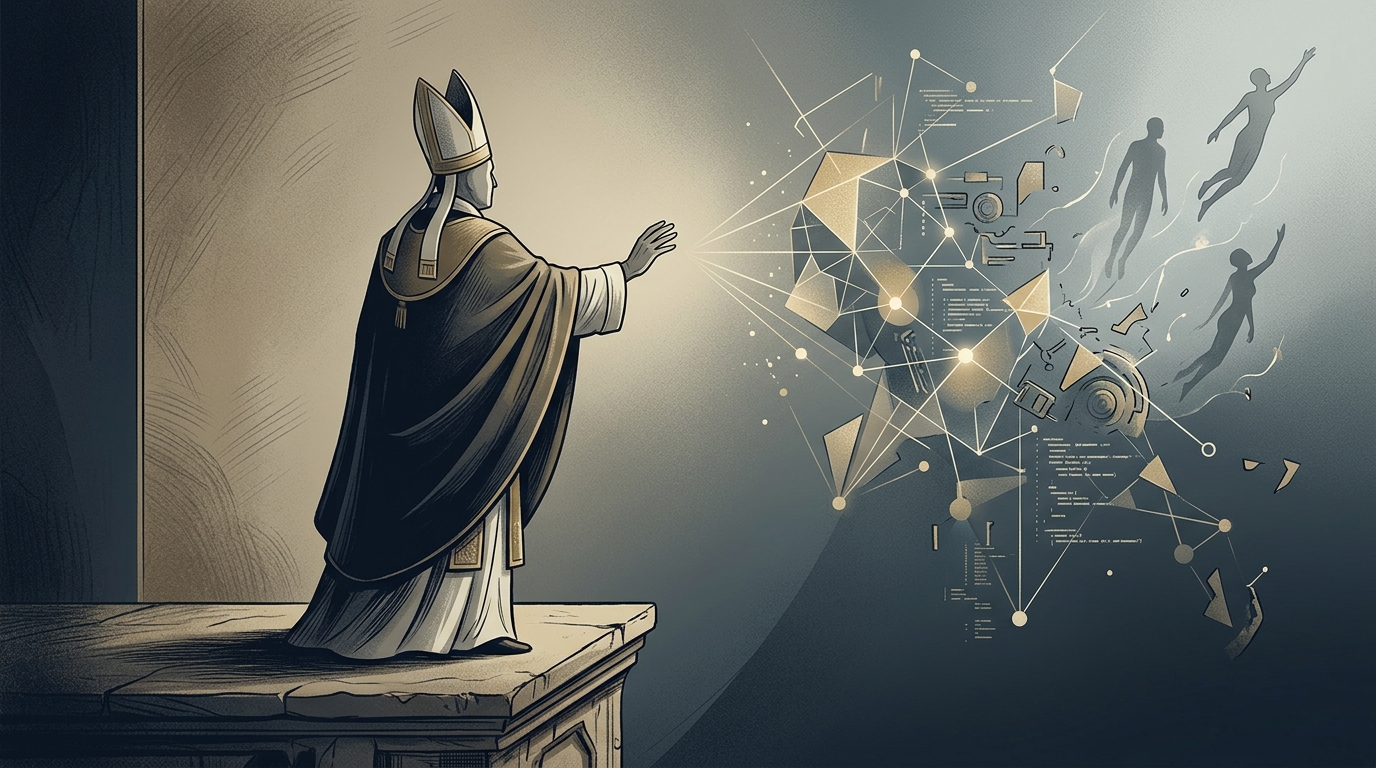
In a move poised to reshape the global ethical landscape surrounding technology, Pope Leo XIV issued a comprehensive manifesto on Monday calling for the immediate "disarming" of Artificial Intelligence (AI). Speaking from the Vatican, the Pontiff expressed profound concern over the velocity at which autonomous systems are evolving, warning that without stringent ethical boundaries, humanity risks sliding into "new forms of slavery."
The document, titled "Humanitas et Machina" (Humanity and Machine), does not restrict its focus to military AI applications but extends to the socio-economic structures that algorithms impose on daily life. The Pope argued that technology, when stripped of spiritual and moral guidance, ceases to serve humanity and begins to oppress it, reducing the individual to a mere data set for exploitation.
"Disarming" as a Moral Imperative
Pope Leo XIV's use of the term "disarming" is multi-layered. While it explicitly references Lethal Autonomous Weapons Systems (LAWS)—the so-called "killer robots"—the Pontiff extends the concept to the "disarming of algorithms" from their capacity to manipulate human will. According to the manifesto, AI must be stripped of features that allow it to make life-and-death or life-altering decisions without human intervention.
- Ethical Decision-Making: The Pope emphasizes that judgment, mercy, and moral responsibility are uniquely human traits that cannot be codified into software.
- Transparency and Oversight: He calls for full scrutiny of "black-box" algorithms that determine access to employment, healthcare, and social welfare.
- Protection of the Vulnerable: Significant emphasis is placed on how AI can exacerbate inequalities in the Global South.
The Threat of "New Forms of Slavery"
Perhaps the most jarring segment of the manifesto is the reference to "new forms of slavery." Pope Leo XIV describes a reality where gig economy workers and anonymous data labelers in developing nations live under a regime of invisible, digital despotism. "When an algorithm dictates the pace of a worker's breath or the value of their survival, we have returned to the darkest eras of our history, dressed in the cloak of progress," the text states.
This critique is aimed directly at the tech giants of Silicon Valley and East Asia. The Vatican argues that the concentration of such immense power in a few hands, through the ownership of data and computational resources, creates a new kind of feudalism. The Pope calls upon the faithful, and all people of goodwill, to resist the "idolatry of efficiency" that sacrifices human connection at the altar of speed.
Global Reaction and Policy Implications
The manifesto arrives at a critical juncture, as the European Union and the United States engage in deliberations over tightening AI regulations. Political leaders have welcomed the intervention as a "voice of conscience" in an era of technological euphoria. However, some analysts point out that the "disarming" proposed by the Pope may face stiff resistance from defense industries and corporations that rely on automation to maximize profits.
"Technology is a gift from God, but it must remain a tool in the hands of the creator, not the jailer of his soul." — Pope Leo XIV
The Vatican is now planning a series of international conferences, inviting scientists, ethicists, and developers to discuss the implementation of "Algor-ethics." The goal is to establish an internationally binding protocol ensuring that artificial intelligence remains "human-centric" and is never used to diminish the value of human life. This intervention marks a significant escalation in the Church's involvement in digital governance, signaling that the battle for the future of AI is as much a spiritual one as it is technical.