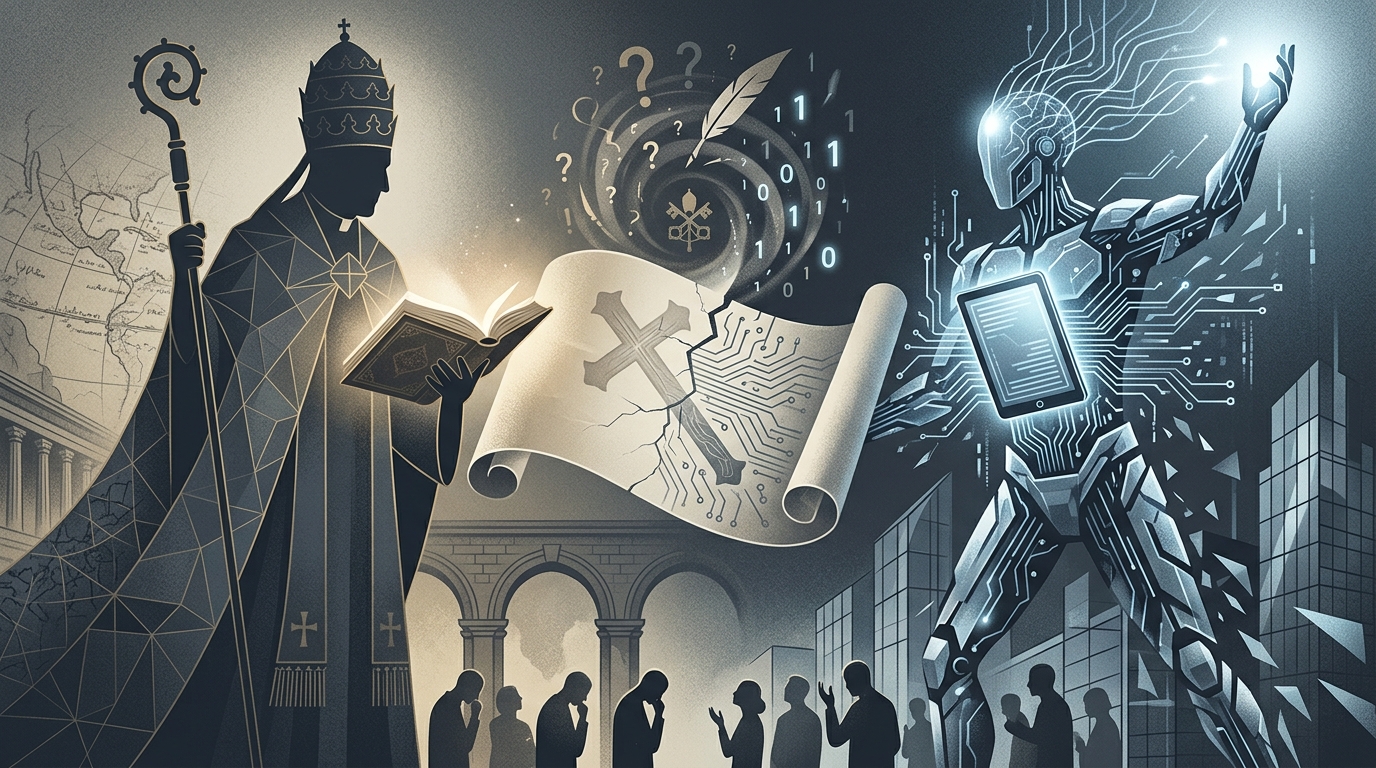
In the heart of the Vatican, where centuries of tradition meet the gravity of spiritual guidance, a new crisis of authenticity is unfolding. Pope Leo XIV’s recent encyclical, titled Magnifica Humanitas, intended to be the Catholic Church’s definitive moral manifesto against the unchecked rise of Artificial Intelligence, is now at the center of an ironic controversy. According to a detailed analysis posted on the LessWrong forum by researcher Linch Zhang, significant portions of the text appear to have been generated by large language models (LLMs).
Anatomy of a Digital Challenge
The revelation began when Zhang submitted the encyclical’s text to a suite of sophisticated AI detection tools, including Pangram, one of 2026’s most reliable systems for identifying synthetic content. The results were, to say the least, eye-opening. Specific paragraphs, particularly those dealing with the technical nature of algorithms and their sociological impact, showed a probability of AI authorship ranging from 40% to 100%. The irony is thick: the very document warning against the "loss of human essence in writing and thought" seems to lack, in certain passages, the human signature it claims to protect.
The analysis went beyond mere statistics. Zhang pointed to specific linguistic structures—the characteristic "smoothness" and lack of stylistic idiosyncrasies that often betray AI models. While the theological rhetoric remains consistent, the transitions between doctrinal positions and social critique bear the hallmark of mechanical optimization. This raises the question: Is this a simple case of Vatican ghostwriters using assistive tools, or a deeper erosion of spiritual creativity?
The Theological Paradox and the Infallibility of the Machine
For the Catholic Church, writing an encyclical is not a mere administrative act; it is considered a product of spiritual reflection and, in some instances, divine inspiration. The possibility that the "Voice of the Shepherd" has been filtered through algorithms trained on billions of parameters of secular data creates an existential crisis for the dogma. If AI can simulate theological thought so convincingly that it is integrated into a papal document, what remains of the uniqueness of human spirituality?
Supporters of the Holy See have been quick to downplay the issue, arguing that technology is used only as a tool for drafting and organizing vast amounts of research. However, critics point out that Magnifica Humanitas explicitly condemns the "delegation of moral judgment to automated systems." Using AI to draft those very condemnations is not just a technical oversight; it is a moral contradiction that threatens the credibility of the entire message.
The Vatican's Response and the New Reality
Thus far, the Holy See Press Office has not issued a formal denial, limiting itself to general statements about "utilizing modern means to spread the Gospel." However, within the halls of the Roman Curia, the debate is fierce. Sources suggest that a group of younger cardinals had proposed using AI to translate and summarize hundreds of drafts sent by bishops worldwide to expedite the encyclical's release.
- Authenticity: Who is the true author when the thought is human but the phrasing is mechanical?
- Transparency: Should religious leaders disclose the use of AI in their writings?
- Ethical Consistency: Can a message remain powerful when its medium of transmission conflicts with its content?
This scandal serves as a microcosm of a global trend. In 2026, the "Dead Internet Theory" seems to be extending to even the most sacred institutions. If even the Pope, the preeminent defender of the human spirit, succumbs to the convenience of algorithmic automation, then humanity may have already lost the battle for its spiritual autonomy. Magnifica Humanitas may ultimately go down in history not for its content, but as the document that proved AI is no longer just a tool, but an invisible co-author of the human destiny.