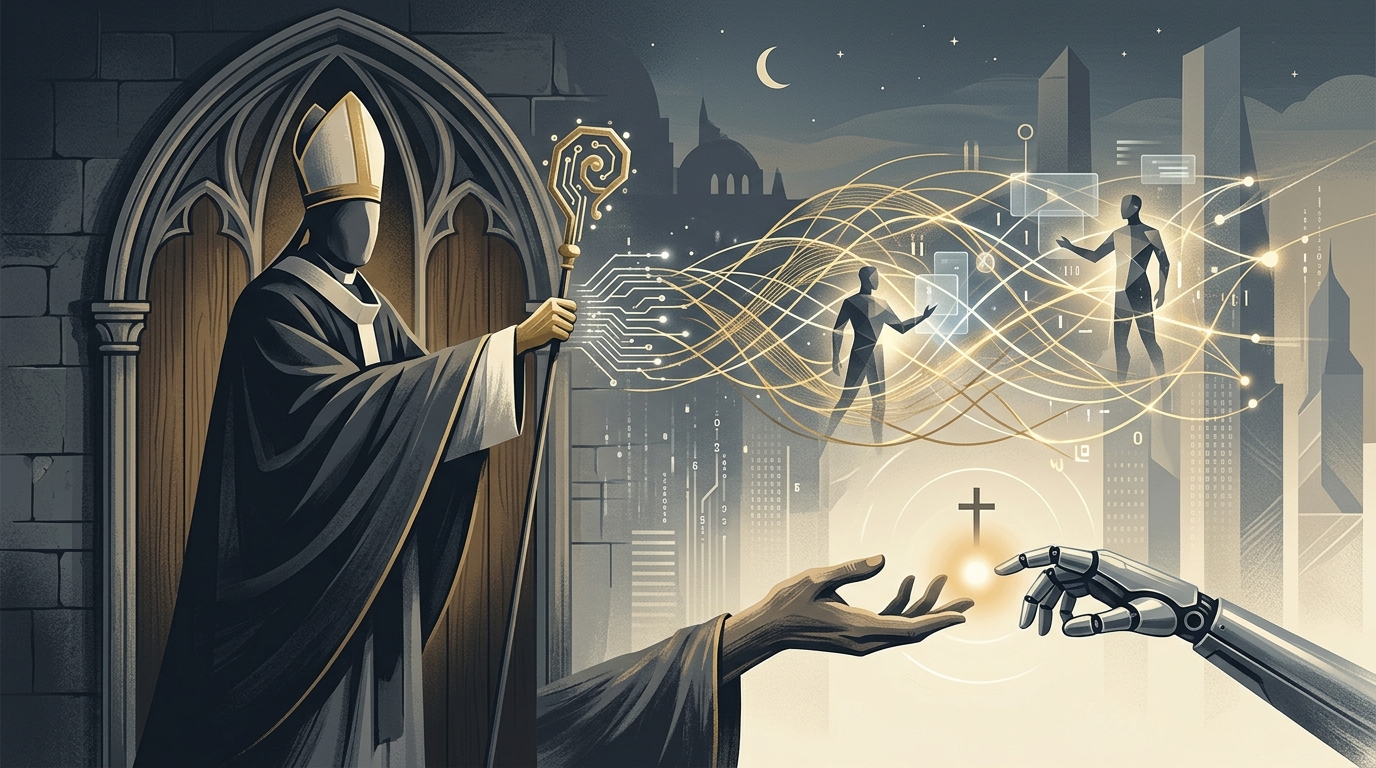
In an era where Artificial Intelligence (AI) has ceased to be a mere utility and has become the backbone of global social and economic organization, the Vatican has intervened with a momentous encyclical poised to define the moral discourse for decades to come. Pope Leo XIV, choosing a name that directly evokes Leo XIII and the landmark 1891 encyclical Rerum Novarum, has issued 'Techné et Spiritus' (Craft and Spirit), placing humanity before its responsibilities toward its own creations.
The encyclical, extensively analyzed by the United States Studies Centre (USSC), does not limit itself to theological generalities. Instead, it dives deep into the waters of algorithmic governance, labor automation, and the very nature of human consciousness. Leo XIV argues that AI is not a neutral technology but a mirror of the biases and aspirations of its creators, calling for a global 'algor-ethics' to protect human dignity from the dictatorship of efficiency.
A New Social Doctrine: From Steam to Silicon
Just as Leo XIII addressed the social upheavals of the Industrial Revolution, Leo XIV attempts to map the landscape of the 'Fourth Industrial Revolution.' In the encyclical, the Pontiff emphasizes that labor is not just a means of survival but an expression of human creativity and participation in the divine work. The mass replacement of workers by autonomous systems, without a parallel social contract, is characterized as a 'sin against social solidarity.'
The text proposes the establishment of a 'Global Fund for Human Development,' funded by taxing profits derived from automation. The Pope does not reject technology; on the contrary, he recognizes it as a gift from God that must, however, serve the 'common home' and not widen the gap between the technological elites and the 'digitally dispossessed' of the global South.
The Challenge of Digital Consciousness and Free Will
One of the most controversial points of the encyclical is the reference to the 'illusion of machine consciousness.' Leo XIV warns that attributing human qualities to large language models and AI agents risks undermining the concept of moral responsibility. 'A machine can simulate compassion, but it cannot love; it can calculate justice, but it cannot feel it,' the text states pointedly.
The encyclical focuses particularly on the threat algorithms pose to free will. Through the continuous manipulation of desires and political beliefs via social networks, humans risk being transformed into a 'predictable object of statistical analysis.' The Church calls for a 'digital fast' and the reclamation of personal mental space, away from the surveillance of algorithms.
Global Governance and Ethical Boundaries
In closing, the Pope appeals to the international community for the creation of a legally binding framework prohibiting the use of AI in Lethal Autonomous Weapons Systems (LAWS) and social scoring systems. 'Techné et Spiritus' is not merely a religious text but a political act seeking to influence legislators in Washington, Brussels, and Beijing.
The USSC analysis highlights that this intervention comes at a critical moment as the US seeks ways to balance innovation with safety. The Vatican's voice, with its immense moral influence over billions of believers, adds a new dimension to the competition for AI supremacy, reminding us that the ultimate judge of progress is not processor speed, but the well-being of the human soul.