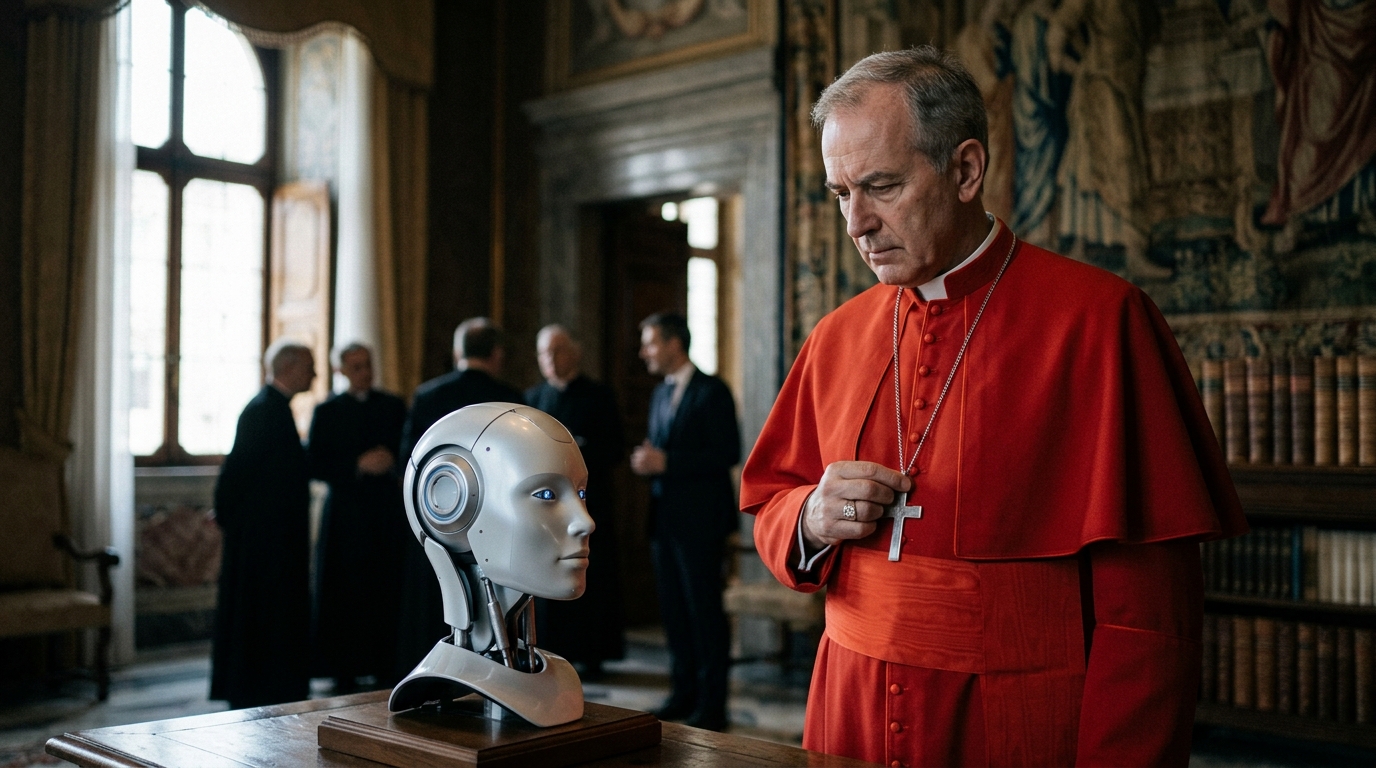
In the twilight of the 19th century, Pope Leo XIII issued the encyclical Rerum Novarum, a document that would redefine the Catholic Church’s social teaching by defending workers' rights against the crushing weight of the Industrial Revolution. Today, in 2026, the spirit of Leo appears to be resurrecting within the halls of the Vatican as the Church, under Pope Francis, adopts an increasingly assertive stance against Artificial Intelligence (AI). Recent coverage by Mother Jones poses a vital question: Is the Vatican joining the 'resistance' against AI?
The Legacy of Leo and the Digital Frontier
The reference to Pope Leo is far from accidental. Just as Leo saw mechanization as a threat to human dignity if left unchecked by moral constraints, today’s Church leadership views algorithms as a new frontier of social alienation. The Vatican does not reject technology per se; rather, it challenges the ideology of technological 'neutrality.' Their position is clear: technology is a human product and, as such, carries the biases and moral responsibilities of its creators.
The concept of 'algorethics,' a term championed by the Pontifical Academy for Life, serves as the cornerstone of this resistance. This is not a simple rejection of progress but a demand that AI serves humanity, rather than the other way around. The Church fears that automating decision-making in sectors like justice, healthcare, and employment could lead to a 'throwaway culture,' where the vulnerable are marginalized by opaque code.
The Rome Call and Global Influence
In 2020, the Vatican launched the 'Rome Call for AI Ethics,' an initiative signed by giants like Microsoft and IBM, and later by representatives of Islam and Judaism. However, by 2026, the rhetoric has sharpened. The Church is no longer satisfied with non-binding declarations. We are witnessing a shift toward supporting rigorous legislative frameworks, akin to the EU AI Act, but with a more profound focus on the spiritual and ethical dimensions.
- Transparency: Every algorithm affecting human lives must be explainable and auditable.
- Inclusion: AI must not widen the gap between wealthy and developing nations.
- Responsibility: The final decision-making power must always remain with a human (human-in-the-loop).
This 'resistance' is not Luddism. It is an attempt to define the boundaries of human sovereignty. The Church fears that if we cede moral judgment to machines, we forfeit the very essence of our humanity: the capacity for mercy, forgiveness, and spiritual discernment.
The Political Dimension of Ethics
Mother Jones points out that the Vatican’s stance aligns with a broader progressive critique of Silicon Valley. It is a rare moment where religious tradition meets social justice activism. Pope Francis’s critique of the 'technocratic paradigm'—the belief that every problem can be solved with more technology—is a direct shot at the heart of surveillance capitalism.
"Technology is not just a tool; it is a way of seeing the world. And if that vision excludes God and neighbor, it becomes a dangerous form of idolatry," says a senior Curia official.
In the coming years, the Church’s intervention could prove decisive. In a world increasingly polarized over AI, the Vatican offers a 'third way': a technology that respects the sanctity of life. Whether it is the ban on autonomous weapons or the protection of believers' data, the Pope’s 'resistance' is a reminder that progress without conscience is merely a path to self-destruction.