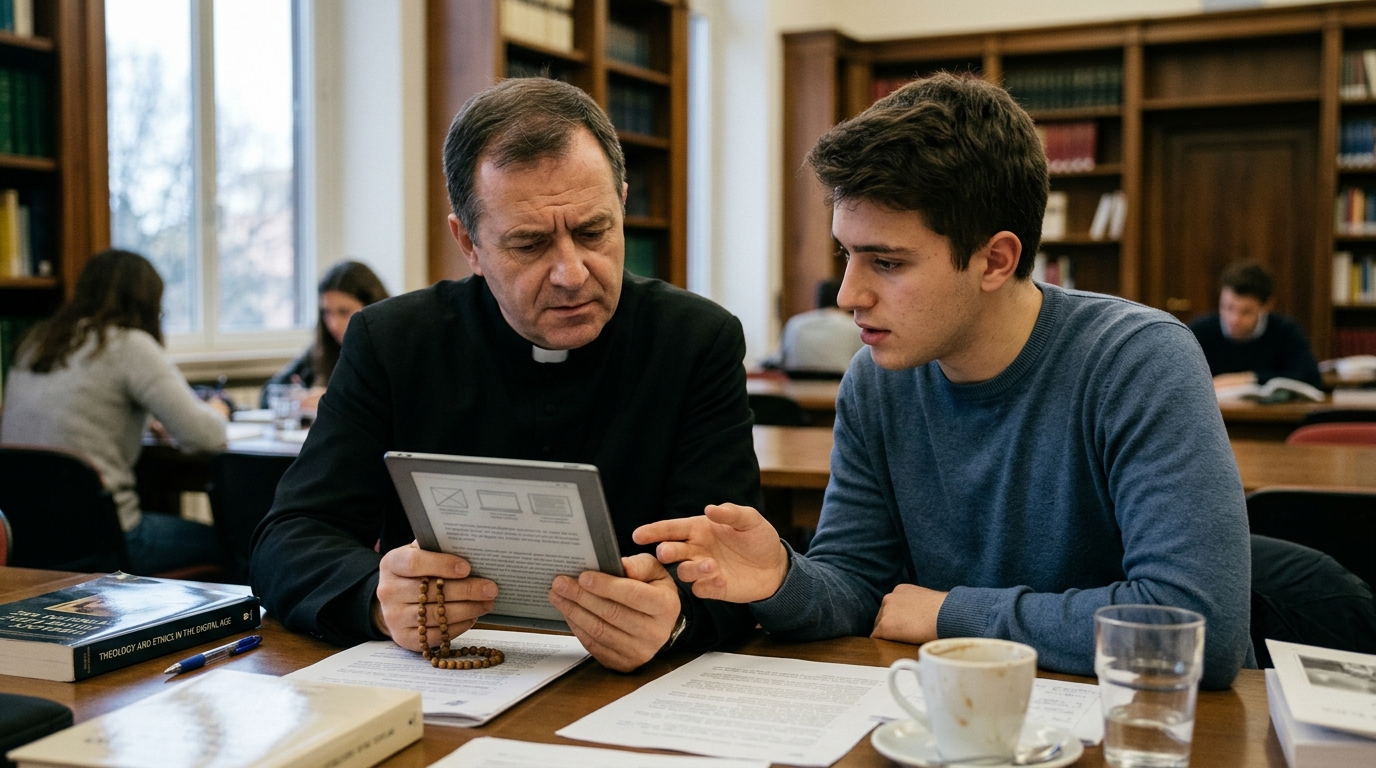
In an era where algorithms dictate everything from our shopping habits to our access to information, the recent intervention by Pope Leo calling for an "ethical disarmament" of Artificial Intelligence (AI) has resonated globally. Although the term "disarmament" is typically associated with autonomous weapons systems, the ethical dimension provided by the Vatican strikes at the very core of human development: education. This plea is not merely about avoiding physical warfare, but about preventing a "cognitive conflict" where students are transformed into passive recipients of biased data.
Disarmament as an Act of Protecting Thought
When the Pontiff speaks of disarming AI, he refers to weakening the mechanisms that "weaponize" information against critical thinking. For educators and ethicists, this translates into a need to protect students from algorithmic manipulation. According to Dr. Helen Papadopoulos, an expert in the Ethics of Technology, "disarmament" in the classroom means that AI should not be used to dictate answers, but to provoke questions. "If we allow AI to become the sole source of truth for a student, we disarm them of their ability to doubt and inquire," she notes.
The Vatican's concern focuses on "algorithmic imposition," where students at vulnerable ages are fed content designed to maximize engagement rather than substantive learning. Disarmament, therefore, is the process of stripping away elements that make technology "addictive" or "manipulative," allowing the student to remain the master of their own educational journey.
The Challenge of Inequality and Digital Ethics
A central point of the Pope's intervention is social justice. Within the context of education, a "weaponized" algorithm can exacerbate existing social inequalities. Students from marginalized backgrounds often face AI systems embedded with biases that may misclassify them or limit their prospects based on historical statistical models. Pope Leo argues that AI must be "stripped" of these discriminatory functions that act as invisible barriers.
- Protecting minor data privacy from commercial exploitation.
- Ensuring human judgment remains the final arbiter in student assessments.
- Promoting "Algor-ethics," a term introduced by the Vatican for the ethical framing of algorithms.
"Education is not the filling of a pail, but the lighting of a fire. Artificial Intelligence must be the fuel, not the extinguisher of human curiosity," states the Holy See's communique.
Toward a New Social Contract in the Classroom
The call for disarmament demands a radical rethink of how tech companies enter schools. Experts interviewed by the Houston Chronicle emphasize that students must be taught how to "deconstruct" AI—understanding how the "black box" of algorithms functions. This constitutes a form of digital self-defense. If a student knows that ChatGPT or Gemini can hallucinate or reproduce stereotypes, the technology loses its "martial" power over their thought process.
In conclusion, the "disarmament" of AI in education, as envisioned by Pope Leo, is not a move against progress, but a move for humanity. It is the demand that technology serve the dignity of the person rather than sacrificing it on the altar of efficiency or profit. For the students of 2026, this message is more relevant than ever as they navigate a world where the boundaries between human and artificial intelligence are becoming increasingly blurred.