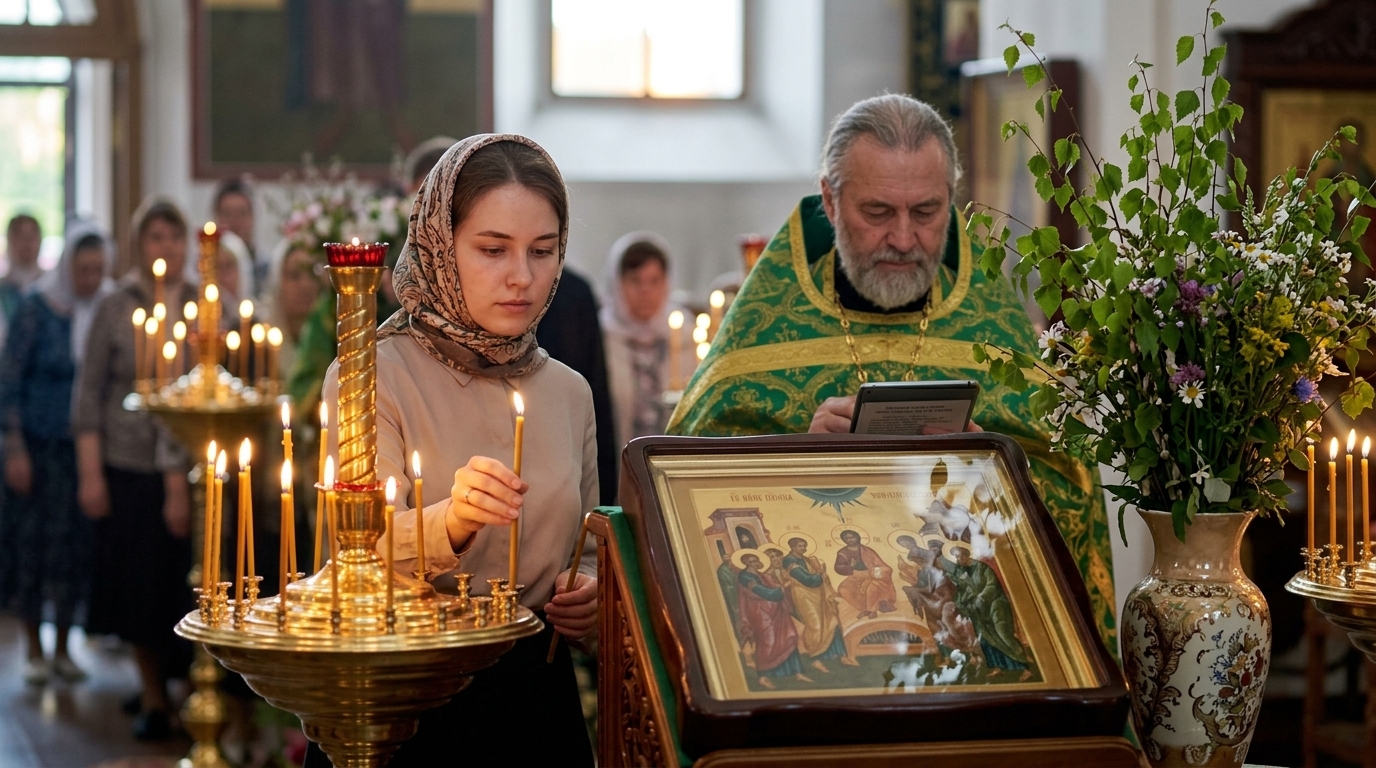
Today, Sunday, May 31, 2026, marks one of the most significant moments in the Orthodox calendar: Pentecost. Fifty days after Easter, the Church celebrates the descent of the Holy Spirit upon the Apostles, a moment traditionally considered the birthday of the Church. However, beyond the dogmatic and ritualistic framework, Pentecost carries a profound symbolism that touches the core of human existence and social cohesion: the possibility of true communication across the barriers of language and origin.
The Theological and Social Weight of Pentecost
In Christian tradition, the event of Pentecost is presented as the reversal of Babel. Where Babel’s human arrogance led to the confusion of languages and fragmentation, Pentecost offers the possibility of universal understanding through "tongues of fire." The Apostles, simple men without formal education, spoke and were understood by crowds of diverse nationalities. This "miracle of language" is not just about verbal communication, but a deeper spiritual encounter.
In the modern era, the concept of "language" has taken on new dimensions. We live in a period where information flows incessantly, yet genuine understanding seems increasingly rare. The ethics of Pentecost call us to reflect on whether the technological bridges we have built—social networks, communication platforms—serve unity or if, conversely, they create new "digital Babels" where everyone speaks only to those who already agree with them.
From Glossolalia to Machine Translation
One cannot help but notice the striking similarity between the promise of Pentecost and the promise of modern Artificial Intelligence. Large Language Models (LLMs) and advanced translation algorithms now promise the abolition of language barriers. Today, in 2026, real-time translation is a given, allowing a Greek speaker to converse with a Japanese speaker seamlessly.
However, the ethical dimension here is critical. While Pentecost presupposes an internal transformation and a spiritual connection, technological "glossolalia" is often a cold, statistical process. AI can translate words, but can it convey the "spirit"? The ethical challenge of our time is to ensure that the ease of communication does not lead to superficiality. Technology can provide the tools, but the intention for a meaningful encounter remains a deeply human responsibility.
The Ethics of Communication in the 21st Century
The feast of Pentecost reminds us that true communication requires humility and listening. In the digital world, the ethics of communication are often bypassed by algorithmic noise. Algorithms prioritize conflict and emotion, leading to polarized societies. The "enlightenment" symbolized by this day could be translated into modern ethics as the need for critical thinking and empathy.
- The quest for truth beyond "fake news."
- Respect for alterity, as expressed by the coexistence of different peoples on the day of Pentecost.
- The responsibility of speech, as words have the power to either build or destroy.
In an age where AI can generate endless content, the value of human speech stemming from experience and character becomes even more imperative. Pentecost is not just a memory of the past, but a constant call for an ethics of communication that places the human being at the center.
Preserving the Sacred in a Secularized Digital World
Finally, today's celebration highlights the importance of tradition as a constant in a rapidly changing world. Traditions, such as the Kneeling Service (Vespers of Genuflection) held today, offer a sense of belonging and a connection to the past that technology cannot replace. The challenge for our society is to find the golden mean: to use the tools of the future without losing the spiritual heritage of the past.
"Pentecost is the celebration of unity within diversity. It is the proof that we can be different and yet one body."
As the bells ring today, they call us to reflect on our own responsibility in shaping a world where communication will be an act of love and understanding, rather than just data transfer. Happy feast day to those celebrating and to the whole world.