In an era where the digital revolution is reshaping the very foundations of creativity, the voice of Olga Tokarczuk resonates not merely as a literary intervention, but as an ontological cry for help. The Polish Nobel laureate, renowned for her deeply humanistic and mythopoetic approach, stands firmly against the encroachment of Artificial Intelligence (AI) into the realm of literature, raising questions that transcend the narrow confines of copyright and touch upon the very essence of human existence.
The 'Tender Narrator' vs. Algorithmic Coldness
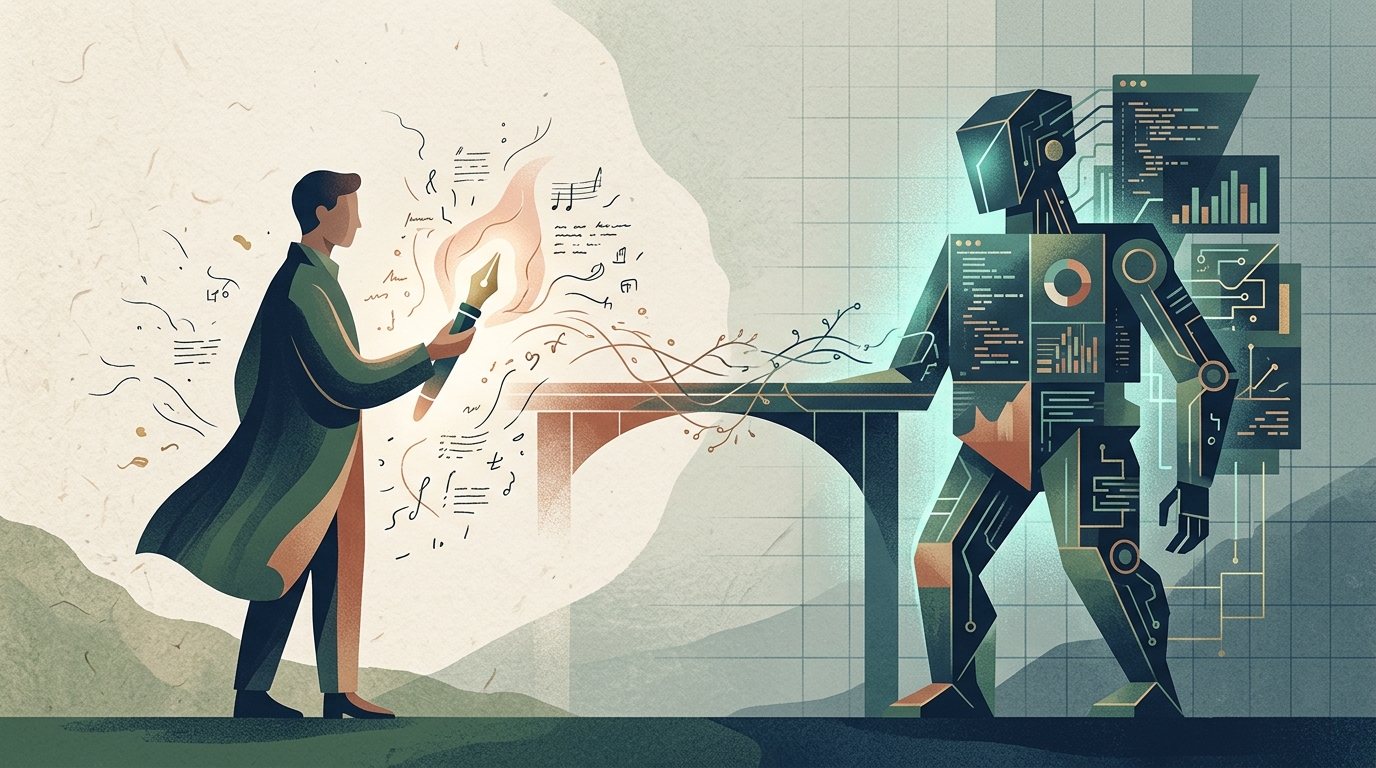
The central concept in Tokarczuk's work, the 'Tender Narrator,' serves as her primary argument against automated writing. For the author, literature is not a simple juxtaposition of words or a statistical probability of predicting the next phrase, as is the case with Large Language Models (LLMs). It is an act of empathy, an attempt to see the world through the eyes of the 'Other.' AI, devoid of biological existence and lived experience, is incapable of 'feeling' the weight of existence, mortality, or the complexity of emotions.
As Tokarczuk points out, AI operates by recombining what already exists. It is a data 'collector' that recycles human culture without adding a new spiritual seed. This process carries the risk of a 'second-rate' reality, where our stories become repetitive, predictable, and ultimately, devoid of meaning. The 'tenderness' the author advocates for requires a connection that only a living organism can offer: the consciousness of pain and joy.
The Threat of Cultural Homogenization
One of Tokarczuk's most serious concerns involves the homogenization of language and thought. Artificial Intelligence tends to favor the average, the most 'probable' expression, smoothing out the linguistic idiosyncrasies and bold metaphors that characterize great literature. In a globalized market, this could lead to the disappearance of local idioms and 'difficult' narratives that do not fit into algorithmic templates.
- The loss of subjectivity: AI has no 'I,' and therefore cannot have an opinion or a point of view.
- The ethics of theft: Training models on authors' works without their consent constitutes a new form of data colonialism.
- The crisis of truth: When machines produce texts that appear human, the distinction between the authentic and the artificial becomes dangerously blurred.
Tokarczuk argues that literature must remain a space of resistance. If we allow algorithms to dictate our stories, we risk losing our ability to imagine alternative worlds, limited instead to a perpetual reproduction of the past.
Intellectual Property and the Future of the Profession
Beyond the philosophical level, there is the practical one. The Polish creator aligns herself with the global movement of authors demanding a stricter regulatory framework. The use of her work, and that of thousands of others, to feed machines that might eventually replace them, is viewed by her as a blatant injustice. However, she remains optimistic about the resilience of the book. She believes that the reader will always seek the 'soul' behind the words, the certainty that another human being, in another place, felt the same thing.
"AI can compose a story, but it cannot take responsibility for it. Responsibility is the foundation of art," seems to be her message to the new generation of creators.
Conclusion: The Return to the Human
Olga Tokarczuk's intervention reminds us that technology is a tool, not the end goal. The challenge posed by AI to literature may be the opportunity we need to redefine what makes us human. In a world flooded with synthetic content, the need for authentic, 'tender' storytelling will become more imperative than ever. Literature will not die because of AI; on the contrary, AI may highlight the priceless value of human imperfection.