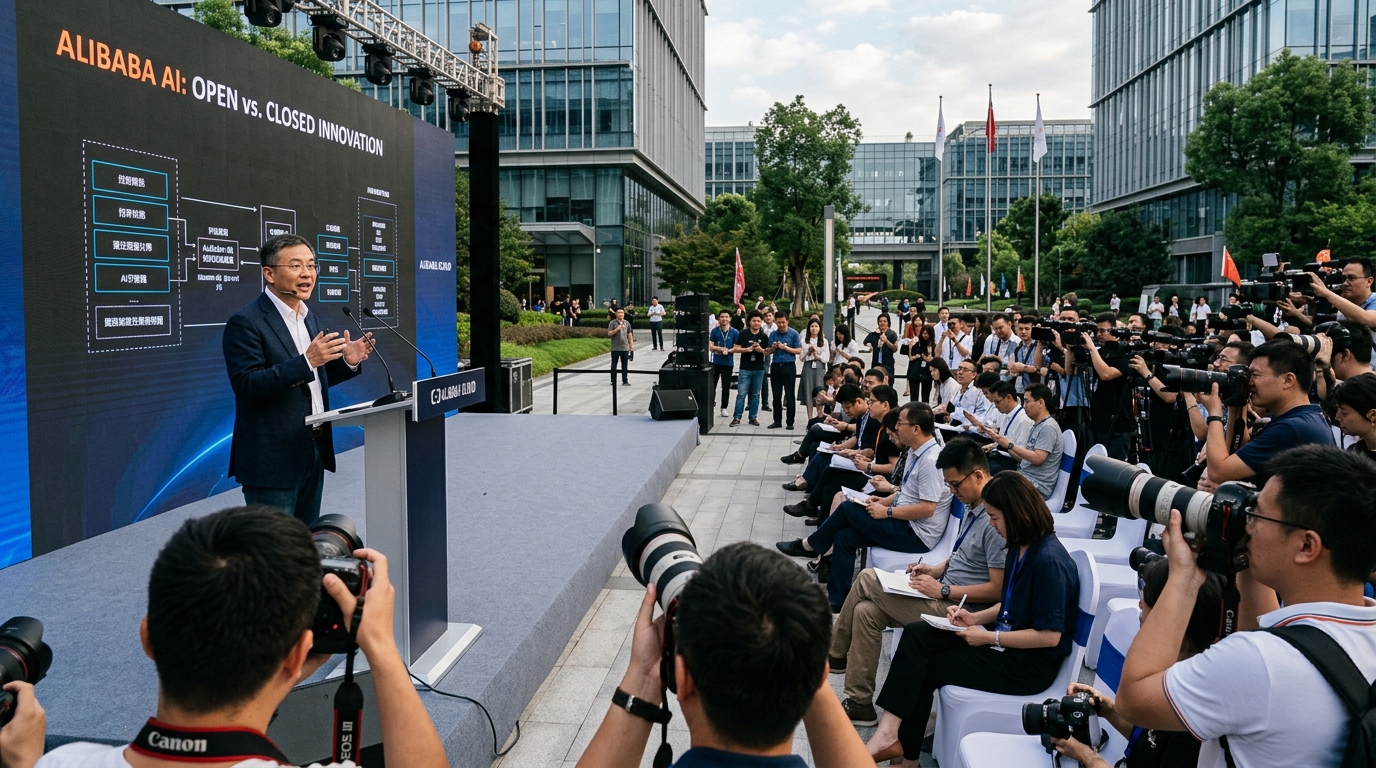
In the shifting landscape of global technological hegemony, Alibaba Cloud has emerged as an unexpected yet pivotal protagonist. Recent analysis within the framework of "AI-RTZ #1143 - AI: Reset to Zero" positions the Chinese giant as the "canary in the coalmine" for the future of Artificial Intelligence. The dilemma between open-source and proprietary models is no longer just a technical disagreement; it is an existential battle for economic viability and geopolitical influence.
Open Source Strategy as a Geopolitical Tool
Alibaba, through its Qwen (Tongyi Qianwen) series, has pursued an aggressive tactic of releasing open weights. Unlike OpenAI or Google, which keep their most powerful models behind paid APIs, Alibaba offers high-performance AI to the entire developer community. This move is not altruistic. In a world where the US imposes strict export restrictions on high-end semiconductors to China, creating a vast ecosystem based on Chinese architecture is a survival strategy.
When a company offers "open" AI, it essentially turns the technology into a commodity, eroding the value of its competitors' closed models. For Alibaba, this means that even if it cannot compete directly in raw compute power due to Nvidia-related sanctions, it can dominate through adoption and standardization. If developers worldwide are building on Qwen, Alibaba remains at the heart of the evolution.
The 'Reset to Zero' and Economic Reality
The term "Reset to Zero" refers to the trend of the marginal value of digital intelligence approaching zero. As models become more efficient and competition intensifies, the cost of producing a "unit of intelligence" is collapsing. Alibaba serves as the canary in the coalmine because its success or failure will indicate whether a company can survive in an environment where AI is free or extremely cheap.
- Infrastructure Costs: Alibaba Cloud must balance massive training costs against diminishing revenues from model distribution.
- Democratization vs. Monopoly: Open source allows smaller firms to innovate but removes the protective "moat" of the major players.
- Chinese Regulation: The need for alignment with Beijing's state directives makes Alibaba's open models a unique case of controlled freedom.
"The battle for AI will not be decided by who has the smartest model, but by who manages to make it the infrastructure upon which the global economy is built."
The Challenge of Closed Systems
On the other hand, closed models (like GPT-4 or Claude) promise greater security, control, and, theoretically, superior performance. However, Alibaba is proving that the performance gap between open and closed source is closing rapidly. If Qwen can offer 95% of GPT-4's capability at 0% of the licensing cost, then OpenAI's business model faces a serious problem. This is the "canary" warning of an impending profitability crisis in the AI industry.
In conclusion, Alibaba is not just competing with Silicon Valley; it is redefining the rules of the game. If its strategy succeeds, we will see a shift toward AI as public infrastructure. If it fails under the weight of costs and geopolitical pressures, closed source will solidify as the only viable model, creating new digital walls in the 21st century.