In an era where information flows at the speed of light and the distinction between reality and fabricated narratives becomes increasingly blurred, a group of students from Magoula, Attica, crossed the threshold of 'Naftemporiki'. This visit was not merely an educational field trip; it was a deep dive into the inner workings of news, a meeting of the younger generation—raised on TikTok and Instagram—with the traditional, robust world of financial and political journalism. In an environment where Artificial Intelligence (AI) can now produce articles in seconds, the fundamental question raised was: What makes news 'real' and why does the human factor remain the last line of defense for democracy?
The Challenge of the Digital Storm
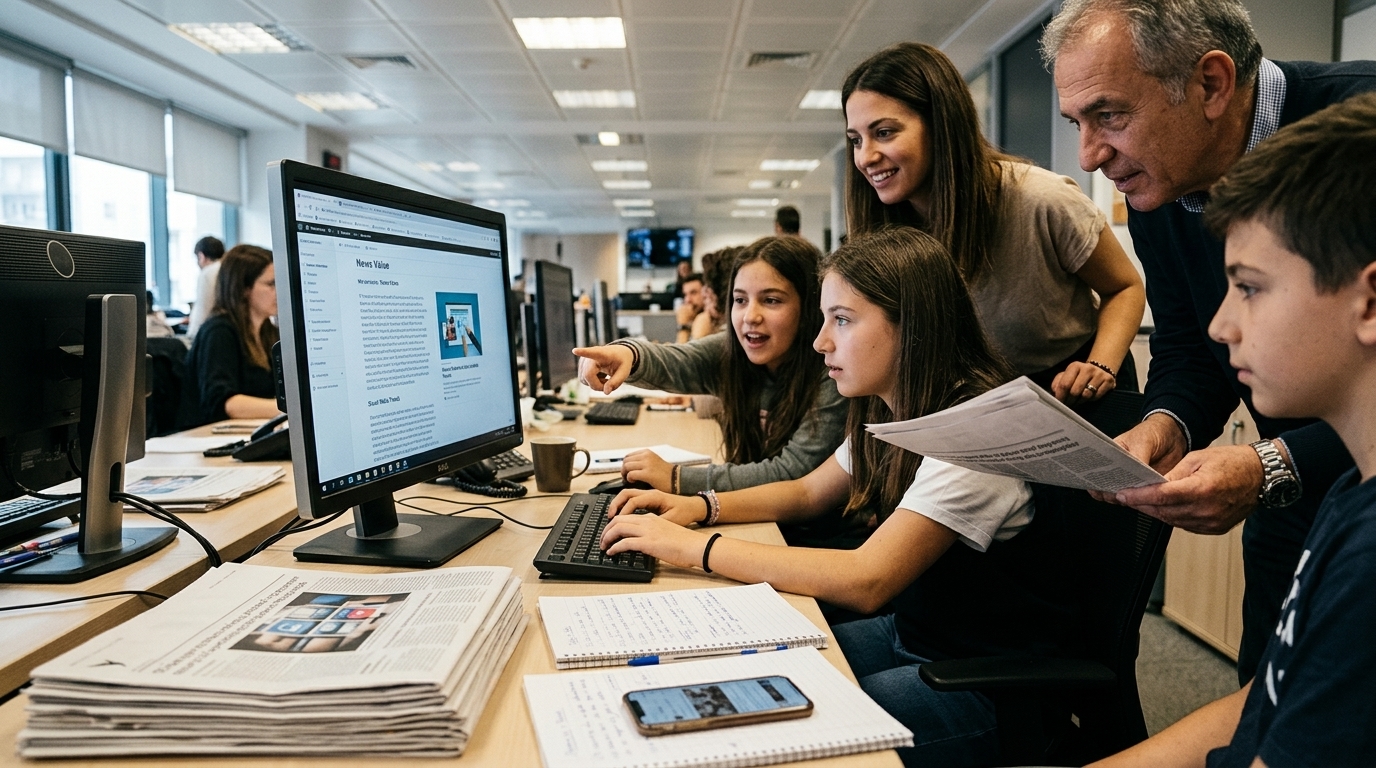
The students of Magoula Junior High, accompanied by their teachers, had the opportunity to see firsthand how a newspaper is constructed and how a modern newsroom operates, blending print with the digital environment. Naftemporiki, with its decades of history, served as the ideal backdrop for children to understand that news is not just a 'post' or a 'story'. It is the result of a painstaking process of cross-referencing, verification, and ethical evaluation.
Today, teenagers are bombarded with 'fast-food' information. Social media algorithms are designed to promote content that triggers emotion—often anger or shock—rather than what is necessarily true. The visit highlighted the urgent need for media literacy. The students asked about fake news, how headlines are selected, and how a journalist manages to remain objective when pressures are high.
Artificial Intelligence: Tool and Threat
The conversation inevitably turned to Artificial Intelligence. The 'little journalists' expressed their curiosity about whether news will be written exclusively by robots in the future. The answer provided by the seasoned journalists at 'N' was clear: AI can process data, summarize texts, and automate routines, but it lacks empathy, ethical judgment, and the ability to ask the 'tough' question to those in power.
Journalism in the AI era is no longer about speed—the machine will always win there—but about validity and context. For a reader to know that behind a text stands a human being who bears the responsibility of their name is the greatest value of our time. The students from Magoula saw in practice that journalistic ethics is a living organism requiring critical thinking, something no text generator can fully replace.
From Magoula to the Global Village
Magoula, an area with a strong industrial character and working-class tradition, brings to the fore the importance of the local voice within the global digital village. These children, who view the world through their mobile screens, discovered that journalism starts 'next door', from the problems of their community, and extends to international markets and geopolitical developments.
- The importance of cross-referencing: Students learned that one source is no source.
- The responsibility of the byline: The journalist's name is a contract of trust with the reader.
- Distinguishing news from opinion: A critical skill for every citizen in the digital age.
Naftemporiki's initiative to open its doors to students is an investment in the future of democracy. When young people learn to question the information served to them and seek the source, they become less vulnerable to manipulation.
"Journalism is not just a profession; it is a public service that requires you to always be alert," one of the editors told the students, summarizing the essence of the visit.
In conclusion, this experience of the children from Magoula reminds us that despite the dominance of algorithms, the need for truth remains deeply human. Educating the youth in the principles of journalism is perhaps the most powerful antidote to internet toxicity and the distortion of reality often brought about by the unchecked use of AI.