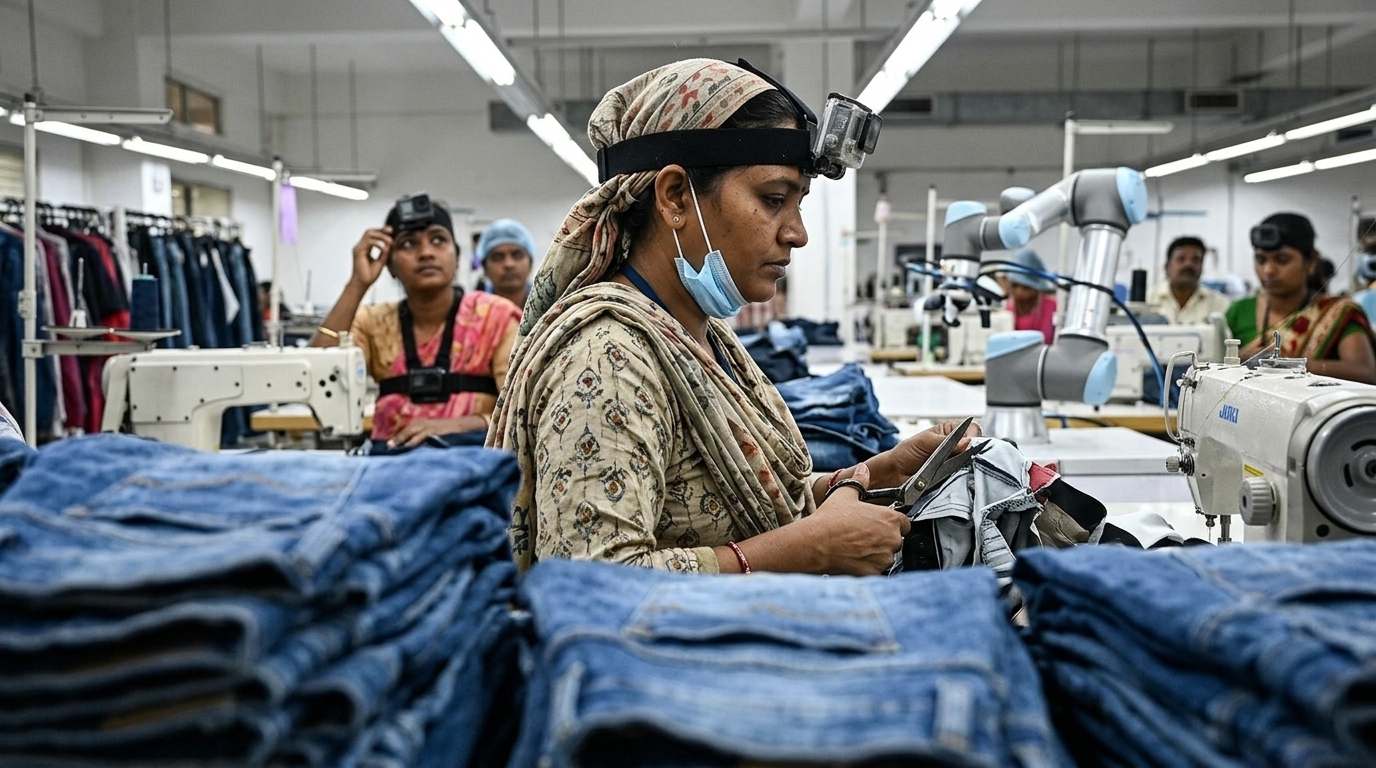
In the bustling industrial hubs of India, where the global fast fashion industry draws its lifeblood from millions of low-wage workers, a silent yet seismic shift is occurring. Garment workers, who for decades have been the backbone of production, now find themselves in the paradoxical position of offering their last and most valuable asset: their kinetic dexterity. However, there is a critical catch: many of them are unaware that the head-mounted cameras they wear are not intended for quality control, but for training the humanoid robots that will soon replace them.
The Digital Shadow of Labor
The process is known as "learning from demonstration" (LfD) and represents the cutting edge of artificial intelligence development. For a robot to handle a delicate fabric, make a precise stitch, or fold a garment with the necessary speed, it requires millions of hours of real-world data. Traditional algorithms struggle with "soft" and deformable objects. The solution found by tech companies is the high-resolution recording of human experience.
According to recent reports, workers in India were asked to wear head-mounted cameras and motion sensors during their shifts. The official justification provided by factory management was "workflow optimization" and "safety enhancement." In reality, the visual footage and telemetry data are being fed into neural networks developed by Silicon Valley giants and specialized robotics startups. Without realizing it, the workers are building the digital twin of their own craft, which will then be used to render their own labor obsolete.
The Ethics of "Invisible" Training
The issue goes beyond simple technological progress and touches the boundaries of labor exploitation and AI ethics. The lack of informed consent is the central point of friction. When a worker agrees to be recorded for safety reasons, using that data to create a competitive automated system is a breach of the employment relationship.
- Transparency: Workers are rarely informed about the end-use of their data.
- Movement Intellectual Property: Who owns the data of a craftsman's skill?
- Economic Compensation: Training an AI model is high-value work, yet it is being paid at an unskilled laborer's wage.
This practice is reminiscent of a modern form of "digital colonialism." Countries in the Global South provide the "raw data"—in this case, human movement and expertise—which is then processed and capitalized upon in the Global North. The result is a product (the robot) that will return to replace the very people who "taught" it.
The Automation Paradox
The irony of the situation is that the more efficient a worker is during the recording, the faster they accelerate their own dismissal. It is a race where the finish line means job loss. Companies argue that automation is necessary to maintain competitiveness and address labor shortages in other regions, but in India, where labor supply is abundant, the motive is purely cost-driven.
"They told us it was to see how we could work more comfortably. Now we understand they were teaching the machine to do what we do," says a worker who wishes to remain anonymous.
Humanoid robot technology, such as Tesla's Optimus or models from Figure and Boston Dynamics, targets exactly these repetitive yet delicate tasks. The garment industry, due to the nature of fabrics, was the "last bastion" of human labor. If this collapses through unfair data collection, the social implications in India and Bangladesh will be immeasurable.
Toward a New Social Contract
The case in India should serve as a wake-up call for international labor organizations. There is an urgent need for a framework that protects the "data rights" of employees. Labor is no longer just the production of a physical object, but also the production of the information that accompanies that act.
If humanity is to transition into an era where robots perform manual tasks, this transition must occur on terms of justice. The workers who train these systems should be considered co-creators and enjoy a share of the automation profits, rather than being cast to the margins of history as disposable tools of a technological revolution that ignored them.