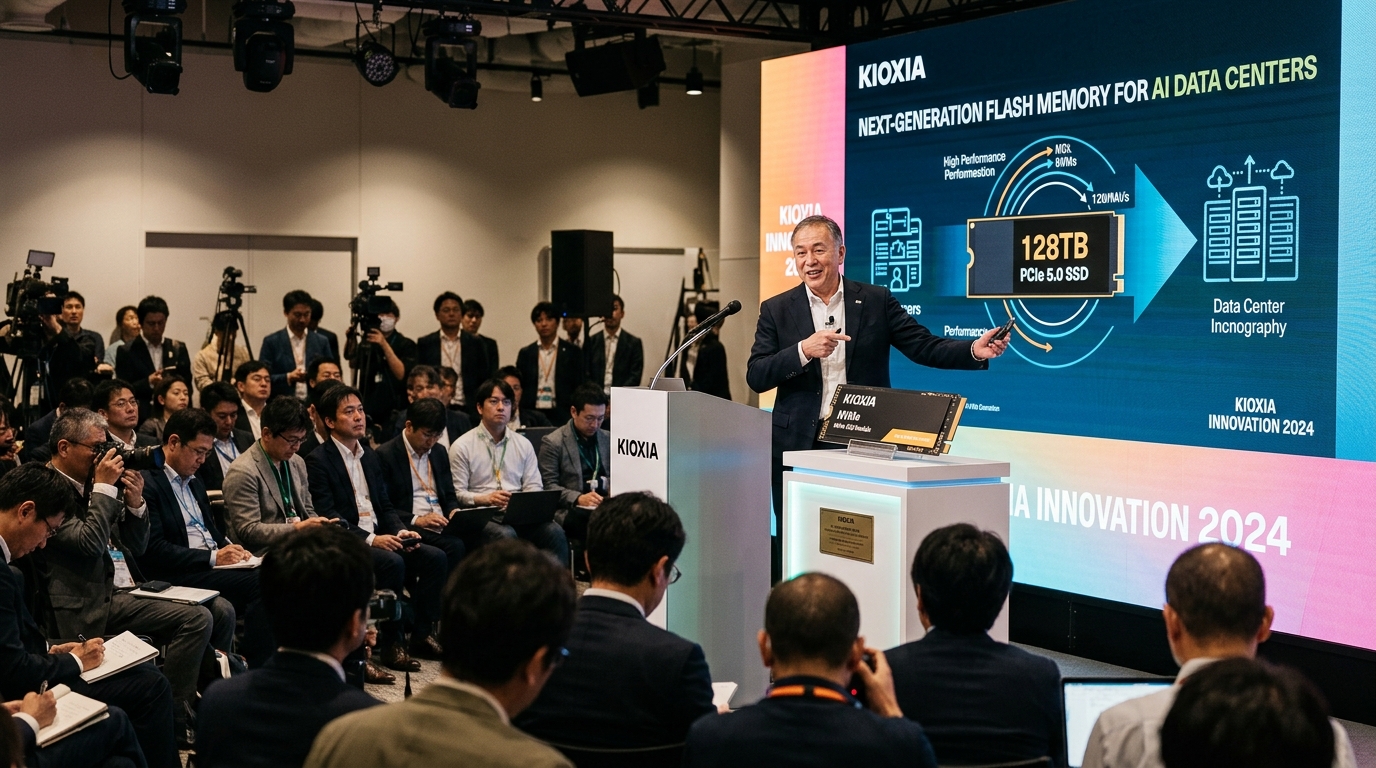
In a move that signals Japan's resurgence in the global semiconductor race, Kioxia Holdings Corp. has announced the shipment of samples of its next-generation flash memory, specifically engineered for the rigorous demands of Artificial Intelligence (AI) data centers. This development is far more than a routine technical refresh; it represents a strategic gambit to reclaim market share from South Korean titans Samsung Electronics and SK Hynix.
The Architecture of the AI Era
Kioxia’s new memory chips leverage the company’s sophisticated BiCS FLASH technology, utilizing vertical stacking (3D NAND) to achieve unprecedented data density and transfer speeds. While the media often fixates on Nvidia’s GPUs as the brains of AI, the structural reality is that these processors are ineffective without memory subsystems capable of feeding them massive datasets at lightning speed.
The new chips promise a significant reduction in power consumption—a critical metric for modern data centers grappling with soaring electricity costs and stringent sustainability targets. Training and running Large Language Models (LLMs) require storage media with minimal latency, and this is precisely where Kioxia is positioning its latest samples.
Competition and Geopolitical Maneuvering
The timing of this announcement is calculated. Kioxia, born from the spin-off of Toshiba’s memory division, has weathered a turbulent period of financial instability and stalled merger talks with America’s Western Digital. The current AI boom provides a vital lifeline and a prime opportunity for the company to rekindle investor appetite ahead of a highly anticipated Initial Public Offering (IPO).
- 30% increase in sequential read speeds compared to previous iterations.
- Enhanced power efficiency profiles to lower Total Cost of Ownership (TCO).
- Strategic sampling with Tier-1 cloud service providers and server OEMs.
Furthermore, the Japanese government views Kioxia as a national champion. In an era where technological sovereignty is synonymous with national security, bolstering domestic semiconductor production is a top priority for Tokyo. The government has already committed billions of yen in subsidies to expand Kioxia’s manufacturing facilities in Yokkaichi and Kitakami.
Challenges and the Road Ahead
However, the climb to the top remains steep. SK Hynix has already established a formidable lead in High Bandwidth Memory (HBM), which works in tandem with GPUs. Kioxia must prove that its flash technology is indispensable for the storage tier of AI systems—the layer where the "fuel" of intelligence, the raw data, resides.
"The data center market is undergoing a radical transformation. It is no longer enough to offer capacity; you must offer intelligent data management at the hardware level," industry analysts note.
In conclusion, Kioxia’s move to sample its technology with major cloud providers (such as Microsoft, Google, and Amazon) is the critical first step toward validation. If these trials prove successful, the Japanese firm could find itself at the epicenter of the next AI investment cycle, shifting the balance of power in a market previously dominated by South Korean and American interests.