In the heart of Brussels, where linguistic diversity serves as the bedrock of European unity, a silent revolution is threatening to upend a centuries-old tradition. Translators, the invisible heroes bridging the gaps between the EU’s 24 official languages, face an existential challenge: the breakneck evolution of Large Language Models (LLMs). As we move into the second half of 2026, the question is no longer whether AI can translate, but whether the human translator remains essential in a world demanding speed and cost-efficiency.
The Illusion of Perfection and the Context Gap
The progress of AI in natural language processing is undeniable. Tools that were considered experimental three years ago now produce texts that, at first glance, appear flawless. However, industry professionals point out that AI suffers from what they call "cultural deafness." Translation is not a mere substitution of words; it is an act of cultural mediation.
- Idioms and Humor: AI often fails to capture the ironic tone or local idioms that breathe life into a text.
- Legal and Technical Precision: In high-stakes documents, a single mistranslated word can lead to diplomatic incidents or legal battles.
- Emotional Intelligence: The ability to perceive the author's "intent" remains, for now, an exclusively human prerogative.
As one veteran literary translator from Athens puts it: "AI can translate the structure of a sentence, but it cannot translate the silence between the words or the weight of a historical reference that only a Greek or a Pole would immediately grasp."
The Trap of 'Post-Editing' and Economic Pressure
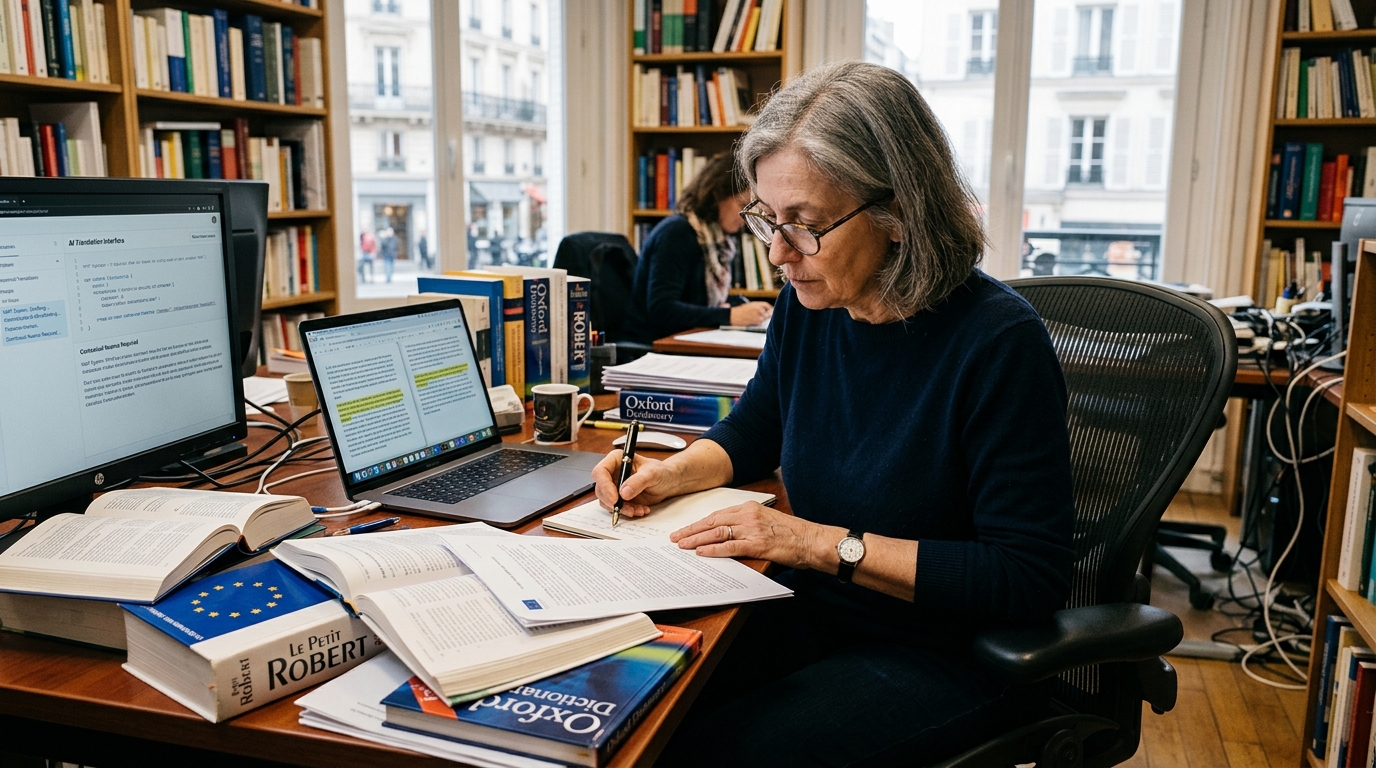
The labor market has shifted violently toward the Machine Translation Post-Editing (MTPE) model. In this scenario, AI generates the first draft, and a human is tasked with "fixing" it. While this sounds efficient, it actually creates a new form of cognitive exhaustion. Compensation has plummeted as companies increasingly view translation as a mere "editorial" task.
"We are being asked to fix garbage in zero time for a third of our old rates. This isn't translation; it's industrial text processing," says a representative from a European translators' union.
This trend poses risks to the quality of global literature and discourse. If young translators abandon the profession due to low wages, who will train the AI models of the future? Artificial intelligence feeds on human creativity; if the source dries up, the quality of generated language will begin to decline in a vicious cycle of mediocrity.
The European Response: Protecting Linguistic Heritage
The European Union, recognizing the danger, has begun investing in "sovereign" language models that respect the nuances of less-spoken languages. Greek, Finnish, or Hungarian are often marginalized by large American models, which tend to "Anglicize" the syntax and thought processes of other nations.
Hope for translators lies in specialization. "Translator-authors" and "translator-lawyers" remain in high demand. The market seems to be splitting in two: on one side, the mass production of disposable AI-generated content, and on the other, the high art of translation for texts requiring prestige, trust, and soul. The future belongs neither to AI alone nor to humans alone, but to their collaboration—provided that human judgment remains the final filter.
Conclusion: Human Touch as a Luxury?
As we move forward, "human translation" may evolve into a luxury product, akin to handcrafted watches or custom-made garments. In an ocean of automated content, authenticity and deep understanding will be the currencies of highest value. Europe’s translators should not fear the algorithm but master it, constantly reminding the world that language is the mirror of human experience, and no code can feel the joy or pain hidden behind a word.