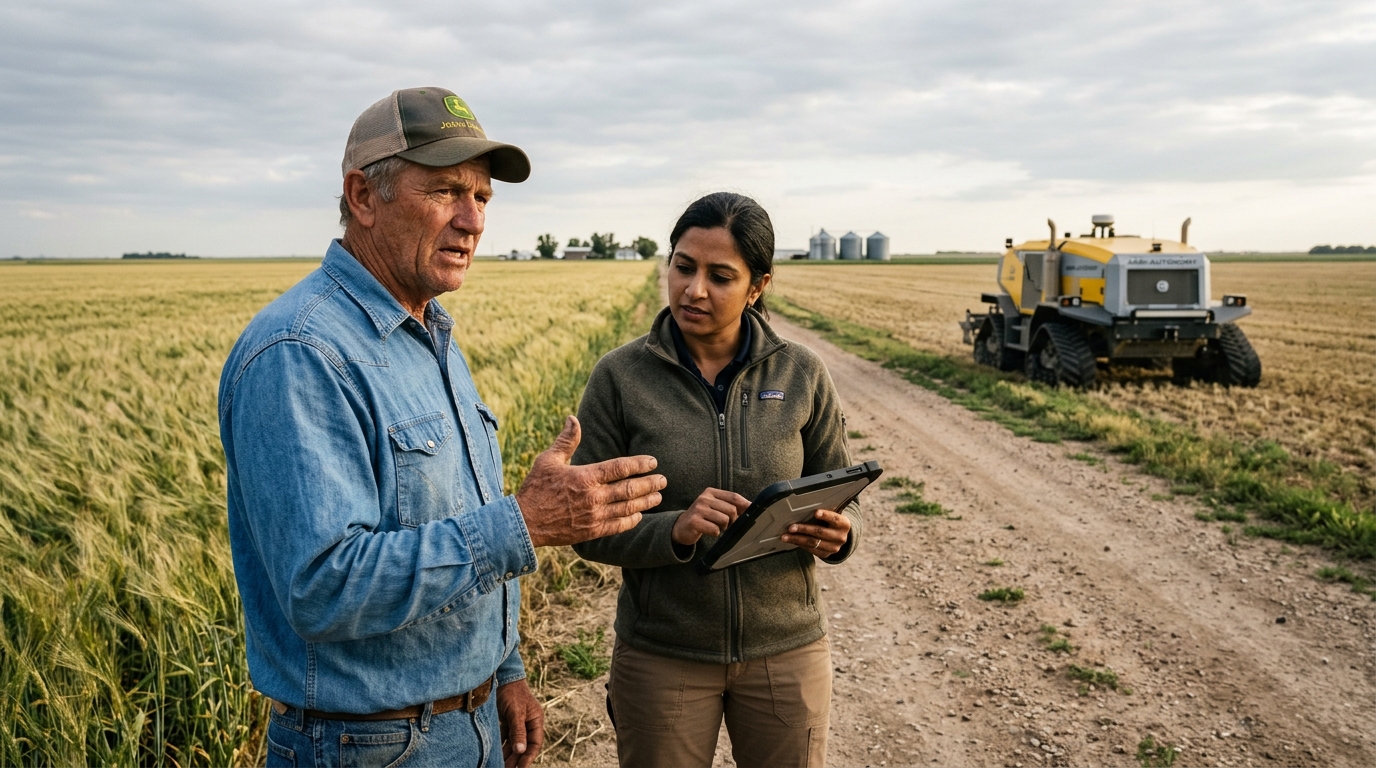
In the heart of the American Grain Belt, where generational traditions meet cutting-edge technology, a new survey reported by the Iowa Capital Dispatch brings to light a sobering reality for Silicon Valley evangelists: farmers are not ready to hand over the keys to their tractors to algorithms. Despite the glossy promises of 'precision agriculture' and yield optimization, the majority of producers remain deeply skeptical, raising critical questions about ethics, data ownership, and the reliability of automated systems.
The Trust Gap: Why Algorithms Struggle in the Soil
The survey highlights a significant paradox. While major AgTech firms promote Artificial Intelligence as the panacea for food security and climate change, the individuals actually working the land feel increasingly alienated from these developments. This skepticism doesn't stem from mere technophobia, but from a pragmatic assessment of risk. Farmers in Iowa, and by extension globally, worry that AI cannot grasp the subtle nuances of local microclimates or the unpredictable nature of biology with the same fidelity as human experience.
Furthermore, there is the 'black box' problem. When an algorithm suggests a specific fertilizer rate or a planting window, it rarely provides the underlying reasoning. For a producer whose entire livelihood depends on a single annual harvest, blindly trusting a machine represents a gamble that many are unwilling to take. The lack of explainability in AI models is a significant barrier to adoption in a high-stakes industry like farming.
Data as the New Crop: Who Controls the Information?
One of the thorniest ethical issues raised by the survey is data sovereignty. Every sensor on a modern tractor collects vast amounts of information regarding soil composition, moisture levels, and crop performance. This data is the 'gold' that fuels AI models. However, farmers are asking: Who owns this data? Is it the person tilling the soil, or the corporation that manufactured the software?
There is a pervasive fear that agricultural giants will use this aggregated data to manipulate markets, control the supply chain, or create monopolistic conditions that render the independent farmer a mere tenant of a digital platform. This power imbalance sits at the core of the skeptical stance recorded in the survey. Without clear legal frameworks protecting the farmer's right to their own data, AI integration feels less like progress and more like an extraction of value.
The Ethics of Algorithmic Farming and Empirical Loss
Beyond economics and technicalities, there is a deeper ethical dimension: the gradual erosion of traditional knowledge. Farming has always been an art based on observation, intuition, and a profound connection to the environment. Replacing this relationship with screen interfaces and automated commands threatens to transform agriculture into a sterile industrial process, devoid of the human element that has sustained civilizations for millennia.
The moral hazard lies in the possibility that AI might prioritize short-term profit maximization over long-term soil health. If an algorithm is trained solely on yield data, it might ignore the ecological impacts of over-intensive farming, leading to irreversible damage to the ecosystem. The survey reflects a concern that by outsourcing decision-making to machines, we are losing the stewardship role that defines the farming profession.
Bridging the Divide: A Human-Centric Path Forward
To bridge the chasm revealed by the Iowa survey, a radical change in approach is required. AI in agriculture must not be designed in sterile offices in California but in collaboration with those who labor in the fields. Algorithmic transparency, robust data privacy protections, and the preservation of farmer autonomy are non-negotiable prerequisites.
The future of farming should not be a choice between the past and the future, but a synthesis of both. Technology must serve as a tool that empowers the producer, respecting their heritage and judgment. For AI to be truly successful in the fields, it must prove itself not just as a more efficient calculator, but as a trustworthy partner in the ancient and essential task of feeding the world. The goal should be 'augmented intelligence,' where the machine enhances the farmer's expertise rather than attempting to replace it.