The discussion surrounding Artificial Intelligence (AI) often oscillates between two extremes: on one side, dystopian warnings of an existential threat capable of eradicating humanity, and on the other, its daily, almost playful use across social media platforms. Recently, both the Greek and international political scenes provided two characteristic examples of this new reality. The image of Greek government spokesperson Pavlos Marinakis as a 'grill master' and the communication strategy of Hungarian politician Peter Magyar featuring his puppy highlight how AI and digital tools are reshaping the political landscape.
Satire as a Political Tool: The Case of the 'Grill Master'
The instance of Pavlos Marinakis’s image, created with AI tools to depict him in the role of a traditional folk griller, was not merely a social media joke. It is part of a broader trend where technology is utilized to either 'humanize' or deconstruct political figures. In the visual age, AI allows for the rapid production of content that can go viral, bypassing traditional media filters. The question that arises is whether such practices undermine the seriousness of political discourse or if they represent a necessary adaptation to the language of Gen Z.
The use of AI in satire is as old as the technology itself, but the ease of access to tools like Midjourney or DALL-E has changed the rules of the game. When a politician appears in a context entirely foreign to their office, the message received by the viewer is twofold: there is an element of relatability, and simultaneously, a sense that reality is now malleable. This malleability is what concerns analysts, as the boundaries between innocent satire and deliberate distortion become increasingly blurred.
Peter Magyar and the Strategy of 'Digital Proximity'
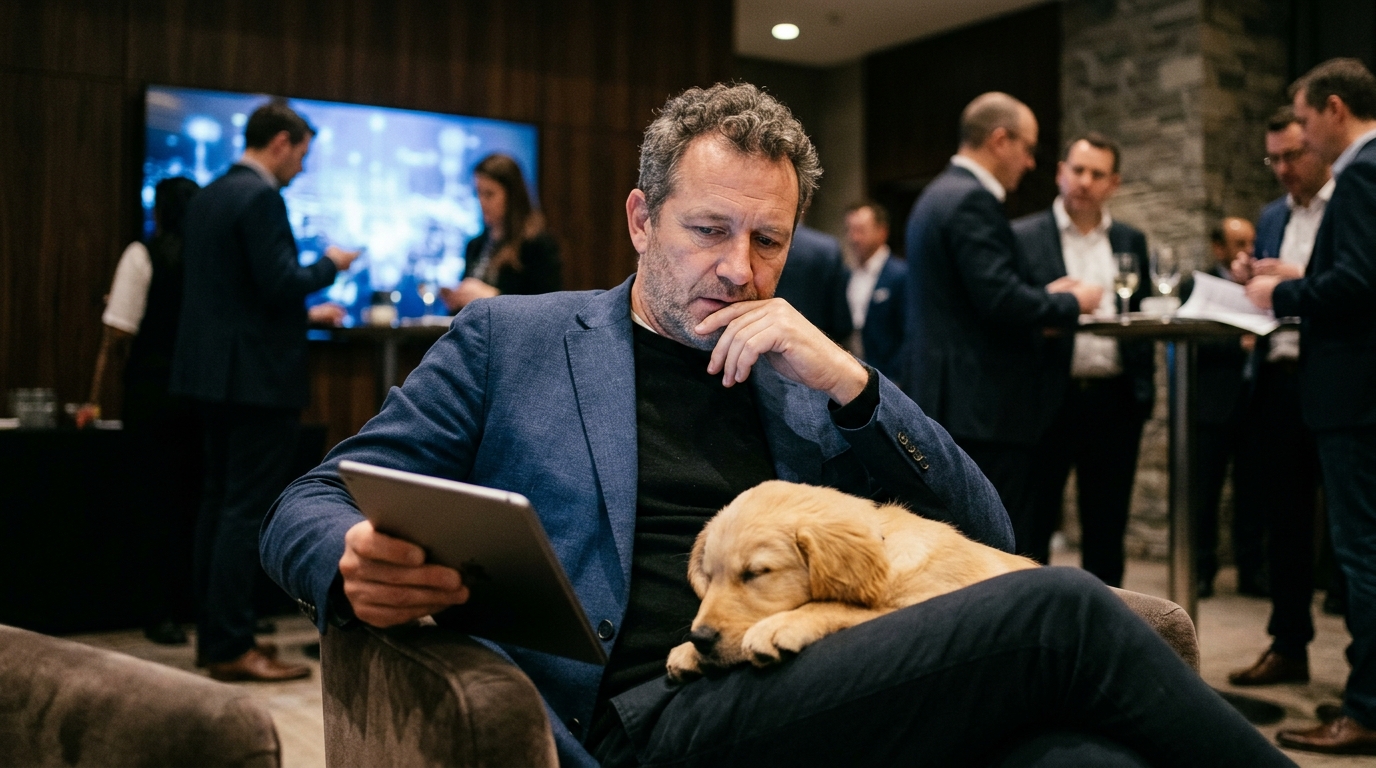
In Hungary, Peter Magyar—the man who shook the foundations of Viktor Orbán’s political dominance—employed a different but equally effective approach. Incorporating a puppy into his communication campaign, combined with a strong social media presence, served as a counterweight to state-controlled propaganda. Although AI may not have played the leading role in creating the imagery here, the logic of 'algorithmic success' remains the same. Magyar understood that in the digital world, emotion and immediacy trump rigid political rhetoric.
Magyar’s puppy became a symbol of a new, more 'human' politics, which nevertheless relies on the same technological infrastructure that allows deepfakes to flourish. The ability to control the narrative through visual stimuli that evoke positive emotions is a power that AI can multiply in the future, potentially creating 'perfect' political leaders who are products of algorithmic optimization.
Existential Threat or a Crisis of Truth?
When we speak of AI as an existential threat, we usually imagine science-fiction scenarios. However, the real threat may be much more mundane: the complete collapse of trust in what we see and hear. If Pavlos Marinakis can become a 'grill master' for a laugh, what stops a malicious actor from creating a video where a leader declares war or confesses to a scandal that never happened?
- The erosion of objective truth through the mass production of synthetic content.
- The use of AI for hyper-personalized voter targeting that exploits psychological vulnerabilities.
- The difficulty for regulatory bodies to keep pace with the speed of technological evolution.
The European Union, with the AI Act, is attempting to establish rules, particularly regarding the labeling of AI-generated content. However, in the political arena, where an impression often lasts longer than a debunking, the challenge remains immense. AI does not threaten our existence as biological beings, but it threatens the existence of the common ground upon which democracy is built.
Conclusion: The Challenge of a New Era
The transition from traditional posters to AI-generated images and viral videos is irreversible. The 'grill master' Marinakis and Magyar’s puppy are merely precursors to an era where politics will be conducted in an 'augmented reality' environment. The goal is not to ban the technology, but to educate citizens to be critical of what they consume. The existential threat of AI lies not in the software code, but in our potential resignation from the pursuit of truth.