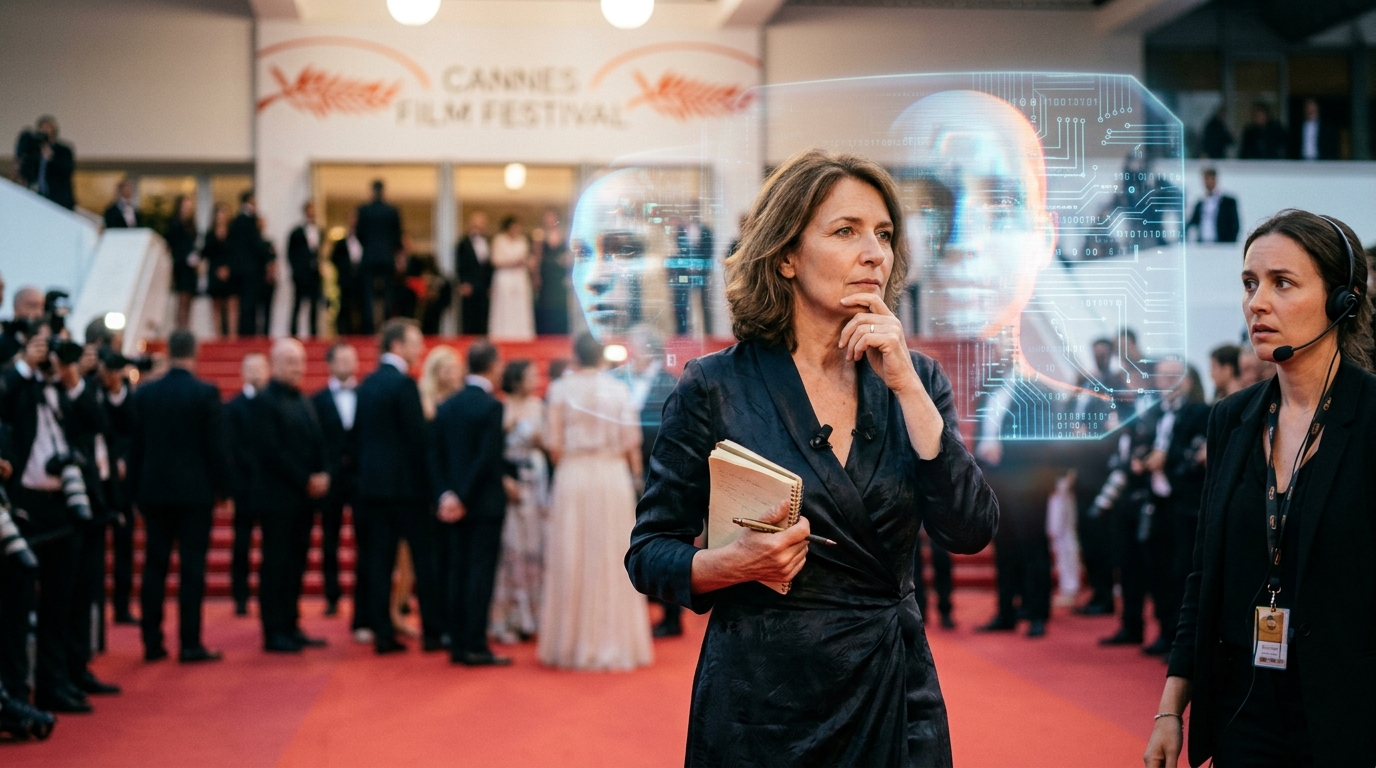
On the sun-drenched Croisette, where the tradition of cinema meets high fashion and artistic rigor, a new, invisible protagonist has begun to steal the spotlight. Artificial Intelligence (AI) is no longer a science fiction trope projected onto screens, but a reality reshaping the very foundations of the Seventh Art. This year's Cannes Film Festival became the stage for an intense ideological and practical clash: is AI the ultimate tool in the hands of the creator, or an existential threat poised to displace humanity from the heart of storytelling?
The Digital Transformation of Production
The discussions at Cannes were not limited to theoretical anxieties. In professional panels, the focus shifted toward the staggering possibilities offered by this technology. From the "de-aging" of actors—as seen in the latest Indiana Jones installment—to the creation of entire environments through generative AI, the potential seems limitless. For independent producers, AI promises something revolutionary: the democratization of visual effects. Where millions of dollars and hundreds of technicians were once required, a creator with a powerful computer can now visualize their vision at a fraction of the cost.
However, this convenience comes with a heavy price. Industry professionals, from screenwriters to VFX artists, see their livelihoods threatened by algorithms that can generate script drafts or color-grade scenes in seconds. The concern is not merely economic but artistic. Can an algorithm, trained on thousands of existing films, produce something truly original? Or is it destined to recycle the past, leading to a sterile aesthetic uniformity across global cinema?
The Ethics of Imagery and Actors' Rights
The most pressing issue at Cannes was the protection of the human image and voice. With the rise of deepfakes and digital twins, actors fear losing control over their own likenesses. While recent strikes in Hollywood laid the groundwork for legal protections, the conversation in Cannes took a more philosophical turn. "Cinema is the recording of a human moment, a genuine emotion," noted a prominent French director during a press conference. "If we replace the actor's gaze with pixels generated by a machine, we are no longer talking about art, but about a consumer product."
The European Union, through the AI Act, is attempting to establish transparency rules, requiring the labeling of any AI-generated content. In cinema, however, the lines are blurred. Where does digital enhancement end and artificial creation begin? Creators are demanding clarity and, above all, a guarantee that AI will remain a supportive tool rather than the "director" of the creative process. The fear of "synthetic actors" replacing the nuance of human performance remains a central theme of the festival's debates.
The Future of Storytelling: Coexistence or Replacement?
Despite the reservations, many see AI as a new type of "camera." Just as the advent of sound or color initially sparked backlash only to eventually enrich the cinematic language, AI could open new avenues for storytelling. Imagine films that adapt in real-time to the viewer's reactions, or scripts that explore non-linear realities in ways that were previously technically impossible. The potential for immersive, personalized experiences is vast, yet it challenges the collective experience of traditional theater-going.
The takeaway from this year's Cannes is that the industry stands at a critical crossroads. Technology cannot be halted, but it can be steered. The challenge for the future is not to ban AI, but to integrate it in a way that enhances human creativity rather than substituting it. The "soul" of a film will always be the human experience, the imperfection, and the unpredictable spark of inspiration—elements that, at least for now, no algorithm can convincingly replicate. As the festival concludes, the message is clear: the red carpet belongs to the dreamers, not just the processors.
- AI is drastically lowering production costs for independent filmmakers.
- Intellectual property and likeness rights remain the primary legal battlegrounds.
- Ethical dilemmas arise from the use of digital replicas of deceased actors.
- Europe's AI Act is setting a global precedent for transparency in creative industries.
"Technology must serve the vision, not dictate it. In Cannes, we celebrate the human spirit, not the software."