At the dawn of the third decade of the 21st century, humanity faces an identity crisis that concerns not its survival, but the very essence of its expression. The rise of Generative AI has flooded our digital world with images, texts, and music that, at first glance, resemble works of art. However, as a growing number of intellectuals and artists argue, the concept of "AI art" is an oxymoron, a structural contradiction that threatens to strip culture of its deepest meaning.
The Ontology of Effort and the Aesthetics of Suffering
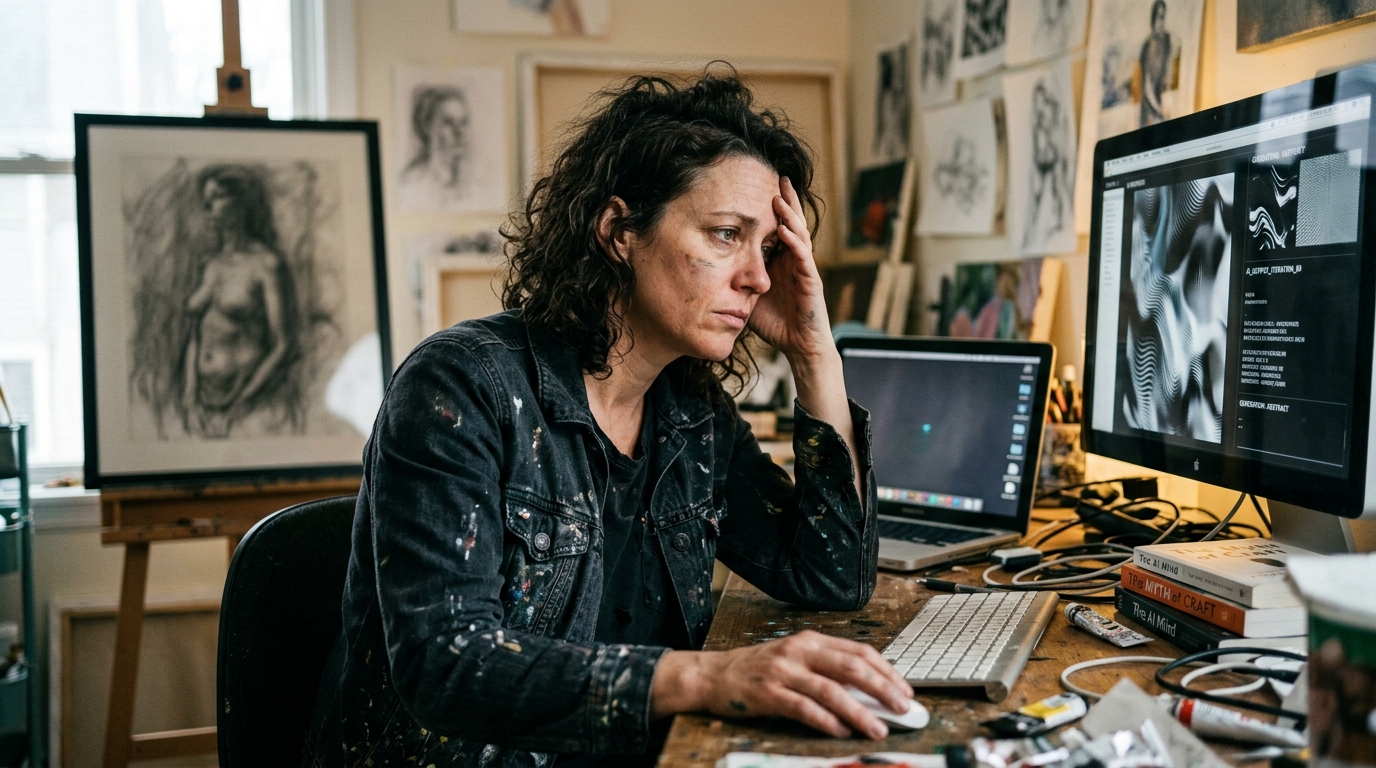
Art, historically, has never been just the final result. It was the process, the struggle with the material, the transcendence of the creator's limits. When Michelangelo painted the Sistine Chapel, he wasn't just producing images; he was depositing his physical decay, his spiritual agony, and years of solitary effort. What we call "blood, sweat, and tears" is not a romantic exaggeration, but the ontological basis of artistic value. AI, by contrast, operates in a zero-friction environment. It produces results in seconds, without a body to feel pain or a soul to harbor doubt.
The absence of this "friction" renders the produced work aesthetically polished but spiritually hollow. AI does not "create" in the sense of birthing something new from nothing; it recombines statistical probabilities based on vast datasets of human creation. It is a "stochastic parrot" that mimics the external appearance of art while ignoring its internal motivation. As noted in recent analyses, art that lacks the biological and emotional cost of its creator ceases to be communication and turns into mere decoration.
The Illusion of Democratized Creativity
AI proponents often argue that this technology "democratizes" art, allowing anyone to express themselves without possessing technical skills. However, this approach confuses consumption with creation. Giving a prompt to an algorithm does not make you an artist, any more than ordering a meal in a restaurant makes you a chef. Art requires a commitment that goes beyond selecting parameters from a menu.
- Art as a soul's testimony: The link between lived experience and expression.
- The devaluation of labor: How automation erodes the economic value of creativity.
- The question of authenticity: AI as a mirror reflecting the past without envisioning the future.
Furthermore, there is the political dimension of data theft. AI models are trained on millions of works by artists who never gave their consent. This is a form of cultural cannibalism, where the machine devours human effort to produce cheap substitutes that will eventually replace the creators themselves in the labor market. AI "art" is, to a large extent, the product of a massive intellectual property mining operation.
The End of Anthropocentrism in Aesthetics?
If we accept that AI can produce art, then we accept that human experience is redundant for aesthetic pleasure. This represents a radical break with the tradition of humanism. For centuries, art was the bridge between two consciousnesses. When we look at a painting, we communicate with the spirit of the painter. With AI, the bridge leads to a server in California. There is "no one" on the other side.
"Art is the highest form of hope," Gerhard Richter once said. But hope is a human quality. A machine does not hope, does not fear death, does not fall in love.
In conclusion, the challenge posed by AI is not technical, but ethical and philosophical. We must decide whether art is a content production industry or a sacred process of understanding the world. If we choose the former, AI is the perfect tool. If we choose the latter, then AI will always remain a contradiction, a brilliant but soulless reflection of what we once called human greatness.