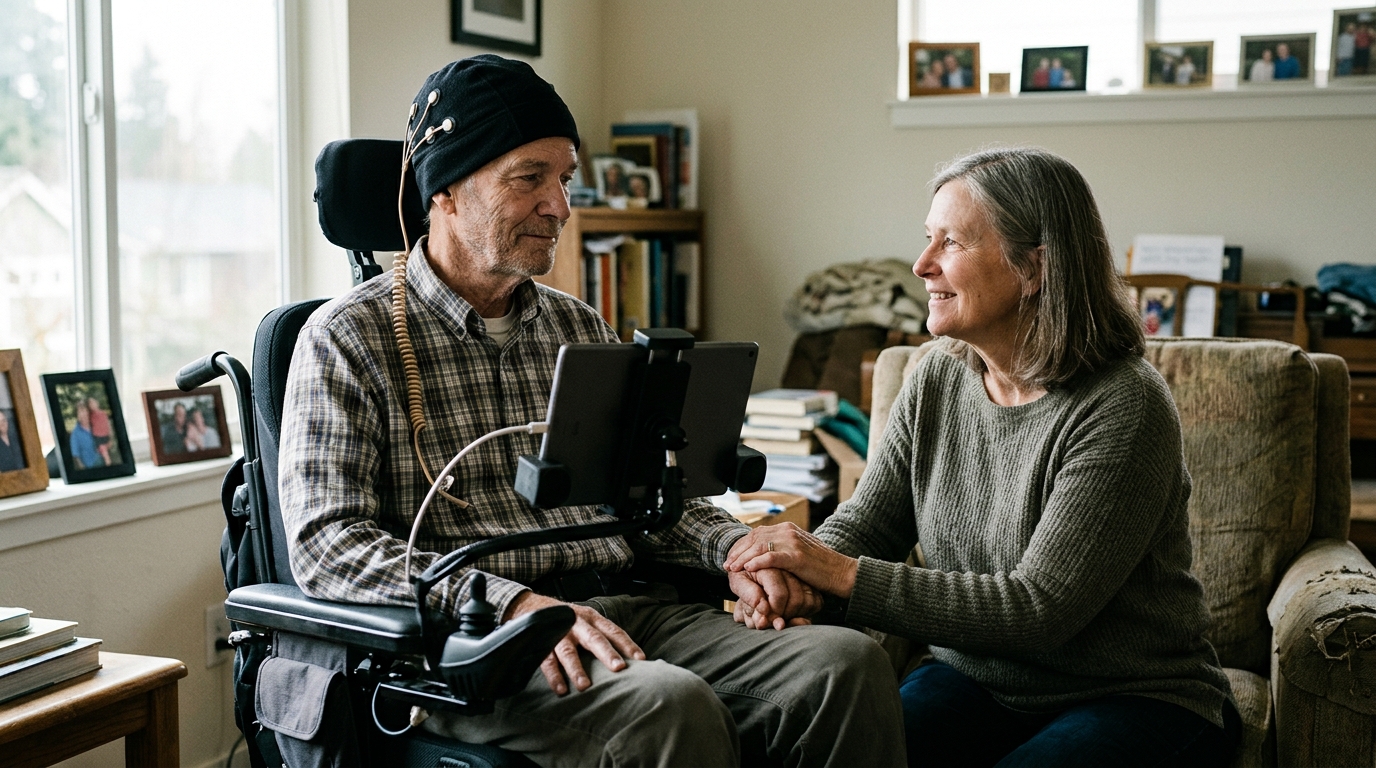
Amyotrophic Lateral Sclerosis (ALS), often referred to as Lou Gehrig’s disease, remains one of the most daunting challenges in modern medicine. It is a progressive neurodegenerative disease that attacks nerve cells in the brain and spinal cord, eventually leading to total paralysis while the patient’s cognitive functions often remain entirely intact. For decades, the phenomenon of being "locked-in" within one's own body was an inescapable reality. However, as of 2026, Artificial Intelligence (AI) has emerged as a transformative force, offering not just a voice, but a renewed sense of agency and dignity.
The Digital Preservation of Identity
One of the most devastating aspects of ALS is the gradual loss of speech. AI-driven voice banking has undergone a radical evolution to address this. Patients in the early stages of the disease can now record a small sample of their voice—sometimes requiring only a few minutes of audio—and AI models can generate a high-fidelity digital clone. This "digital twin" preserves the unique timbre, accent, and emotional nuances of the individual’s original voice.
Unlike the robotic, synthesized voices of the past, modern systems integrated with Large Language Models (LLMs) allow patients to communicate in real-time. These devices convert text to speech with a natural fluidity that was previously unthinkable. This technology transcends mere utility; it is about preserving the essence of the person. When a patient can use their own voice to speak to their loved ones, the technology stops being a cold tool and becomes a medium for human connection, maintaining the patient's role within their family and social circle.
Brain-Computer Interfaces: Bridging Mind and Machine
The frontier of ALS care lies in Brain-Computer Interfaces (BCI). Companies like Synchron and Neuralink, powered by sophisticated machine learning algorithms, have made significant strides in decoding brain signals associated with intent. For a patient who can no longer move a limb, the ability to send an email, browse the web, or control smart home environments using only their thoughts is nothing short of a miracle.
AI is the engine of this interpretation. Algorithms are trained to recognize patterns of electrical activity in the brain and translate them into digital commands. Furthermore, context-aware predictive text models significantly speed up communication, allowing patients to engage in social interactions at a pace that mimics natural conversation. While this technological leap raises profound ethical questions regarding the privacy of one's thoughts, for those living with ALS, the restoration of autonomy far outweighs the theoretical risks. The focus is shifting from simply surviving the disease to actively living with it.
Ethical Dilemmas and the Question of Accessibility
Despite the optimism, the integration of AI into ALS care brings critical ethical challenges to the fore. The foremost concern is accessibility. While these technologies are advancing rapidly in tech hubs within the US and Europe, they remain prohibitively expensive for the vast majority of the global population. There is a real danger that "digital autonomy" could become a luxury, further widening the gap in healthcare outcomes between the wealthy and the marginalized.
Moreover, the ownership of biometric data is a pressing issue. An individual’s voice and brain patterns are their most personal data points. Ensuring that technology corporations do not exploit this data for secondary purposes is paramount. We need a robust regulatory framework to guarantee that these tools remain patient-centric. Ethics also dictates that AI should not replace the human element of caregiving; rather, it should augment it, freeing caregivers from the technical burdens of communication so they can provide the emotional support that no machine can replicate.
The Road Ahead: A Future Without Silence
The application of AI in ALS treatment represents the pinnacle of technology serving the common good. This is not about optimizing ad clicks or industrial automation; it is about restoring the fundamental human right to communicate. As BCI technology becomes less invasive and AI algorithms more precise, the vision of a life without the constraints of physical paralysis is moving closer to reality. Our collective challenge is to ensure that this "voice of hope" is accessible to every patient, regardless of their socioeconomic status, ensuring that no one is left behind in the silence.