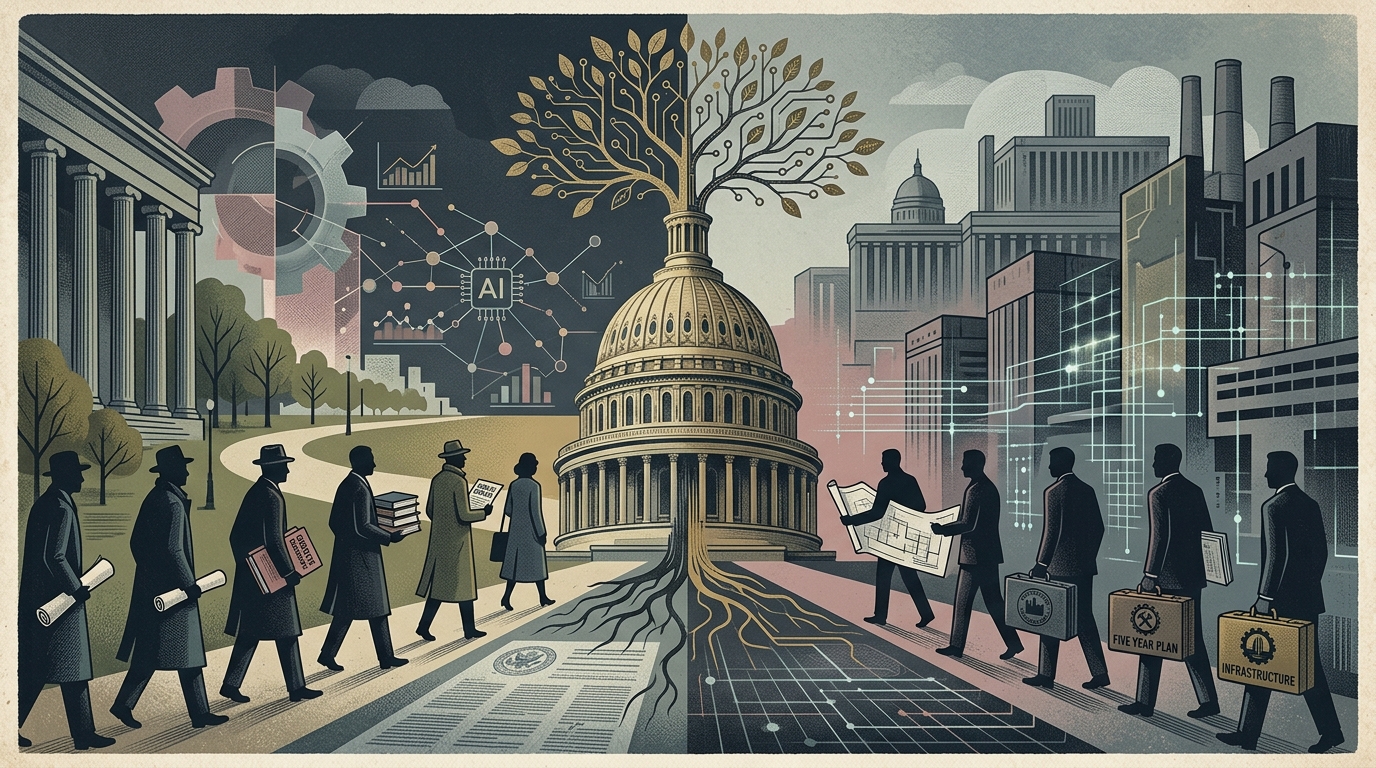
In the corridors of power in Washington, the atmosphere surrounding Artificial Intelligence (AI) has shifted from initial excitement to a profound, almost existential concern. The recent 'productive' meeting between White House officials and the leadership of Anthropic, one of the most prominent players in the sector, was far from a routine briefing. It represents the latest chapter in a complex negotiation over how innovation can coexist with rigorous state oversight without stifling U.S. competitiveness against global rivals like China.
Anthropic, founded by former OpenAI executives with a core focus on 'AI safety,' occupies a unique position in this landscape. While other tech titans lobby for lighter regulation, Anthropic has built its brand on the concept of 'Constitutional AI.' Yet, even for a company that prioritizes ethics, the White House's demands for transparency in algorithms and pre-release safety testing by government bodies are proving to be a difficult pill to swallow.
The Regulatory Tightrope: Privacy vs. Public Safety
The primary point of friction during the meeting was the implementation of President Biden’s Executive Order on AI. This landmark directive requires companies developing models with massive computational power to share safety test results with the government. Anthropic, while cooperative, voices concerns echoed across Silicon Valley: where does the protection of public interest end, and where does government intrusion into proprietary trade secrets begin?
Analysts suggest that the White House is seeking a compromise that would allow the newly established U.S. AI Safety Institute to access models before they are released to the general public. Anthropic appears to be moving toward a form of 'controlled access,' where government researchers can stress-test systems for potential misuse in biological weaponry or large-scale cyberattacks, without forcing the company to hand over the underlying 'weights' or source code that constitute its primary intellectual property.
Constitutional AI and the Geopolitical Chessboard
The conversation extends far beyond technical benchmarks; it is deeply rooted in economic and geopolitical strategy. The U.S. government fears that if regulations become overly burdensome, American firms will lose their edge to Chinese competitors such as Baidu and Alibaba, which operate under a vastly different regime of state direction. Conversely, Anthropic argues that safety is the ultimate competitive advantage. A model that is reliable, predictable, and free from 'hallucinations' is inherently more attractive to enterprise clients and government agencies alike.
During the meeting, Anthropic positioned itself as a bridge between the radical transparency demanded by activists and the closed-door development favored by some of its peers. With billions in backing from Amazon and Google, the company has the financial clout to shape the legislative landscape. Their strategy is to prove that 'responsible development' is not an obstacle to profitability but a prerequisite for it. Reports indicate that the discussion also touched upon the necessity of international standards, ensuring that rules forged in Washington do not turn the U.S. into a 'regulatory island' that drives talent and capital elsewhere.
Toward a New Social Contract for Technology
The outcome of these deliberations will likely define the future of the digital economy. If the White House and Anthropic can reach a sustainable compromise, it will serve as a blueprint for the entire industry. Already, OpenAI and Meta are closely monitoring these interactions, knowing that the precedents set today will govern their operations tomorrow. The central challenge remains: how do you regulate a technology that evolves faster than the bureaucracy tasked with overseeing it?
Ultimately, this 'productive' meeting suggests a pivot toward collaborative governance. Instead of a head-on collision between Silicon Valley and the Beltway, we are witnessing an attempt to co-author the rules of the road. Anthropic seems willing to trade a degree of absolute autonomy for legal certainty and state validation. For the White House, the success of this compromise is essential to ensure that the AI revolution does not culminate in an uncontrollable security crisis, but rather serves as a catalyst for sustained economic growth and national resilience.