On May 24, 2026, the global investment community is witnessing one of the most radical shifts in the history of capital markets. SpaceX, once viewed as a daring challenger in the aerospace industry, is undergoing a strategic pivot that is set to redefine our understanding of Artificial Intelligence (AI) and mega-cap Initial Public Offerings (IPOs). According to Bloomberg Tech, Elon Musk’s venture is no longer marketing itself merely as a launch provider, but as a comprehensive AI platform targeting a staggering $26.5 trillion total addressable market.
The Strategic Pivot: From Rockets to Real-Time Data
The move to rebrand SpaceX as an AI company is far from a mere marketing gimmick. It is built upon the massive infrastructure of Starlink, which now operates as the world’s largest low-latency data transmission network. SpaceX’s ability to process real-time data from thousands of satellites, utilizing advanced algorithms for flight automation and global connectivity, places it at the very heart of the AI infrastructure layer. The $26.5 trillion market opportunity cited by the company encompasses not just telecommunications, but autonomous shipping, precision agriculture, and global security systems.
Larry Tabb, Head of Market Structure Research at Bloomberg, notes that SpaceX is positioning itself to wrest market share from current investor favorites like Nvidia and Microsoft. The key differentiator is vertical integration: SpaceX controls the hardware (rockets and satellites), the software, and the distribution network. This model creates a competitive moat that is virtually impenetrable for terrestrial competitors who rely on third-party infrastructure for their AI deployments.
Market Displacement and Capital Reallocation
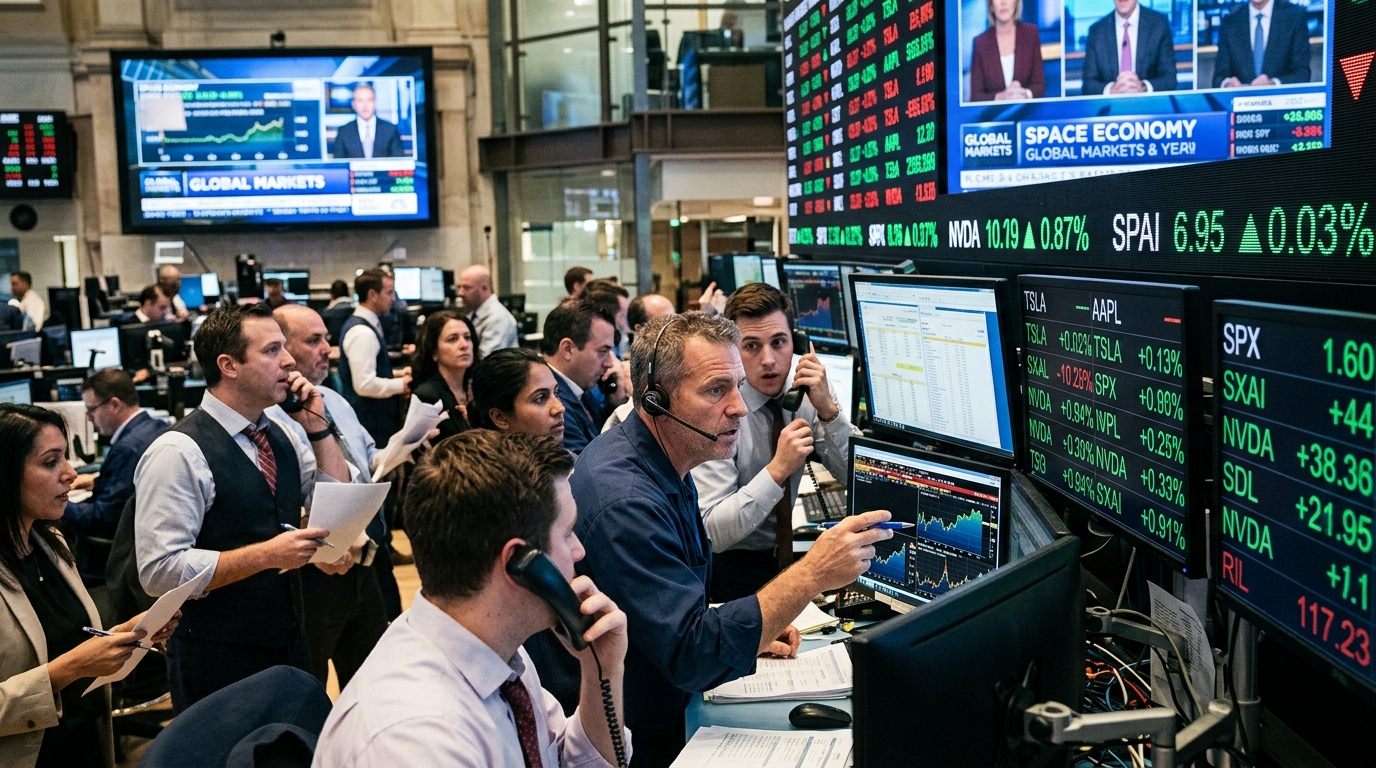
The anticipated SpaceX IPO is being hailed as the "Holy Grail" for institutional investors. With tech valuations reaching unprecedented levels in mid-2026, the entry of a player of this magnitude is expected to trigger a significant reallocation of capital. Many investors may liquidate positions in traditional semiconductor or cloud computing firms to gain exposure to SpaceX, viewing it as a more holistic play on the future of autonomous systems.
- Valuation Dynamics: Analysts predict that SpaceX could potentially surpass Apple in market capitalization within the next decade if its AI service revenue projections hold true.
- Index Weighting: The company’s eventual inclusion in the S&P 500 and Nasdaq 100 will force passive funds to acquire billions of dollars in shares, creating a demand shock unlike anything seen in recent market history.
- Competitive Pressure: Rivals like Amazon’s Project Kuiper are now under immense pressure to accelerate their programs to avoid being permanently sidelined in the "Space-AI" race.
Geopolitics and the Regulatory Frontier
"SpaceX is no longer just an American company; it is a global infrastructure operating beyond the traditional boundaries of nation-states," a prominent Wall Street analysis recently stated.
The dominance of SpaceX in both AI and global data raises profound questions regarding regulation and antitrust. The European Union and China are closely monitoring the company’s progress, as reliance on a private network for critical AI applications could pose risks to national sovereignty. However, the economic gravity of the IPO is so strong that most governments appear willing to facilitate its growth, hoping to capture spillover benefits for their local tech ecosystems.
The use of AI for real-time geospatial analysis gives SpaceX an advantage that no other firm possesses. From predicting natural disasters to optimizing global supply chains, "Space-AI" is becoming the new backbone of the global economy. The IPO will provide the necessary capital to finalize the Starship program, which aims to further reduce the cost of space access, closing a self-reinforcing loop of innovation and massive profitability.
Conclusion: A New Era for Global Capitalism
SpaceX’s transition into a Mega-Cap AI entity marks the end of an era where artificial intelligence was confined to data centers and computer screens. AI has now found a physical body in orbit, and the market is responding with a mix of euphoria and caution regarding the concentration of power. The $26.5 trillion bet is audacious, but if Elon Musk’s track record has taught us anything, it is that traditional market rules often fail to apply to his ventures. 2026 will be remembered as the year the boundaries between Earth, space, and digital intelligence finally dissolved.