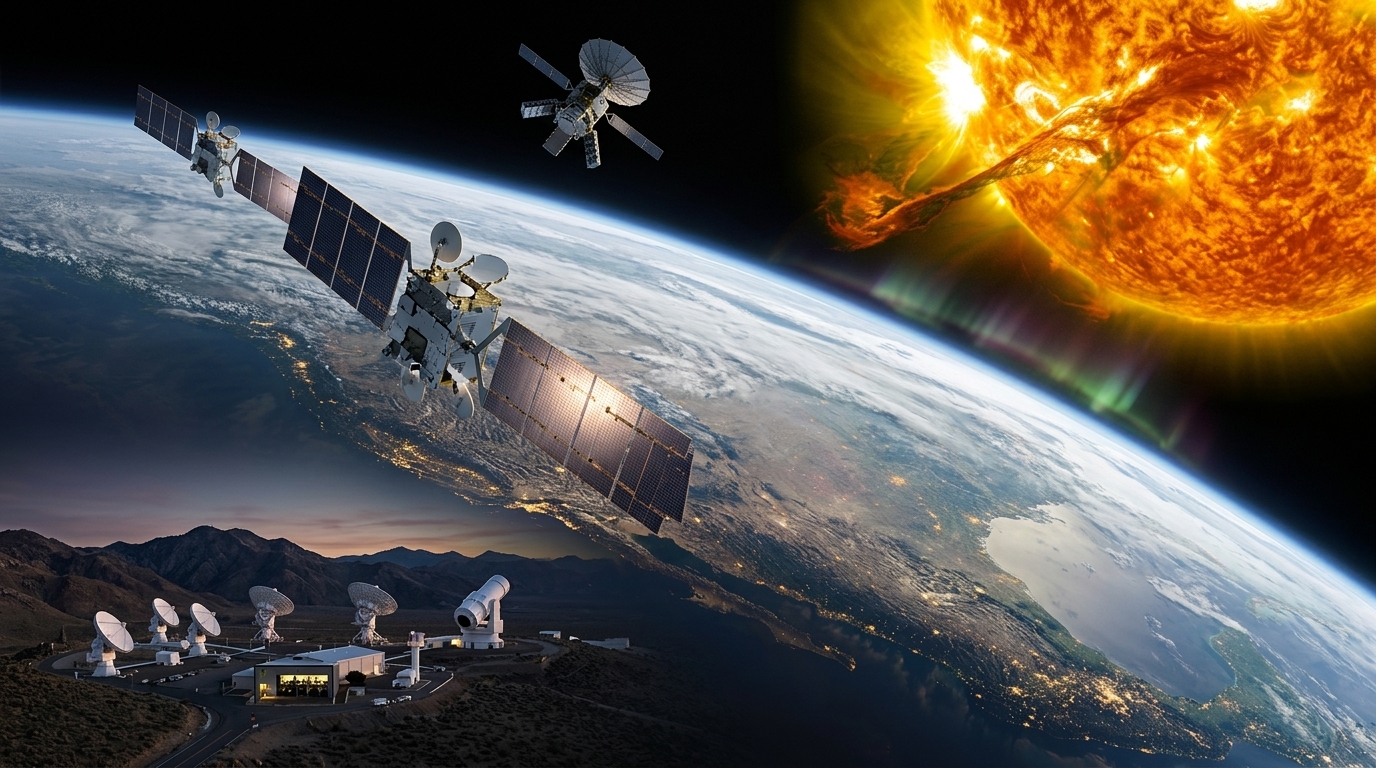
In an era where our dependence on technology is near-absolute, understanding the invisible forces surrounding our planet is no longer an academic luxury but a matter of national and global security. The National Observatory of Athens (NOA), through the Institute for Astronomy, Astrophysics, Space Applications and Remote Sensing (IAASARS), is at the forefront of this effort with the pioneering "Swarm-AWARE" project. This Greek initiative leverages Artificial Intelligence and data from the European Space Agency's (ESA) Swarm mission to "listen" to the whispers of Earth's magnetic field.
The Swarm Mission and the Role of Artificial Intelligence
ESA's Swarm mission consists of a trio of satellites in low Earth orbit, precisely measuring magnetic signals originating from the core, mantle, crust, oceans, ionosphere, and magnetosphere. The Swarm-AWARE project adds a critical layer of analysis to this vast amount of data. By using advanced machine learning algorithms, Greek scientists can now distinguish "signal" from "noise," identifying anomalies that previously remained invisible to the human eye or traditional software.
The importance of this work is twofold. On one hand, it allows for the monitoring of space weather—solar storms that eject charged particles toward Earth. These phenomena can cause severe damage to telecommunications satellites, disrupt GPS signals, and, in extreme cases, destroy terrestrial power grids. The ability to forecast and understand these events early serves as the "space shield" of modern society.
From Space to the Ground: Earthquakes and Tsunamis
Perhaps the most fascinating aspect of Swarm-AWARE is the attempt to link atmospheric disturbances with geological phenomena. It is well-known in the scientific community that major events, such as powerful earthquakes, tsunamis, or volcanic eruptions, generate acoustic and gravity waves that travel upward, reaching the ionosphere. There, they interact with ionized gas and alter the local magnetic field.
- Precursor Signals: Research focuses on identifying electromagnetic changes that may precede an earthquake, potentially offering valuable minutes of warning.
- Tsunami Monitoring: Disturbances in the ionosphere caused by the displacement of massive water bodies can be detected by satellites faster than by ground sensors in some cases.
- Volcanic Activity: Analyzing atmospheric waves from eruptions helps in understanding the intensity and dispersion of volcanic ash, critical for aviation safety.
As NOA researchers note, utilizing data from SpaceX's Starlink satellite constellation provides an additional, dense source of information. With thousands of these satellites in low orbit, their sensors—though intended for telecommunications—can function as a massive space weather detection network, complementing ESA's scientific instruments.
Strategic Importance for Greece and the EU
Greece's participation in such programs is not only scientific but also strategic. Our country, located in a seismically active region at the crossroads of three continents, has every interest in leading the development of early warning technologies. Swarm-AWARE places the National Observatory of Athens on the global map of space research, proving that Greek scientific talent can produce high-value innovation.
"Understanding the interaction between Earth and Space is the key to protecting the infrastructure of the future. With Swarm-AWARE, we are turning satellite data into knowledge that saves lives," sources close to the project state.
In conclusion, the Swarm-AWARE project is a brilliant example of how Artificial Intelligence can bridge different scientific fields. From plasma physics in space to seismology within the Earth's interior, Greek science is now "reading" the planet's signs in a way that, until a few years ago, seemed like science fiction. The challenge now lies in integrating these tools into civil protection mechanisms at both national and European levels, ensuring that data translates into real-world resilience.