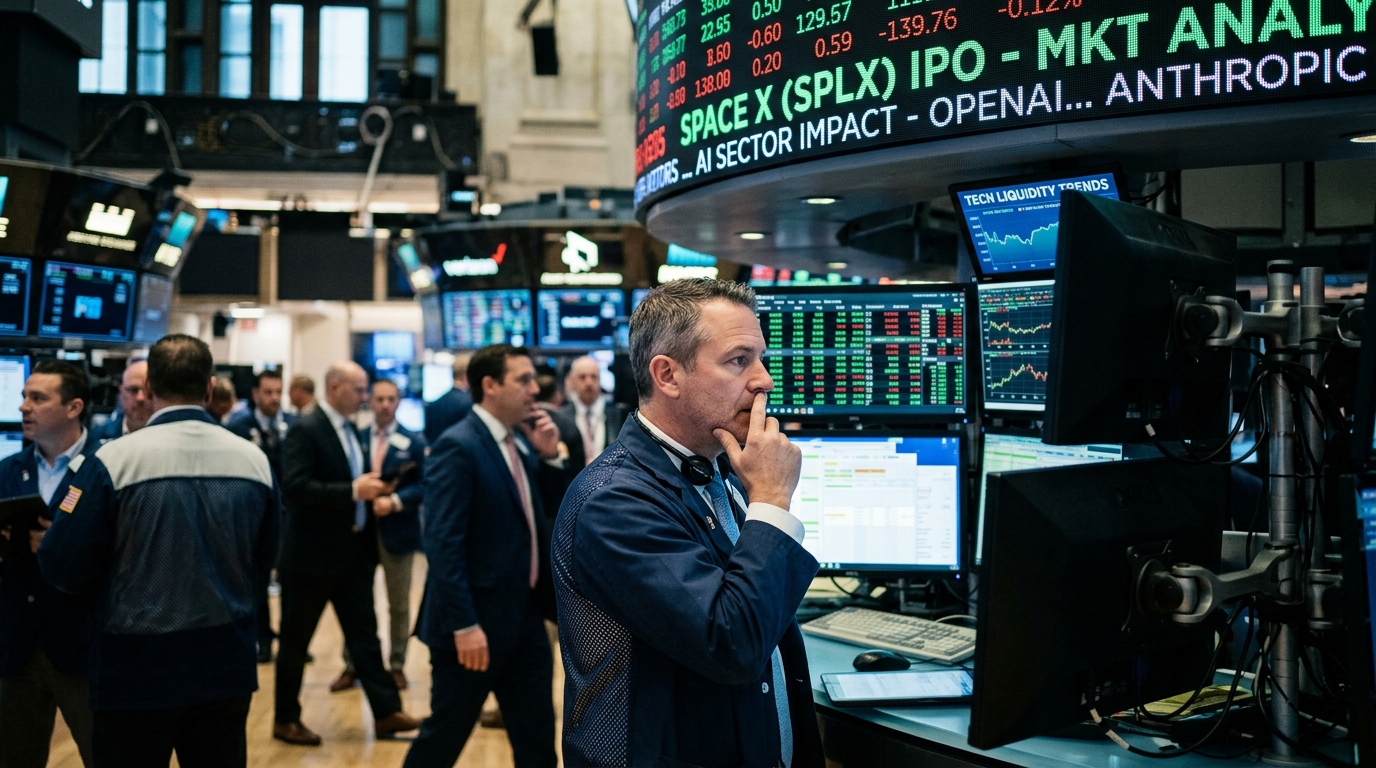
The news that SpaceX, Elon Musk’s aerospace crown jewel, is preparing for an initial public offering (IPO) or a significant secondary sale that would value the company at over $200 billion, has sent shockwaves through Silicon Valley. Yet, these tremors are not confined to the space industry. For AI leaders like OpenAI and Anthropic, the SpaceX trajectory serves as both a critical roadmap and a challenge for their financial futures.
The SpaceX Phenomenon as a Blueprint
For years, major private tech companies—the so-called "unicorns"—avoided the public markets, preferring the comfort of private capital that allowed them to grow without the relentless pressure of quarterly earnings. SpaceX has been the standard-bearer of this strategy. However, the need for massive capital to fund Starlink constellations and Mars missions is finally pushing it toward the embrace of public investors.
OpenAI and Anthropic find themselves in a similar predicament. Developing Large Language Models (LLMs) requires billions of dollars in compute power and Nvidia chips. To date, they have relied on strategic investors like Microsoft, Google, and Amazon. But as their capital requirements escalate, the private market may no longer suffice. The success of a SpaceX IPO will prove whether institutional investors have the appetite to absorb companies with massive operational costs but equally massive potential.
The Liquidity Pressure Cooker
One of the primary issues facing OpenAI and Anthropic is the growing pressure from employees and early investors. Many hold shares worth millions on paper but have no way to liquidate them. SpaceX has managed this through regular tender offers, allowing employees to sell stakes to new investors. This has kept the workforce motivated without needing a formal IPO.
If SpaceX moves forward with a public listing, it paves the way for OpenAI to consider a similar exit. However, OpenAI has a much more complex structure. Its transition from a non-profit to a "capped-profit" entity raises legal and ethical questions that SpaceX never had to face. Investors will demand clarity on who controls the company: a board focused on the safety of humanity or shareholders seeking returns?
Competition for Capital
There is, however, a darker side to this development. Public markets do not have infinite depth for cash-burning "frontier tech" companies. A SpaceX IPO could soak up a significant portion of the available liquidity from mutual funds and ETFs targeting cutting-edge technology. This means OpenAI and Anthropic might find themselves competing with Musk not just in technology (via xAI), but for the attention and dollars of Wall Street.
- SpaceX sets the valuation benchmark for infrastructure-heavy tech companies.
- OpenAI must solve its governance puzzle before approaching public markets.
- Anthropic, as the "safety-first" alternative, may attract more conservative institutional capital.
In conclusion, the SpaceX move signals the end of the era of the "experimental unicorn." Frontier technology is returning to traditional market rules, where transparency and profitability—or at least a clear path toward it—will be the prerequisites for survival in the 21st century.
The Strategic Importance of Anthropic
While OpenAI dominates the headlines, Anthropic is watching these developments with keen interest. Founded by former OpenAI executives with an emphasis on AI alignment and safety, the company could benefit from a SpaceX IPO if it fosters a positive sentiment for high-R&D firms. Anthropic possesses a cleaner corporate structure than OpenAI, making it more "palatable" for public investors who are wary of board-room drama.
"The market is no longer just buying promises; it is buying scale and strategic dominance. SpaceX has it, OpenAI is building it, and Anthropic is guaranteeing its safety," says a Morgan Stanley analyst.
Ultimately, the SpaceX IPO will act as the ultimate stress test for whether Wall Street is ready to fund the future of humanity, whether that future lies among the stars or within the algorithms.