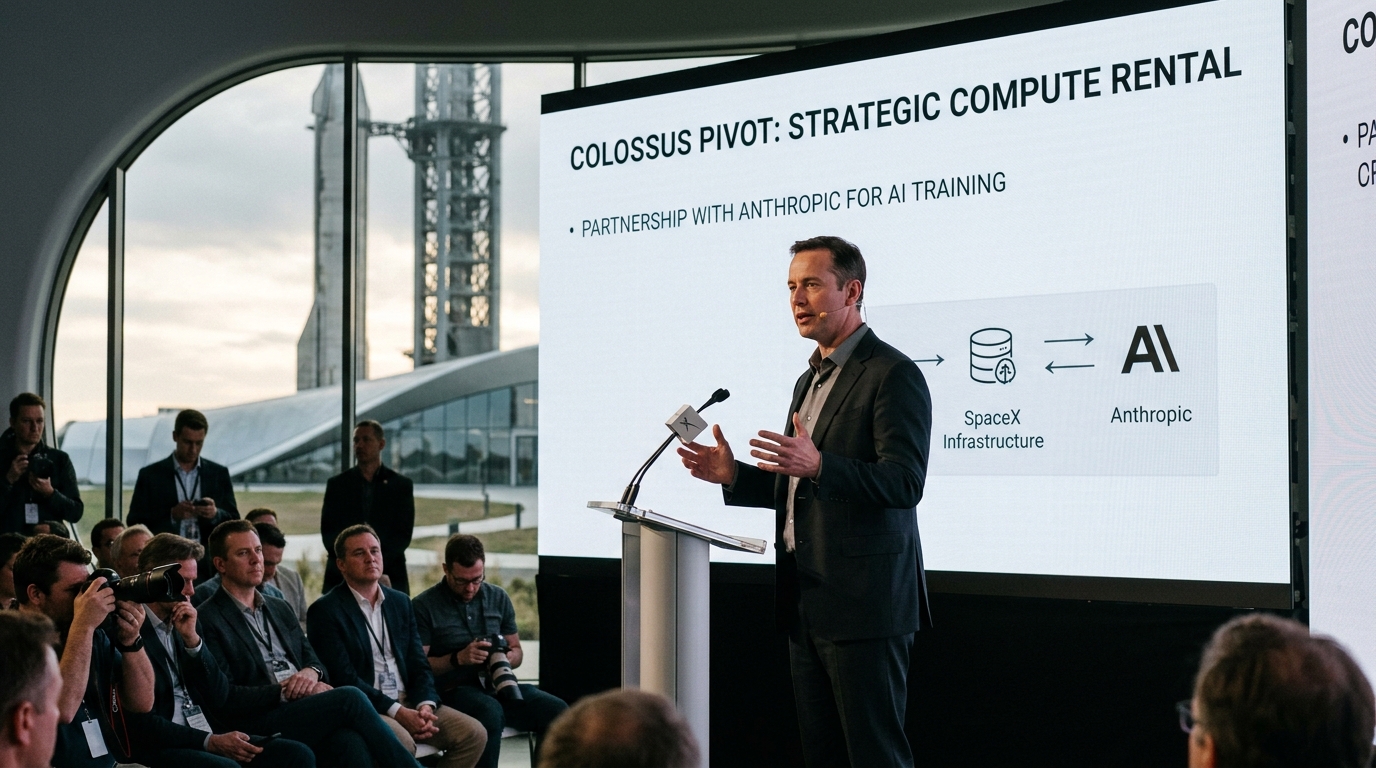
In a move that has reverberated through the global tech landscape, SpaceX has decided to lease the full capacity of its 'Colossus 1' data center in Memphis to Anthropic PBC. According to reports from Bloomberg, this decision was finalized after SpaceX and xAI internal teams encountered significant technical friction while attempting to utilize the facility for training the latest iterations of Grok AI models. This development marks a rare moment of strategic recalibration for Elon Musk’s ecosystem, which typically prides itself on vertical integration and total technological self-reliance.
The Technical Wall at Colossus
Colossus 1 is no ordinary data center. Designed to house hundreds of thousands of high-end GPUs, it was envisioned as the crown jewel of Musk’s artificial intelligence ambitions. However, scale alone does not guarantee performance. Sources familiar with the matter indicate that engineering teams faced persistent issues with system interconnectivity and thermal management—factors that are absolutely critical for the stability of training Large Language Models (LLMs).
Training models like Grok requires perfect synchronization across thousands of chips. When even a small percentage of these units experience latency or hardware failure, the entire training run can stall, costing millions of dollars in wasted time and electricity. It appears that the architecture of Colossus, while impressive on paper, proved more temperamental in practice than anticipated, leading SpaceX to seek an external tenant with perhaps different software methodologies or less immediate scaling demands.
Anthropic: An Unexpected Tenant
The choice of Anthropic as the primary tenant is particularly striking. The company, backed by giants such as Google and Amazon, is considered one of xAI’s most direct competitors. This agreement suggests that SpaceX is now prioritizing financial viability and operational cost recovery over the exclusive control of compute power. For Anthropic, access to such a massive infrastructure is a windfall, allowing them to accelerate the development of their Claude models without waiting for the completion of their own dedicated facilities.
- The deal covers the total capacity of the Colossus 1 facility.
- xAI will reportedly shift Grok’s development to other, more stable clusters.
- The move offloads the massive maintenance and utility costs from SpaceX’s balance sheet.
This 'cohabitation' of rivals under the same ownership structure indicates a maturing AI market. Compute power is increasingly becoming a commodity that can be traded or leased, even to competitors, when market conditions demand it.
Economic and Political Implications
The construction of Colossus in Memphis was already a point of contention regarding local water and energy consumption. The revelation that SpaceX itself cannot fully utilize the facility for its intended purpose may reignite pushback from the local community and regulatory bodies. If a project of this magnitude serves merely as a 'landlord' operation for third-party firms, the arguments regarding local innovation and strategic regional importance begin to lose weight.
"It's not just about the silicon; it's about the fabric that binds it. SpaceX learned the hard way that raw power is no substitute for specialized network architecture," noted a senior industry analyst.
In the long run, this move might be part of a broader pivot by Musk to position SpaceX as an AI Infrastructure Provider, akin to Amazon’s AWS. If SpaceX can iron out the technical kinks and offer Colossus as a reliable cloud service, it could unlock a massive new revenue stream, diversifying its income beyond rocket launches and Starlink satellite services. However, for now, it stands as a testament to the immense difficulty of building the world's largest AI supercomputers.