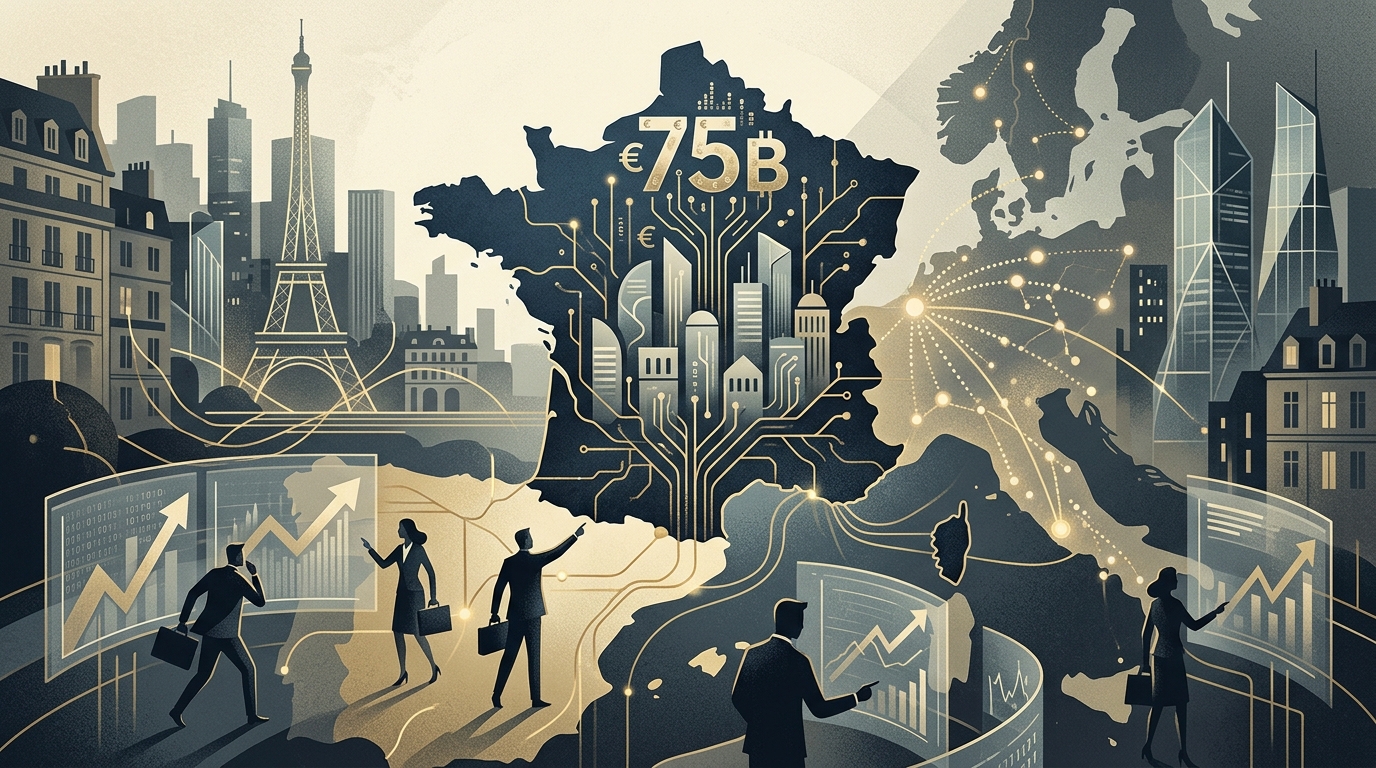
In a move described as a tectonic shift for the European technological ecosystem, the Japanese conglomerate SoftBank, led by the visionary Masayoshi Son, has announced an unprecedented €75 billion investment to construct AI data centers in France. The announcement, made during the 'Choose France' summit in Paris, marks the largest single foreign investment in the history of the Fifth Republic and places the country at the epicenter of the global race for computational power.
Why France? The Synergy of Nuclear Energy and Talent
SoftBank's decision to select France as its primary base for AI expansion in Europe is no coincidence. Analysts point to two main pillars for this choice: stable energy supply and exceptional human capital. France, boasting one of the world's most robust and stable nuclear energy grids through EDF, provides the essential 'clean' and continuous electricity required by next-generation data centers. These facilities, which will house hundreds of thousands of Graphics Processing Units (GPUs), consume massive amounts of energy, making energy security the number one criterion for site selection.
Furthermore, Emmanuel Macron's government has systematically cultivated an innovation-friendly environment, providing incentives for startups like Mistral AI and H, which are already competing with American giants. SoftBank's investment is expected to act as a multiplier, creating thousands of high-skilled jobs and strengthening the domestic supply chain for semiconductors and cooling systems.
From Vision Fund to Infrastructure: SoftBank's Transformation
For Masayoshi Son, this move represents the culmination of a strategic pivot. Following a few challenging years for the Vision Fund, SoftBank is now focusing entirely on AI infrastructure. Owning Arm Holdings, whose processor designs dominate the mobile market and are rapidly expanding into data centers, gives SoftBank a unique advantage. The investment in France is not just about buildings and servers; it is about creating an integrated ecosystem where Arm hardware meets AI software on European soil.
Critics, however, raise questions about the financing of such a gargantuan project. Seventy-five billion euros is an amount that exceeds the annual budget of many European states. SoftBank plans to use a mix of equity and debt, taking advantage of the interest rate easing observed in 2026, as well as strategic partnerships with French banking groups. The scale of the investment suggests that Son views artificial intelligence not merely as a tech trend, but as the new 'electricity' of the global economy.
Geopolitical Implications and European Sovereignty
This move comes at a time when the European Union is struggling to find its own voice between the US and China. SoftBank's investment gives France—and by extension the EU—the opportunity to claim 'digital sovereignty.' Instead of relying exclusively on clouds from Amazon (AWS) or Microsoft (Azure), Europe can now host critical data and computing power on infrastructure that, while funded by foreign capital, operates under the EU's strict regulatory framework for data protection (GDPR) and the AI Act.
However, there is another side to the coin. The massive demand for energy may strain the French grid, sparking concerns from environmental organizations worried about AI's carbon footprint, despite the use of nuclear power. Furthermore, reliance on a single major investor carries risks in the event of future financial instability within the group. Nevertheless, Paris seems willing to take the risk, believing that the AI train is one that France cannot afford to miss.
Conclusion: A Vision for 2030
The €75 billion investment is a statement of confidence in Europe's future as an innovation hub. If the plan is implemented according to schedule, by 2030, France will possess the strongest computing infrastructure on the continent. For the rest of the world, it is a clear message: the battle for AI supremacy will not only be fought in the code labs of Silicon Valley but also in the physical infrastructure, energy, and geopolitical strategy of nations.