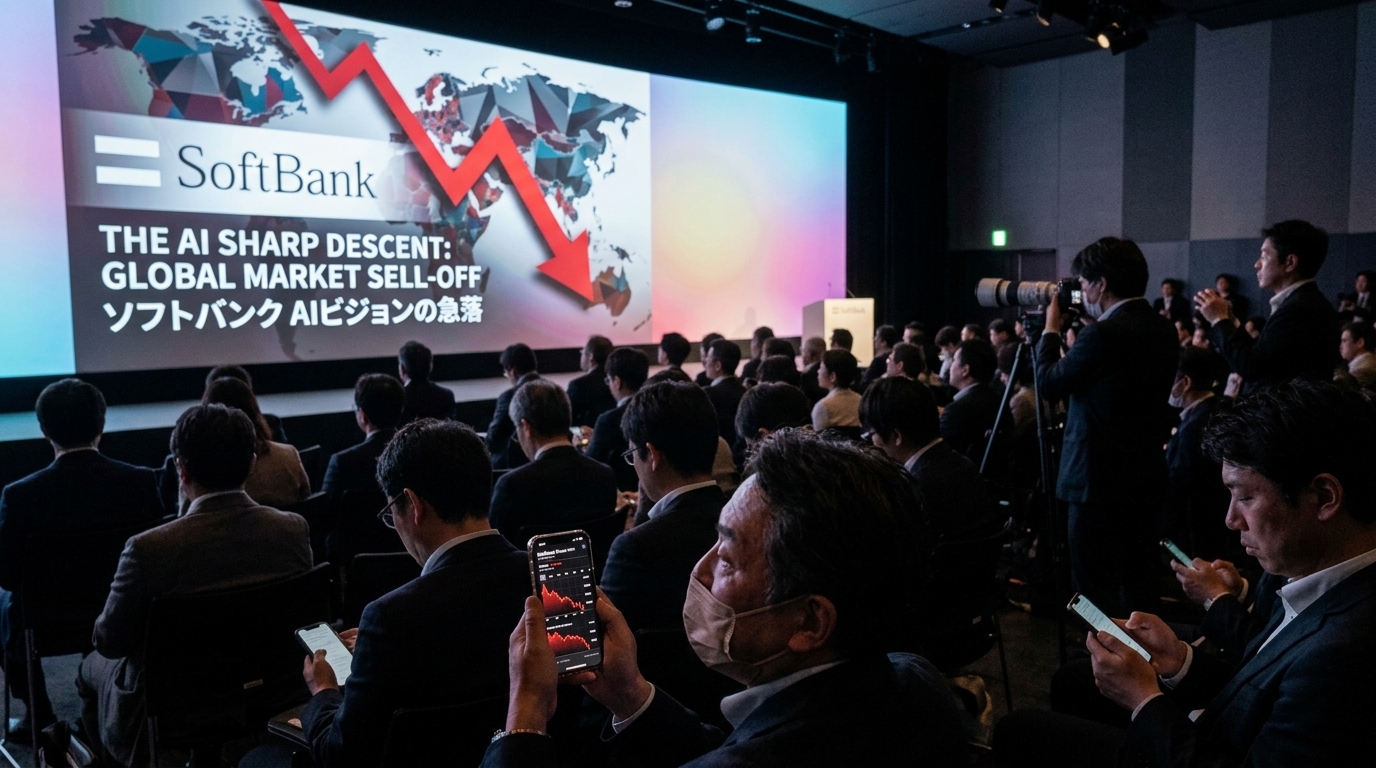
The recent financial storm that hit SoftBank Group Corp., with its stock plunging 10% on the Tokyo Stock Exchange, is more than just an isolated corporate headline. It is the loudest signal yet that the Artificial Intelligence (AI) fever is entering a phase of critical testing. For Masayoshi Son, the founder and 'visionary' behind the Japanese conglomerate, this drop serves as a stark reminder that markets can be unforgiving when the gap between expectation and profitability begins to widen.
The Masayoshi Son Gambit and the Arm Connection
Over the past few years, SoftBank has transitioned from a telecommunications firm into an investment powerhouse focused almost exclusively on cutting-edge technology. Son’s strategy is clear: SoftBank must dominate the AI infrastructure. The 'crown jewel' of this strategy is Arm Holdings, the British semiconductor design firm in which SoftBank holds a majority stake. Arm provides the blueprint for processors worldwide, and its recent stock surge had propelled SoftBank’s valuation to dizzying heights.
However, this tight linkage proved to be a double-edged sword. As the semiconductor sector faces pressure due to concerns over slowing demand and geopolitical tensions between the US and China, SoftBank found itself exposed. The 10% slide reflects investor fears that Arm’s valuation—and by extension, SoftBank’s—was built on overly optimistic scenarios that failed to account for market cycles and macroeconomic headwinds.
The Great Correction: From Hype to Reality
SoftBank’s sell-off did not occur in a vacuum. It was accompanied by a broader retreat in global tech stocks, affecting giants like Nvidia and ASML. Analysts point out that we are currently moving through the 'trough of disillusionment' in the technology cycle. After two years of an unceasing rally fueled by ChatGPT and the promises of Generative AI, institutional investors are beginning to demand tangible results on balance sheets.
Capital expenditures (CapEx) by Big Tech companies have skyrocketed, yet the revenue directly attributable to AI has not yet reached levels that justify current Price-to-Earnings (P/E) ratios. SoftBank, through its Vision Funds, has poured billions into startups promising an AI revolution, but many remain deeply unprofitable, heightening the parent company's risk profile during periods of market volatility.
Macroeconomic Factors and the Yen
Furthermore, Japan’s domestic economy is playing a decisive role. Volatility in the Yen-Dollar exchange rate and shifts in the Bank of Japan’s (BoJ) monetary policy have created an unstable environment for the carry trade. SoftBank, which carries significant dollar-denominated debt but reports in Yen, is directly impacted by these fluctuations. As interest rates in Japan begin to creep up, the cost of servicing debt becomes more expensive, putting additional downward pressure on the stock.
Despite the plunge, Son remains defiantly optimistic. In recent addresses, he has spoken of 'Artificial Super Intelligence' (ASI) as the ultimate goal, arguing that short-term market tremors are insignificant compared to the historical shift on the horizon. However, for shareholders who saw 10% of their value evaporate in a single session, the vision of the future feels less comforting than the immediate need for stability in the present.
Market Implications
The SoftBank case serves as a case study for the current state of the global economy. Technology remains the primary engine of growth, but the excessive concentration of capital in a single narrative (AI) creates systemic risks. This correction may ultimately be healthy, as it prunes speculative excess and allows companies with genuine value to distinguish themselves. The question remains: is this the beginning of a prolonged downturn, or merely a temporary hurdle on the path to digital supremacy?