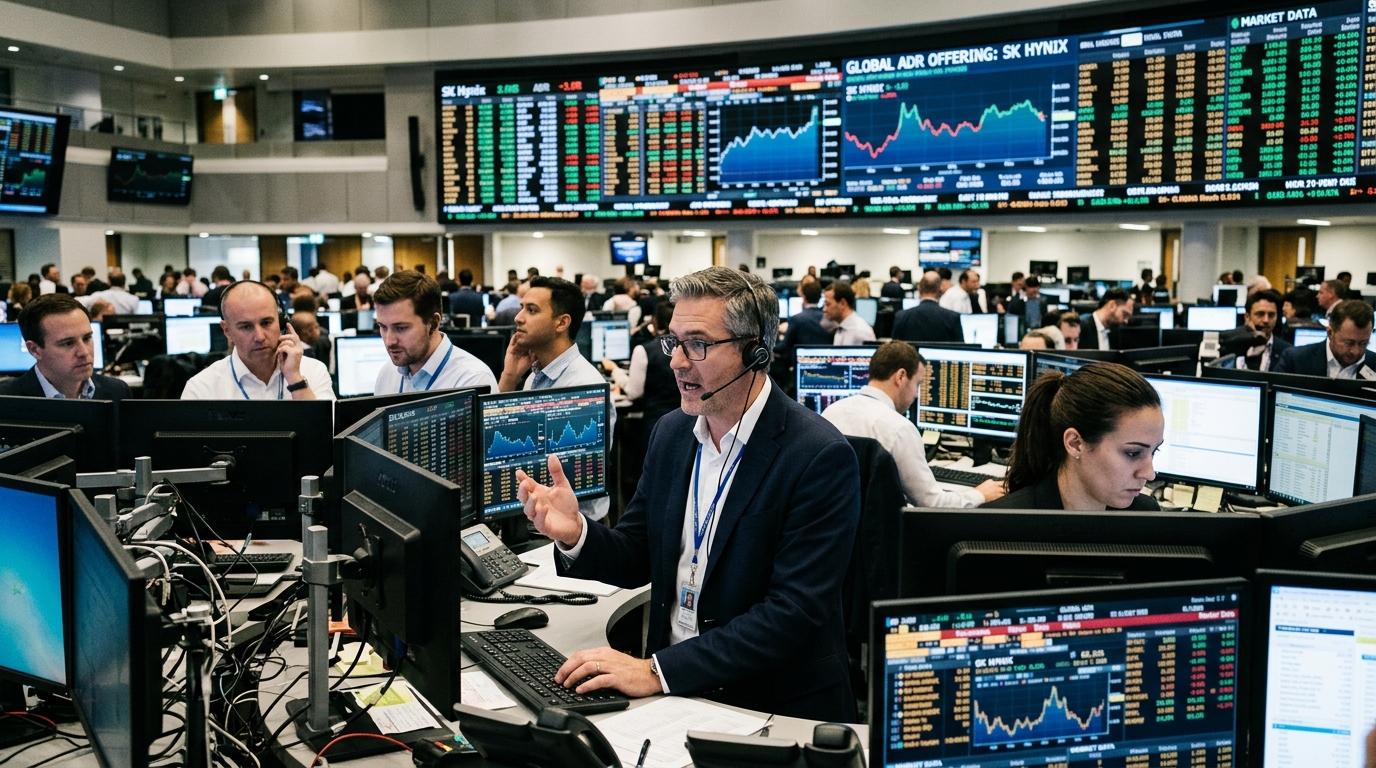
The global semiconductor landscape is witnessing a seismic shift that transcends technological boundaries, moving into the high-stakes arena of capital market strategy. SK Hynix Inc., the world’s second-largest memory chipmaker and the undisputed leader in the critical High Bandwidth Memory (HBM) sector, is reportedly preparing one of the largest share sales in history via American Depositary Receipts (ADRs). According to sources familiar with the matter, the South Korean giant is considering a fee payout of approximately 0.5% to the investment banks managing the deal—a figure that, while seemingly modest in percentage terms, represents a multi-million dollar windfall given the massive scale of the offering.
The Strategic Logic of the 0.5% Fee
In the world of institutional finance, fees are often the primary point of contention between corporations and banking behemoths. For an ADR issuance of this magnitude, a 0.5% fee sits at the lower end of the typical spectrum, signaling the immense attractiveness of the deal. Wall Street’s elite firms are competing fiercely for a role in the syndicate, not merely for the immediate compensation, but for the prestige of being associated with a transaction that will fundamentally underpin the infrastructure of Artificial Intelligence. SK Hynix is operating from a position of strength, leveraging the financial sector's desperation to be linked to the AI "success story."
The decision to pursue a mega-ADR listing in the United States is no coincidence. The company seeks to tap into the deepest pool of liquidity on the planet, moving beyond the constraints of the Korea Exchange (KRX). This move is a direct attempt to combat the "Korea Discount"—the historical tendency for South Korean equities to trade at lower price-to-earnings multiples than their global peers due to geopolitical risks and corporate governance concerns. By establishing a primary presence on US boards, SK Hynix is hunting for a valuation that mirrors its role as the primary hardware backbone for Nvidia’s AI GPUs.
The High-Stakes Race for HBM Dominance
The true catalyst for this capital raise is the relentless pursuit of technological supremacy. SK Hynix has successfully outpaced rivals Samsung and Micron in the development of HBM3 and HBM3E—the specialized memory chips essential for training Large Language Models (LLMs). Demand has reached such a fever pitch that the company’s production capacity for 2024 and most of 2025 is already sold out. However, maintaining this lead requires astronomical investments in R&D and the construction of next-generation fabrication plants (fabs).
- Massive investments in new manufacturing clusters in South Korea and the US.
- Accelerated development of HBM4 to stay ahead of Samsung’s aggressive catch-up efforts.
- Strengthening supply chain resilience amidst escalating global trade tensions.
SK Hynix plans to spend tens of billions of dollars on the "Yongin Semiconductor Cluster," a gargantuan industrial park destined to be the heart of its future production. The proceeds from the ADR offering will be funneled directly into these capital-intensive projects, ensuring the company does not fall behind in the AI arms race due to liquidity constraints.
Geopolitical Implications and the US Alignment
Choosing New York as the venue for this capital raise carries a potent political message. As the United States seeks to re-shore semiconductor manufacturing through the CHIPS Act, SK Hynix is signaling a deep alignment with American economic interests. The company has already committed to investing in advanced chip packaging facilities in Indiana. A deep financial integration with the US market via an ADR further solidifies its status as a "trusted partner" in the global supply chain, strategically distancing its financial fortunes from Chinese influence.
"This move isn't just about the cash. It's about the cultural and economic pivot of a Korean empire toward the West, where the heart of AI capitalization beats," noted a senior semiconductor analyst.
In conclusion, the 0.5% fee is merely the tip of the iceberg. What we are witnessing is the transformation of a traditional memory manufacturer into a global financial and technological titan, willing to pay the price of entry into the Wall Street elite to secure its dominance in the age of Artificial Intelligence.