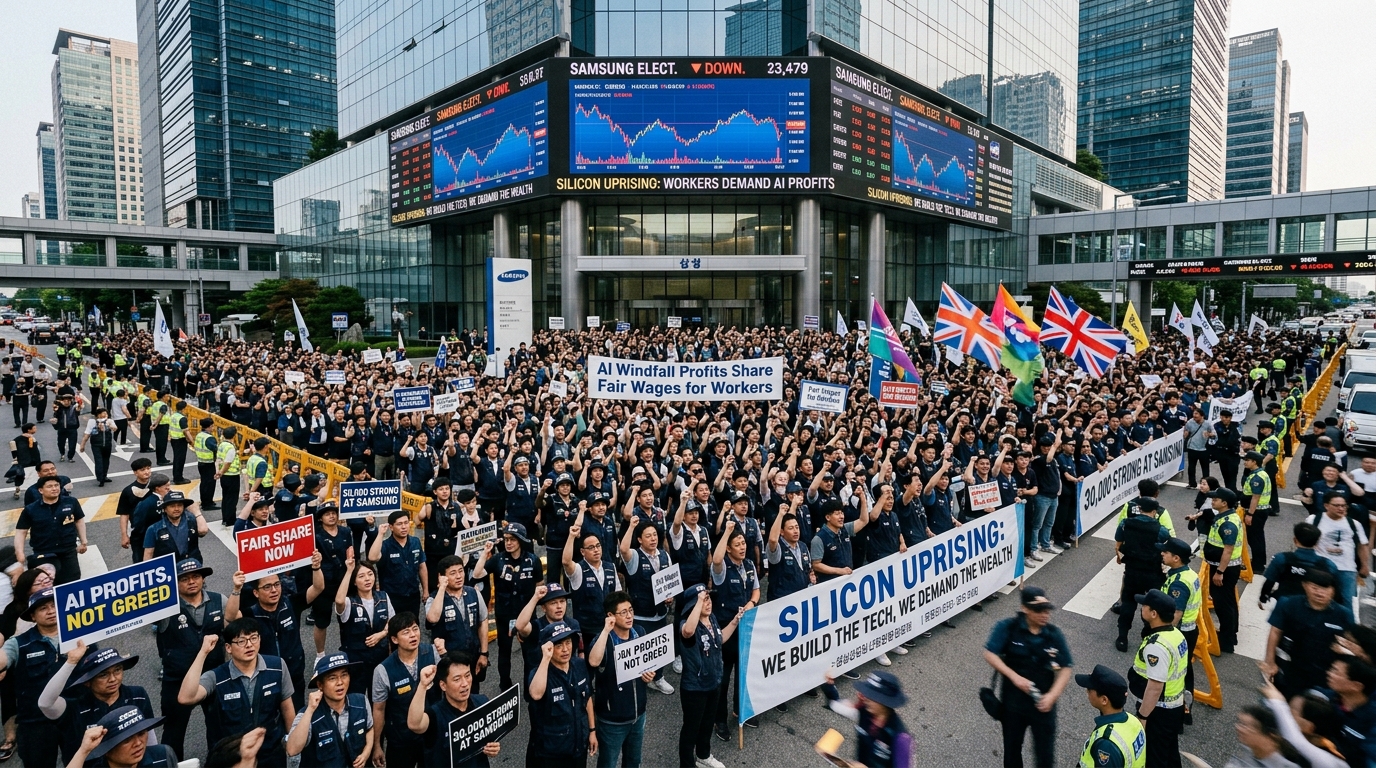
On April 23, 2026, the streets surrounding Samsung Electronics Co.’s massive semiconductor production complex in Giheung, South Korea, were transformed into a sea of banners and chants. Approximately 30,000 workers and supporters gathered in one of the largest labor mobilizations in the company’s history, issuing a clear and resounding demand: a fair share of the astronomical profits reaped from the Artificial Intelligence (AI) boom.
This rally is not merely a local labor dispute; it represents the first major crack in the narrative of the AI "golden age," where capital markets lionize tech corporations while the foundation of the production chain feels marginalized. As Samsung announces record-breaking profits from sales of High Bandwidth Memory (HBM) and advanced processors, the workers who make this technology possible are demanding they not be treated as disposable components of a wealth-generating machine.
The Silicon Gold Rush and the Profit Gap
The rise of generative AI has catapulted demand for specialized semiconductors to levels unforeseen just three years ago. Samsung, as a dominant player in the global memory and foundry markets, has found itself at the eye of this storm. However, the company’s financial success appears to have bred intense internal resentment. According to union representatives, while executive bonuses have soared to stratospheric levels, wage increases for shop-floor workers and engineers have failed to keep pace with inflation or the company’s profitability.
“We are not asking for charity; we are asking for our fair share of the value we create,” stated one of the rally organizers. The criticism focuses on the fact that AI chip production requires extreme precision, increased working hours, and continuous retraining—factors that, according to protesters, are not being adequately compensated. Samsung Electronics, which for decades operated without strong union representation, now faces an organized force it can no longer ignore.
Geopolitical Implications and the Global Supply Chain
This mobilization occurs at a critical juncture on the international geopolitical stage. South Korea is the cornerstone of global semiconductor supply chain security. Any prolonged strike or instability at Samsung could trigger a domino effect of delays in AI server production for giants like Microsoft, Google, and Meta. Analysts warn that if Samsung management does not reach an agreement soon, global memory chip prices could see a sharp spike.
Furthermore, Samsung is under intense pressure from domestic competition, primarily from SK Hynix, which managed to take an early lead in the HBM3E chip market. An internal labor relations crisis is the last thing the company needs as it strives to reclaim its technological supremacy. The South Korean government is monitoring the situation closely, as the semiconductor sector represents a massive percentage of national exports.
The Human Cost of Artificial Intelligence
Beyond the numbers and economic figures, the protest highlights a deeper philosophical and social conflict. As society pivots toward automation, there is a risk of undervaluing the human labor required to build AI infrastructure. Samsung workers point out that "smart" machines are not built out of thin air; they require thousands of hours of labor in clean rooms under high-pressure conditions.
The company’s rhetoric regarding “innovation” and the “future” clashes with the reality of workers struggling with the cost of living in Seoul. The demand for “AI Profit Transparency” is a new slogan likely to resonate across other tech giants. If Samsung yields to these demands, it will set a global precedent for how tech companies must share the benefits of automation with their human workforce.
Conclusion: A Warning for the Future
The gathering of 30,000 people outside Giheung is a warning shot for the entire Silicon Valley industry and beyond. The AI era promises unimaginable wealth, but the distribution of that wealth will be the defining political and economic issue of the next decade. Samsung is now called to choose: will it remain an inflexible corporate titan, or will it become the model for a new, inclusive tech economy?