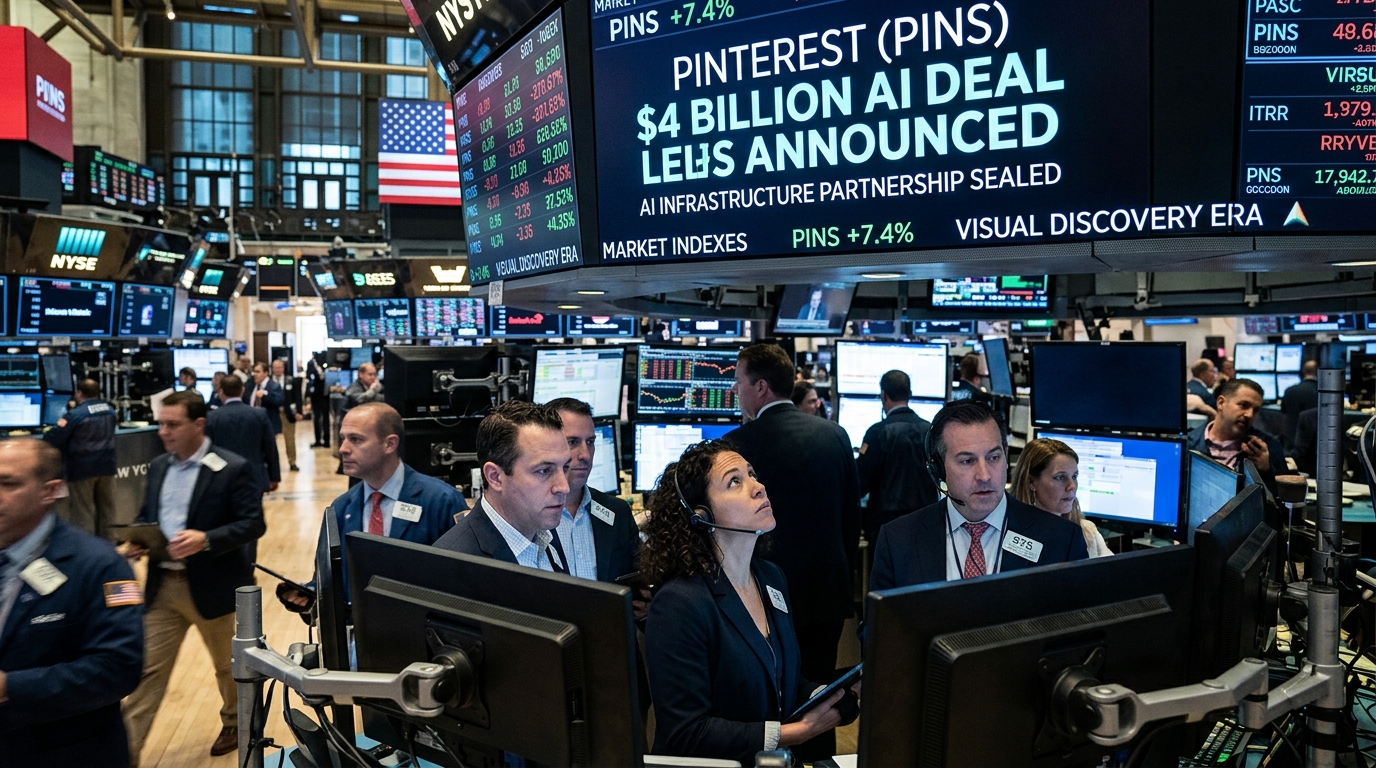
In a move that underscores the staggering entry price for the AI elite, Pinterest has announced a monumental $4 billion spending commitment for cloud infrastructure and AI technologies. The multi-year agreement marks the company's definitive pivot from a digital scrapbooking site to a technological powerhouse built on advanced computer vision and machine learning.
The Strategy of 'Curated' Artificial Intelligence
For Pinterest, AI is not a novel feature but the very marrow of its operations. Unlike Facebook or X (formerly Twitter), where content is often text-based or ephemeral video, Pinterest manages a vast ocean of visual data. The platform's ability to 'understand' the contents of a photograph—from the specific aesthetic of a mid-century modern chair to the exact shade of a lipstick—requires immense computational power.
The new $4 billion investment aims to supercharge recommendation engines that can now predict user desires before they are even articulated. By leveraging Generative AI, Pinterest intends to build tools that allow users to visualize products within their own personal spaces, thereby cementing its lead in the social commerce sector.
The High Cost of Compute
This deal highlights a broader trend in the tech industry: the 'infrastructure tax.' As companies rush to integrate AI, cloud providers (such as Google and Amazon) are becoming the ultimate kingmakers. Pinterest, while possessing proprietary algorithms, relies on the GPUs and processing units of these cloud giants to train and deploy its increasingly complex models.
- Real-time visual search enhancement across billions of images.
- Optimization of ad revenue through hyper-accurate intent targeting.
- Development of Generative AI tools for content creators and brands.
- Global expansion of integrated e-commerce capabilities.
Market analysts suggest that the $4 billion figure is a necessary ante to stay competitive against the likes of TikTok and Instagram. The battle for user attention has migrated from the creative layer to the infrastructure layer. Whoever possesses the fastest, most intelligent processing engine will ultimately secure the lion's share of global advertising spend.
Economic Implications and the Road Ahead
The market has reacted favorably to Pinterest’s commitment, viewing it as a strategic future-proofing of the business. However, the central challenge remains: how to translate this massive Capital Expenditure (CapEx) into sustained profitability. Pinterest is betting that AI will bridge the gap between 'inspiration' and 'purchase,' turning every pin into a potential transaction.
"We are not just building a search engine; we are building an engine for realization," a company executive noted during a recent earnings call.
In an environment where data is the new oil, Pinterest holds one of the cleanest and most commercially intent-rich datasets in the world. Its ability to parse consumer intent through the lens of AI makes it a unique and formidable player in the Silicon Valley ecosystem.