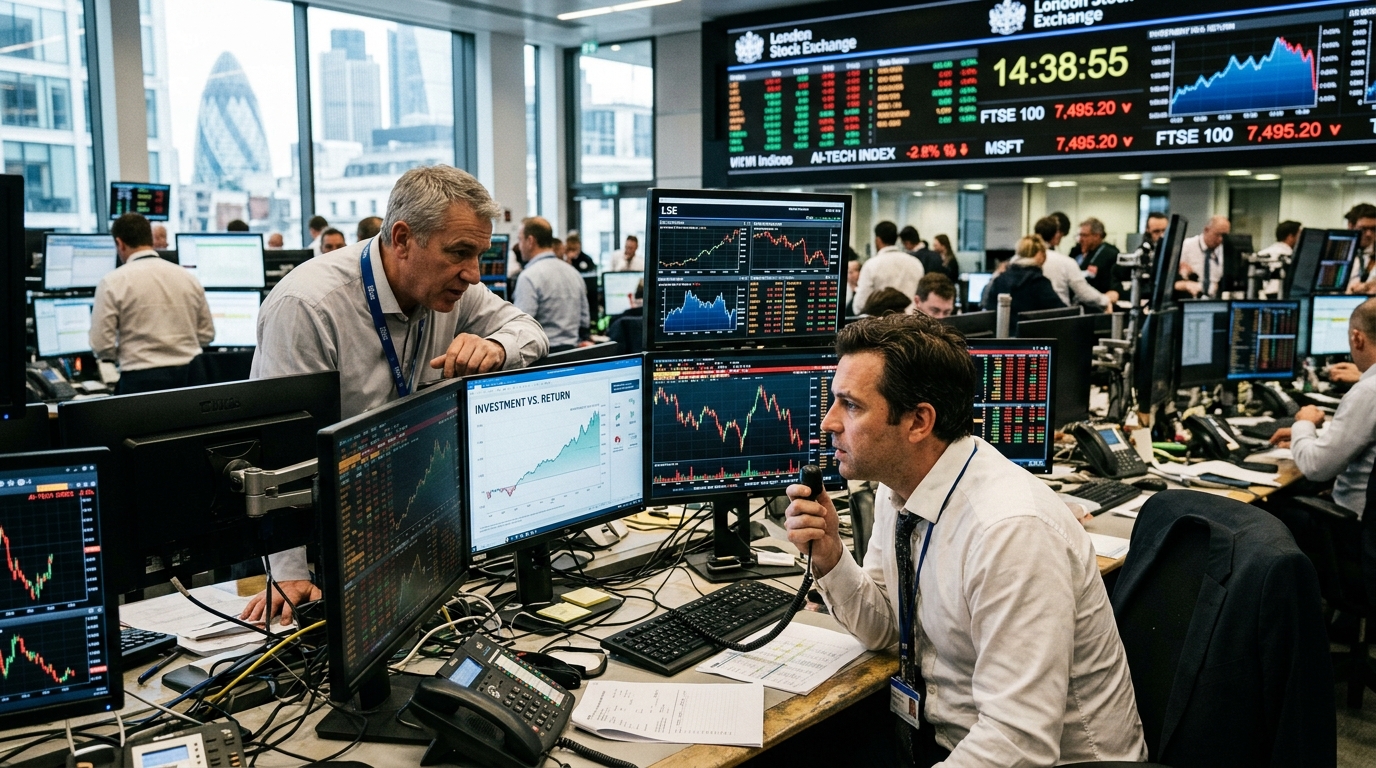
The quest for the next 'golden opportunity' in the stock market is a narrative as old as the exchanges themselves. However, the arrival of Generative AI has fundamentally altered the rules of engagement, creating a structural shift that many analysts liken to the discovery of electricity or the birth of the internet. The prevailing question among retail investors is whether a systematic investment—such as $500 per month—can truly lead to the coveted million-dollar milestone by riding the wave of a single AI powerhouse.
The Semiconductor Hegemon: The Case for Nvidia
When discussing AI and market capitalization, one name inevitably towers above the rest: Nvidia. The company, which began by designing graphics cards for gamers, has morphed into the undisputed 'arms dealer' of the digital future. Its processors (GPUs), such as the H100 and the forthcoming Blackwell architecture, form the backbone of the massive data centers required to train and deploy models like GPT-4.
Nvidia does not merely sell hardware; it sells an entire ecosystem. Through its CUDA platform, it has successfully 'locked in' developers, making it prohibitively expensive and complex to migrate to competing solutions. This 'economic moat' allows the company to maintain profit margins more characteristic of high-margin software firms than traditional hardware manufacturers. For an investor starting with $500 a month, Nvidia represents the ultimate bet on the foundational infrastructure of the AI era.
The Mathematics of a Million: Compounding in Action
To reach $1 million with a $500 monthly contribution, time and the rate of return are the two most critical variables. Assuming a standard 10% annual return—the historical average of the S&P 500—it would take approximately 30 years to reach the goal. However, the allure of AI investing is predicated on the belief that specific stocks can deliver Compound Annual Growth Rates (CAGR) of 15% to 20% over the next decade.
In a scenario where an AI leader like Nvidia, or a concentrated basket of AI blue chips, returns 20% annually, the million-dollar threshold could be crossed in just under 18 years. But is it realistic to expect such outsized gains over a prolonged period? History suggests that periods of explosive growth are often followed by consolidation or sharp corrections. The discipline of Dollar Cost Averaging (DCA) helps mitigate timing risks, but it does not eliminate systemic market risk.
Beyond Hardware: Software as the Next Growth Engine
While Nvidia dominates the current landscape, forward-looking analysts are shifting their focus to the companies that will leverage AI to create new revenue streams. Giants like Microsoft, Alphabet, and Amazon are integrating AI into their cloud services and productivity suites. Their ability to implement subscription models for AI assistants (like Copilot) creates a recurring revenue stream that is highly attractive to long-term shareholders.
"Artificial Intelligence is not just a sub-sector of technology; it is the new operating system of the global economy," Wall Street analysts suggest.
This implies that the stock that ultimately makes the difference in a portfolio might not be the one making the chips, but the one that successfully democratizes AI for everyday business and consumer use. The risk here is saturation and intense competition, as the cost of training models decreases, allowing leaner startups to challenge established incumbents.
Risks and Geopolitical Volatility
Any investment plan promising millions must be scrutinized through the lens of risk. For AI companies, the most significant threat is geopolitical. The heavy reliance on TSMC’s fabrication plants in Taiwan represents an 'Achilles' heel' for the entire industry. Any escalation of tension in the region could sever supply chains and lead to a precipitous drop in valuations.
Furthermore, there is the matter of expectations. Current AI stock prices already bake in scenarios of massive future growth. If corporate earnings fail to meet these lofty projections, the market correction could be severe. However, for the disciplined investor contributing $500 monthly, market downturns often serve as opportunities to accumulate more shares at lower prices, further fueling the power of compounding over the long haul.