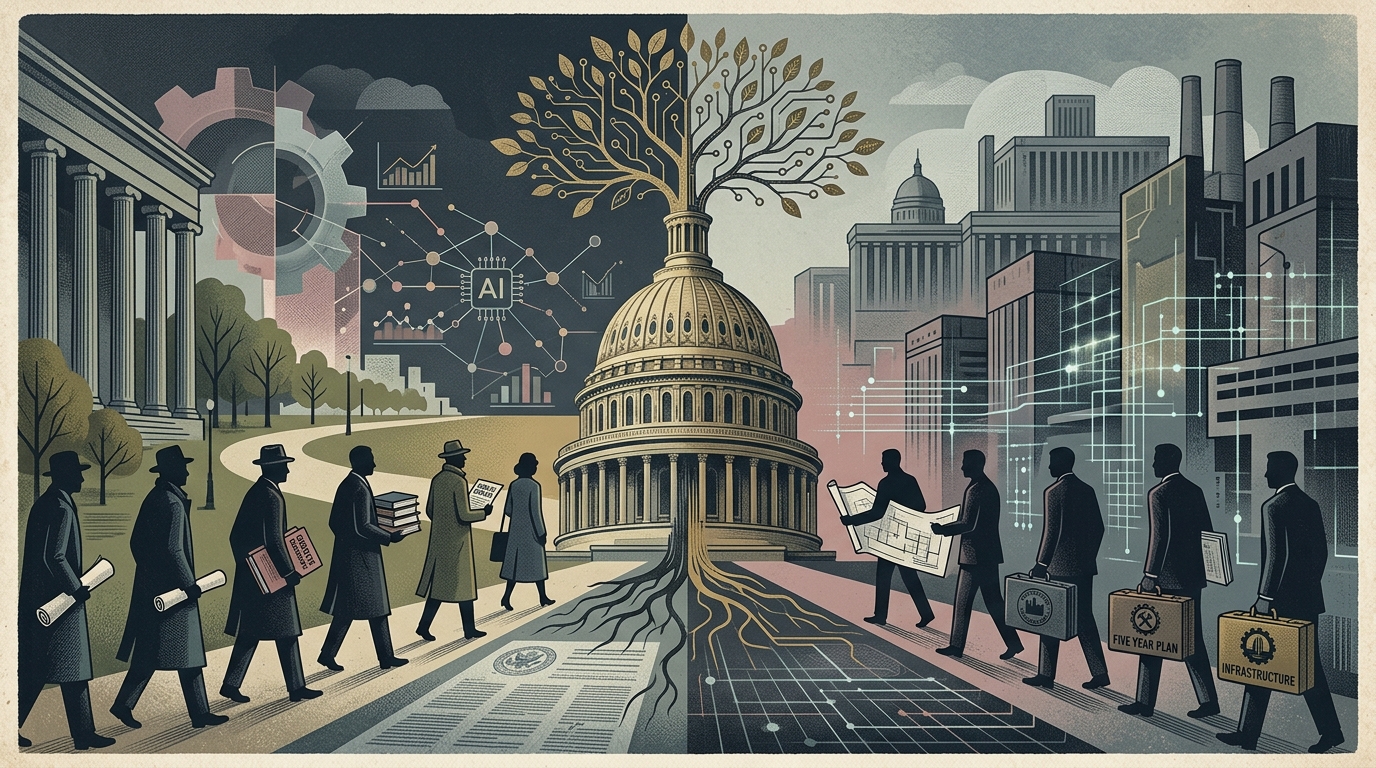
For decades, the prevailing narrative in the business world was the inevitable decline of the 'dinosaurs.' Large multinationals, burdened by heavy structures, bureaucratic bottlenecks, and legacy technology systems from previous decades, were seen as easy prey for nimble Silicon Valley startups. However, as we stand in May 2026, the landscape has shifted radically. Generative Artificial Intelligence has not acted as the meteor that would wipe them out, but rather as a digital fountain of youth.
The Revenge of Proprietary Data
The greatest advantage of traditional companies, which often remained untapped, is the vast volume of historical data they possess. While a startup begins from scratch, an industrial giant or a bank with a 50-year history holds treasures of information. AI now allows these organizations to 'interrogate' their data, identify patterns spanning decades, and automate processes that previously required armies of employees.
In Greece and across Europe, we are seeing traditional groups in energy and banking adopting AI not just to improve customer service, but to redesign supply chains and predict failures in critical infrastructure. The ability of Large Language Models (LLMs) to understand and synthesize corporate knowledge means that 'institutional memory' is no longer lost when executives retire; it is codified and upgraded.
From COBOL to AI: Modernizing the Backbone
One of the biggest weights on 'dinosaur' companies was technical debt. Systems written in obsolete programming languages, such as COBOL, kept companies hostage to the past. AI today functions as a super-translator. AI tools can analyze millions of lines of old code, document it, and convert it into modern cloud architectures in a fraction of the time.
This modernization process, which once required billions of euros and decades of work, is now accelerating dramatically. This allows legacy players to offer digital services that compete head-to-head with neobanks and digital-first enterprises. The 'revenge' of traditional players is based on the fact that they now possess both the credibility of the past and the speed of the future.
The Cultural Challenge: Teaching Old Dogs New Tricks
Of course, technology alone is not enough. The biggest challenge for dinosaur companies remains culture. Hierarchical structures and a fear of failure are often deeply rooted. However, competitive pressure and the ease of use of new AI tools are creating a 'democratization' of innovation within the organization itself. When a production-line employee can use an AI agent to optimize their workflow without needing approval from five levels of management, the company starts moving faster.
"AI is not just a productivity tool for large corporations; it is the mechanism that allows them to shed the weight of their bureaucracy without losing their scale," market analysts note.
The Global Context and the Road Ahead
In the global market, this transition is particularly critical. Large domestic enterprises, which form the backbone of many economies, are in a phase of 'express' digital transformation. The use of AI in risk analysis, retail offer personalization, and energy load management is no longer a science fiction scenario but a daily practice. Companies that manage to integrate AI into their core will be those that dominate the next decade, proving that scale can be combined with agility.
In conclusion, the era of the extinction of major players is postponed indefinitely. The 'dinosaurs' that survived didn't just get faster; they got smarter. And in a world moving at the speed of algorithms, intelligence is the only trait that guarantees the survival of the species. The giants are awake, and they are powered by silicon.