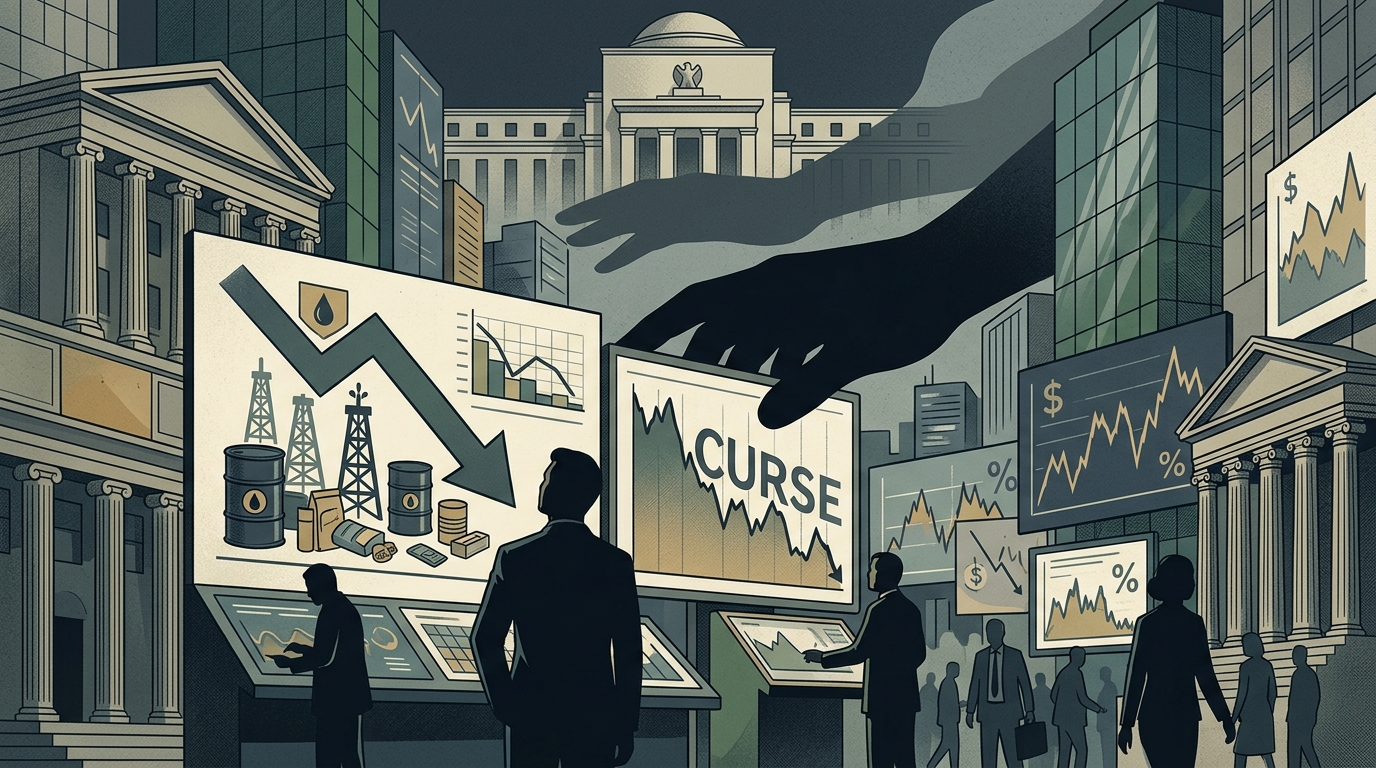
The history of the Federal Reserve is riddled with ironies, but none is as persistent as the "curse" that seems to accompany every new chair of the U.S. central bank. As Kevin Warsh was sworn in last Friday as Jerome Powell's successor, the oil market began sending warning signals. This isn't just a random price fluctuation; it's the revival of a structural problem that Washington and Wall Street have tried to ignore for years: the complete impotence of monetary policy against an energy supply shock.
The Historical Legacy of the "Curse"
From Paul Volcker and Alan Greenspan to Ben Bernanke, almost every new Fed chief has faced a sharp rise in energy prices during the first months of their tenure. Volcker dealt with the second oil shock of 1979, Greenspan with the invasion of Kuwait in 1990, and Bernanke with the frantic climb to $147 per barrel in 2008. Warsh, a man considered a monetary policy "hawk," takes over at a time when oil is not just a commodity, but a geopolitical weapon.
The real shock, however, which many analysts choose to ignore, is not the current price at the pump. It is the structural underinvestment in fossil fuels that has taken place over the last decade in the name of the green transition, without the necessary infrastructure being built to replace the lost energy. This creates a "supply gap" that no amount of interest rate hikes can bridge.
Warsh's Dilemma and the Risk of Stagflation
Kevin Warsh enters the Eccles Building with a clear mandate: to maintain price stability. But what happens when inflation is driven not by excessive consumer demand, but by energy costs that permeate every aspect of the supply chain? If the Fed raises rates to fight oil-fueled inflation, it risks triggering a deep recession without necessarily lowering energy prices. If it does nothing, inflation will erode household purchasing power.
- Dependence on OPEC+ remains at levels reminiscent of the 1970s.
- U.S. shale production has hit a plateau, with companies favoring dividends over new drilling.
- Geopolitical instability in the Middle East adds a "risk premium" that is not controlled by interest rates.
The real shock being ignored is the "rigidity" of supply. In the past, high prices led to an immediate increase in production. Today, environmental constraints and investor pressure for profitability over growth have changed the rules of the game. Warsh will have to navigate a minefield where traditional Fed economic models may prove obsolete.
The Geopolitical Dimension and the "Green" Trap
While the Fed focuses on macroeconomic data, the real battle is being fought in international relations. The strategic alliance between Russia and Saudi Arabia within OPEC+ has created a cartel that effectively controls global energy costs. For the new Fed chair, this means that U.S. monetary policy is, to some extent, a hostage to decisions made in Riyadh and Moscow.
"Oil is no longer an economic variable, but a statement of power. The Fed can control the price of money, but not the price of movement," says a senior market analyst.
Furthermore, the rushed transition to renewable energy sources, while necessary in the long run, has created a period of instability. The lack of investment in refineries and transport infrastructure means that even if the price of crude falls, the cost of final products (gasoline, diesel) may remain high. This is the "hidden shock" that the Fed will face in 2026.
Conclusion: A Tenure on a Tightrope
Kevin Warsh does not have the luxury of time. The market will test him immediately. His success will be judged not only by whether he manages to bring inflation to 2%, but by whether he can convince markets that the Fed understands the new realities of the global energy chessboard. The "curse" of oil is here, and this time, traditional solutions may not be enough. The era of cheap money and abundant energy is in the past, and Warsh is the man called to manage the painful transition to a new economic normalcy.