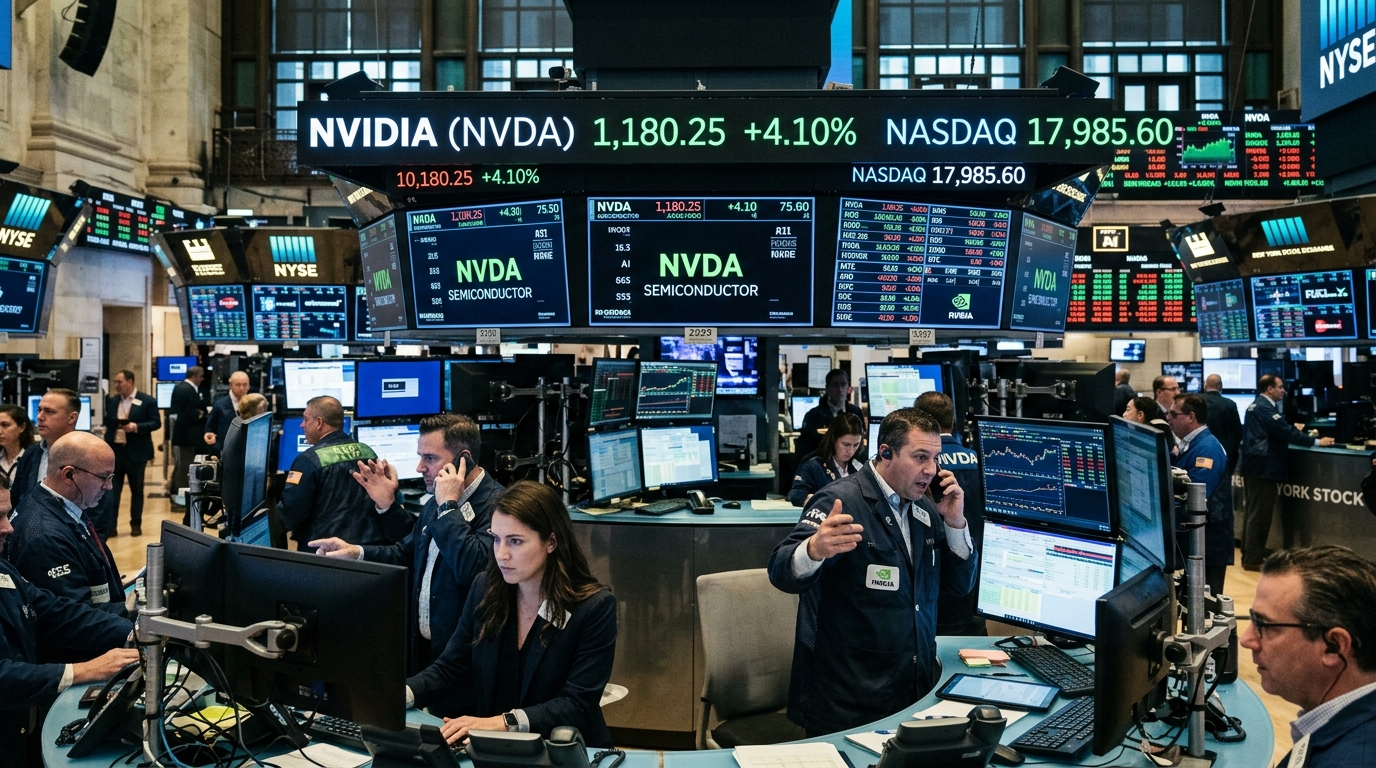
At the heart of the digital revolution we are currently experiencing, one company has managed to transform itself from a manufacturer of gaming graphics cards into the ultimate arbiter of the global technological chessboard. Nvidia, under the leadership of Jensen Huang, is not just predicting the future; it is manufacturing it. Recent estimates suggesting the artificial intelligence (AI) market could reach $200 billion are not merely a figure on a balance sheet, but a declaration of dominance that is rearranging the geopolitical and economic balances of the 21st century.
The Shift to Accelerated Computing
For decades, the world of computing relied on Moore's Law and central processing units (CPUs). However, the advent of Generative AI revealed the limits of this approach. Nvidia recognized early on that the future belongs to accelerated computing. The company's graphics processing units (GPUs), once used for realistic lighting in video games, proved to be the ideal tools for the parallel processing of massive amounts of data required by Large Language Models (LLMs).
The $200 billion forecast reflects a fundamental shift in the capital expenditures of tech giants. Companies like Microsoft, Google, and Meta are no longer just buying "components"; they are investing in infrastructure that will form the foundation of tomorrow's economy. Every H100 or the newer Blackwell chip is not just silicon, but a ticket to the next phase of human productivity.
The CUDA Ecosystem as an Impenetrable Moat
What many analysts overlook is that Nvidia's strength lies not only in hardware but in software. The CUDA ecosystem, the programming platform developed by the company nearly two decades ago, has created a "moat" around its products. Millions of developers worldwide have been trained and work on this framework, making it extremely difficult and costly to switch to competing solutions from AMD or Intel.
Nvidia has managed to create a virtuous cycle of success: the more CUDA is used, the more the software improves, and the more indispensable Nvidia hardware becomes. This vendor lock-in is what gives the company the profit margins that every other industry sector envies, allowing it to steer the market toward the $200 billion milestone.
Geopolitics and "Silicon Diplomacy"
However, the road to $200 billion is not without obstacles. Nvidia is at the center of the technological cold war between the US and China. Export restrictions on advanced chips imposed by Washington have forced the company to redesign products specifically for the Chinese market, with lower performance, in order to comply with legislation without losing a critical revenue source.
Furthermore, the reliance on TSMC in Taiwan for chip manufacturing represents a systemic risk. Any instability in the Taiwan Strait could freeze global AI production overnight. Nvidia, therefore, is not just managing technology, but also an extremely sensitive geopolitical balance, where dominance in the field of artificial intelligence is equivalent to national power.
The Sustainability Challenge and the Road Ahead
As we approach these staggering revenue numbers, the question arises: is this growth sustainable? The energy consumption of data centers housing Nvidia GPUs is immense, raising concerns about the environmental footprint of AI. The company responds with promises of greater energy efficiency in each new generation of chips, but the overall demand for power continues to grow exponentially.
The $200 billion bet is ultimately a bet on the very nature of work and creation. If artificial intelligence manages to deliver the promised value in fields such as medicine, energy, and materials science, then Nvidia's valuation may seem even conservative in the future. But if the AI bubble bursts before the technology finds mass, profitable applications, the fall will be just as spectacular as the rise.