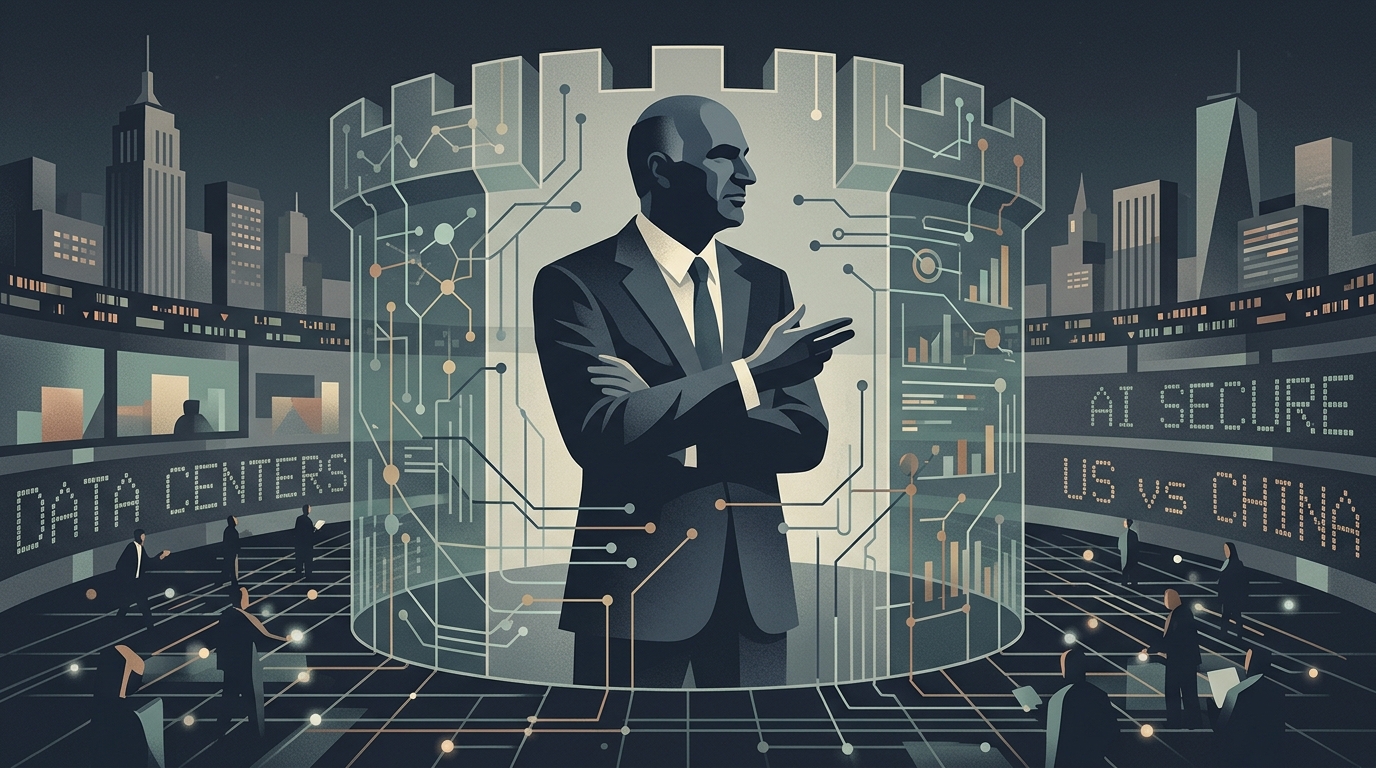
In an era where national power is no longer measured solely by gold reserves or the size of standing armies, but by computational capacity, Kevin O’Leary—the prominent investor and 'Shark Tank' personality—is taking a definitive and hardline stance. According to O’Leary, the battle for dominance in Artificial Intelligence (AI) is an existential struggle, and the United States risks falling behind if it does not radically reshape its infrastructure.
China as the 'Adversary' and the New Reality
O’Leary does not mince words when referring to China. He categorizes it as the primary 'adversary' of the US, emphasizing that Beijing’s progress in AI is not merely a commercial challenge but a direct threat to national security. His concern stems from the fact that AI requires massive amounts of data and, more importantly, the infrastructure to process it. Without a network of modern, energy-independent data centers, the US could lose the innovative edge that has defined it for the last century.
China’s strategy is centrally planned, with the state funneling billions into tech parks and supercomputers. In contrast, US development relies primarily on the private sector, which often hits bureaucratic hurdles, environmental restrictions, and an aging power grid. O’Leary argues that the government must facilitate these investments, viewing them as 'digital fortresses' that will protect the American economy.
The Energy Question: The Growth Bottleneck
One of the most critical points in O’Leary’s argument is the link between data centers and energy. AI is 'hungry' for electricity. Processors from Nvidia and other giants require amounts of power that current municipal infrastructures struggle to provide. The investor proposes building data centers that feature their own power sources, such as Small Modular Reactors (SMRs) or large-scale renewable energy installations.
- Autonomy from the main grid to avoid blackouts.
- Use of next-generation nuclear energy for steady supply.
- Strategic placement in states with favorable regulatory environments.
This approach is not just technical but financial. Building this infrastructure will require capital in the hundreds of billions of dollars, something O’Leary views as the greatest investment opportunity of the decade. However, he warns that if the US does not move quickly, this capital will flow to other regions, leaving America vulnerable.
The Political Dimension and National Sovereignty
O’Leary’s rhetoric aligns with a growing trend in Washington that views technology through the lens of geopolitical competition. The CHIPS Act was only the beginning. The next step is ensuring that the 'intelligence' generated by these chips remains on American soil and serves American interests. O’Leary emphasizes that depending on foreign supply chains or conceding leadership to China would signal the end of American hegemony.
"We cannot allow our adversary to control the brain of the future. AI is the brain, and data centers are the nervous system," he states pointedly.
In conclusion, Kevin O’Leary’s push for more data centers is not just a business pitch. It is a wake-up call for a nation that, despite birthing the digital revolution, now risks being defeated by its own inertia. The conflict with China will not be decided on battlefields, but in server rooms and the code lines of the next generation.