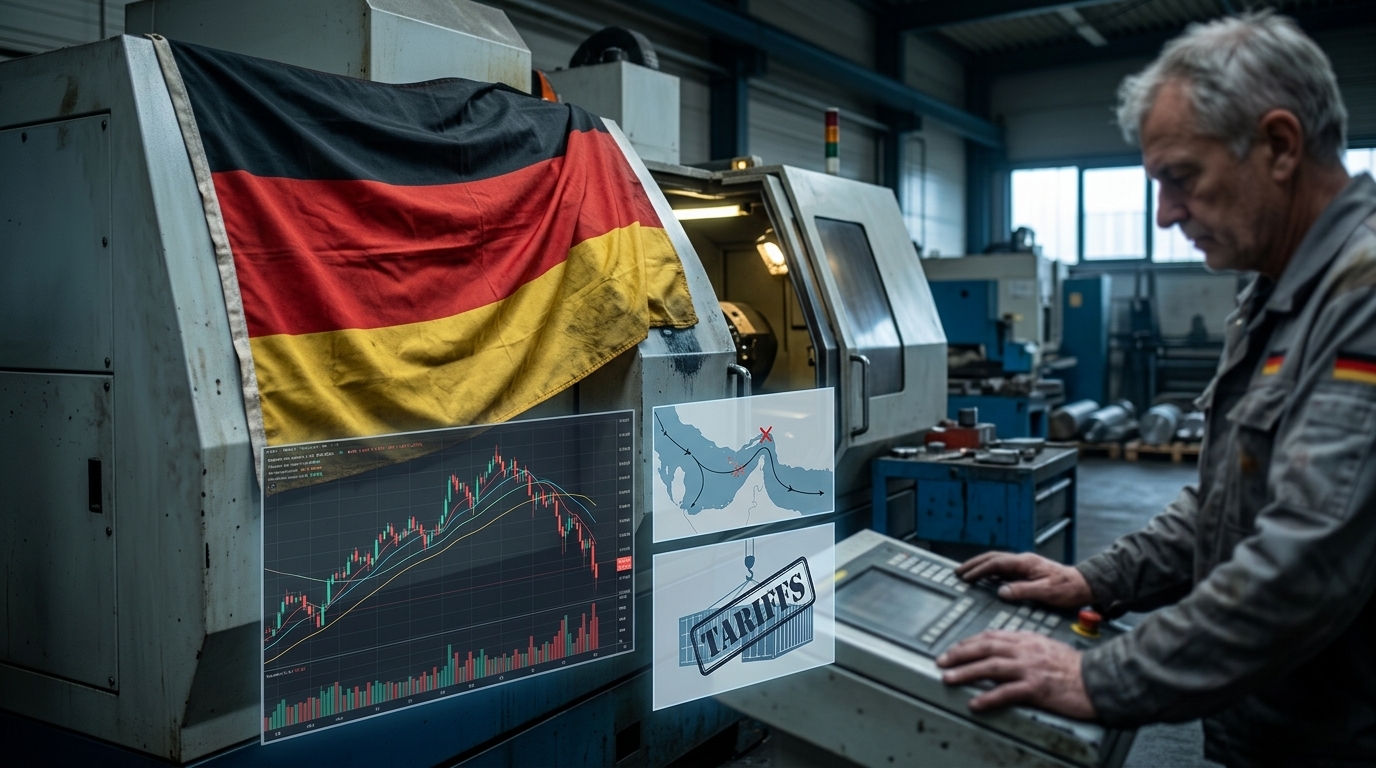
The image of Germany as the undisputed economic engine of Europe is fading dangerously fast. Recent manufacturing data and revised growth forecasts of a meager 0.5% for 2026 paint a picture of a prolonged crisis that is no longer merely cyclical, but structural. Berlin finds itself trapped between the pincers of a new American protectionism and the persistent threat to global supply chains, centered on the Strait of Hormuz.
Manufacturing in Freefall
German manufacturing, the backbone of the national economy, is recording one decline after another. The PMI index remains in contraction territory, reflecting reduced demand from both domestic and international markets. Traditional pillars, such as the automotive and chemical industries, are struggling with high energy costs—a legacy of the decoupling from cheap Russian gas—as well as intense competition from China.
The transition to electromobility has proven more painful than expected. German giants like Volkswagen and Mercedes-Benz are seeing their market shares threatened, while investments in new technologies are delayed due to bureaucracy and a shortage of skilled labor. 'Deindustrialization' is no longer a fantasy scenario but a visible risk openly discussed in the boardrooms of DAX companies.
The US Factor and Tariffs
The election of a more protectionist administration in the US has brought the threat of horizontal tariffs on European products to the forefront. For an export-oriented economy like Germany's, this represents an existential threat. The United States remains Germany's most important trading partner outside the EU, and any burden on the cost of German machinery or cars could lead to a further contraction in production.
Uncertainty surrounding Washington's trade policy is 'freezing' investment decisions. German companies prefer to take a wait-and-see approach, which exacerbates the stagnation. Pressure for 'de-risking' from China, urgently demanded by the US, further complicates the situation, as China is both a critical supplier of raw materials and a massive market for German products.
Geopolitical Instability: The Hormuz Thorn
Beyond the trade war, geopolitical instability in the Middle East, and specifically in the Strait of Hormuz, creates an explosive mix. Hormuz is the most important passage for global oil and liquefied natural gas (LNG) trade. Any disruption there translates directly into an increase in energy prices, dealing a heavy blow to energy-intensive German industry.
Analysts warn that a prolonged closure or a serious crisis in the strait could send the German economy into a deep recession. The dependence on LNG, which replaced Russian gas, makes Germany extremely vulnerable to fluctuations in maritime transport. Supply chain security is now inextricably linked to national security, and Berlin seems to lack ready answers.
Internal Challenges and the Future
On the domestic front, the coalition government is under constant pressure. The debate over the 'debt brake' (Schuldenbremse) divides politicians, with many calling for a relaxation of fiscal rules to fund critical infrastructure and the green transition. However, fiscal discipline remains a sacred cow for a segment of the political system.
In conclusion, Germany is called upon to redefine its economic model in a world that is becoming increasingly hostile to globalization. The 0.5% growth is a warning signal that cannot be ignored. Without bold reforms, investment in innovation, and a more flexible foreign policy, the country risks turning from a leader into a laggard of the European economy, with unpredictable consequences for the entire Eurozone.