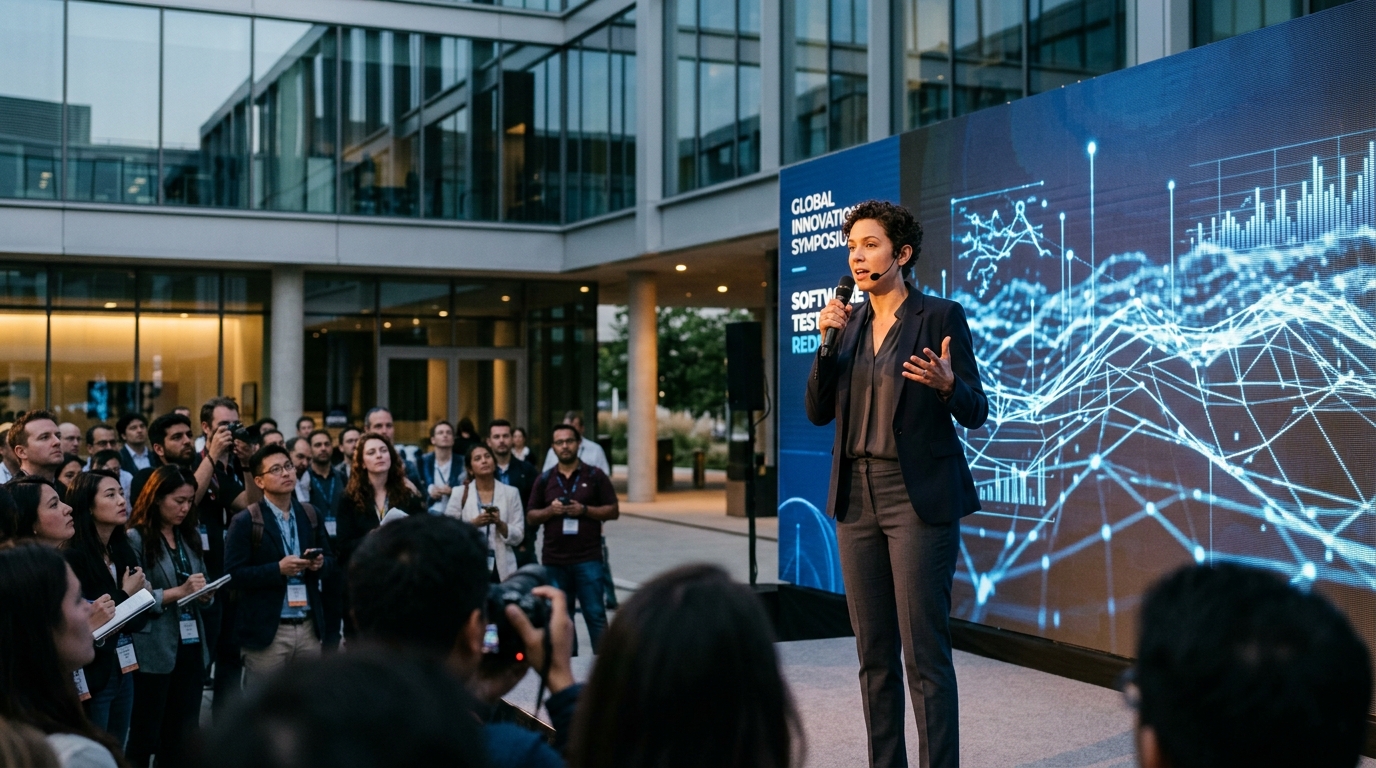
In the ever-evolving landscape of global technology, Quality Assurance (QA) has transcended its role as a mere bug-hunting exercise to become the critical pillar of digital resilience. According to recent market intelligence, the Artificial Intelligence (AI) in software testing market is on the precipice of an unprecedented boom. Industry titans such as Cognizant, Infosys, Capgemini, and Tata Consultancy Services (TCS) are fundamentally restructuring their service offerings, betting billions on autonomous systems that promise to make human error a relic of the past.
The Strategic Pivot of IT Service Giants
The surge in AI-driven testing is not an isolated trend but a structural necessity. As global enterprises migrate toward Continuous Delivery and DevOps models, the traditional bottleneck of manual testing has become unsustainable. Major IT service providers realized early on that their relevance in a cloud-native world depends on their ability to automate complexity. Cognizant and Infosys, for instance, have aggressively integrated Generative AI platforms capable of synthesizing complex test scripts in seconds—a task that previously consumed days of high-level engineering labor.
This strategic shift is about more than just velocity; it is about cognitive scale. The sheer volume of code being generated by AI-assisted developers requires an equally intelligent counterpart to verify it. TCS, through its proprietary AI suites, is focusing on 'predictive software maintenance,' utilizing machine learning algorithms to analyze historical failure patterns and preemptively secure code before it reaches production.
From Automation to Autonomy: The 'Self-Healing' Revolution
Perhaps the most transformative development within this market is the maturation of 'self-healing' test automation. Historically, automated test suites were notoriously brittle; a minor change in an application's user interface (UI) would cause scripts to fail, necessitating manual intervention and maintenance. Today, AI-native testing tools utilize computer vision and heuristic analysis to adapt to changes in real-time.
- Dynamic Adaptation: AI models can recognize when a UI element has moved or changed its properties, automatically updating the test logic without human input.
- Synthetic Data Generation: Generative AI creates hyper-realistic test datasets that mimic production environments while maintaining strict data privacy compliance.
- Visual Regression at Scale: Sophisticated vision models compare screen states with pixel-perfect accuracy, identifying aesthetic glitches that would escape the human eye.
Capgemini has been a vocal proponent of this 'Quality Engineering' vision, where quality is not a final check but an intrinsic property of the entire development lifecycle. This 'Shift-Left' methodology, powered by AI, allows organizations to reduce the cost of defect remediation by up to 40%, a value proposition that is driving massive enterprise adoption.
Market Dynamics and the Labor Paradox
While shareholders of these tech giants anticipate expanded margins and recurring revenue streams, the labor market faces a profound transformation. The demand for entry-level manual testers is cratering, replaced by an insatiable need for 'AI Quality Engineers'—professionals capable of orchestrating and auditing the AI models themselves.
"AI will not replace testers, but testers who use AI will inevitably replace those who do not," is the prevailing sentiment among industry leaders.
There is also a significant geopolitical dimension to this boom. India, the global epicenter of IT services, is at the heart of this transition. Firms like Infosys and Wipro are embarked on massive upskilling initiatives, retraining hundreds of thousands of employees in AI competencies to ward off competition from lean, AI-first startups that threaten to disrupt the traditional labor-arbitrage model.
Challenges and the Future of Digital Trust
Despite the bullish projections, significant hurdles remain. The primary concern is the 'black box' nature of AI decision-making. When an AI system validates a mission-critical application—such as a medical device or an autonomous vehicle system—engineers must be able to explain the rationale behind that validation. The lack of explainability in deep learning models poses a risk that many regulated industries are hesitant to accept.
Furthermore, the integrity of AI testing is only as good as the data it consumes. Biased or incomplete training data can lead to systemic blind spots in software quality. The future of the AI testing market, therefore, is not just a race for speed, but a quest for transparency. As we move toward 2030, the ability of a corporation to guarantee the ethical and technical integrity of its AI systems will become its most valuable asset.