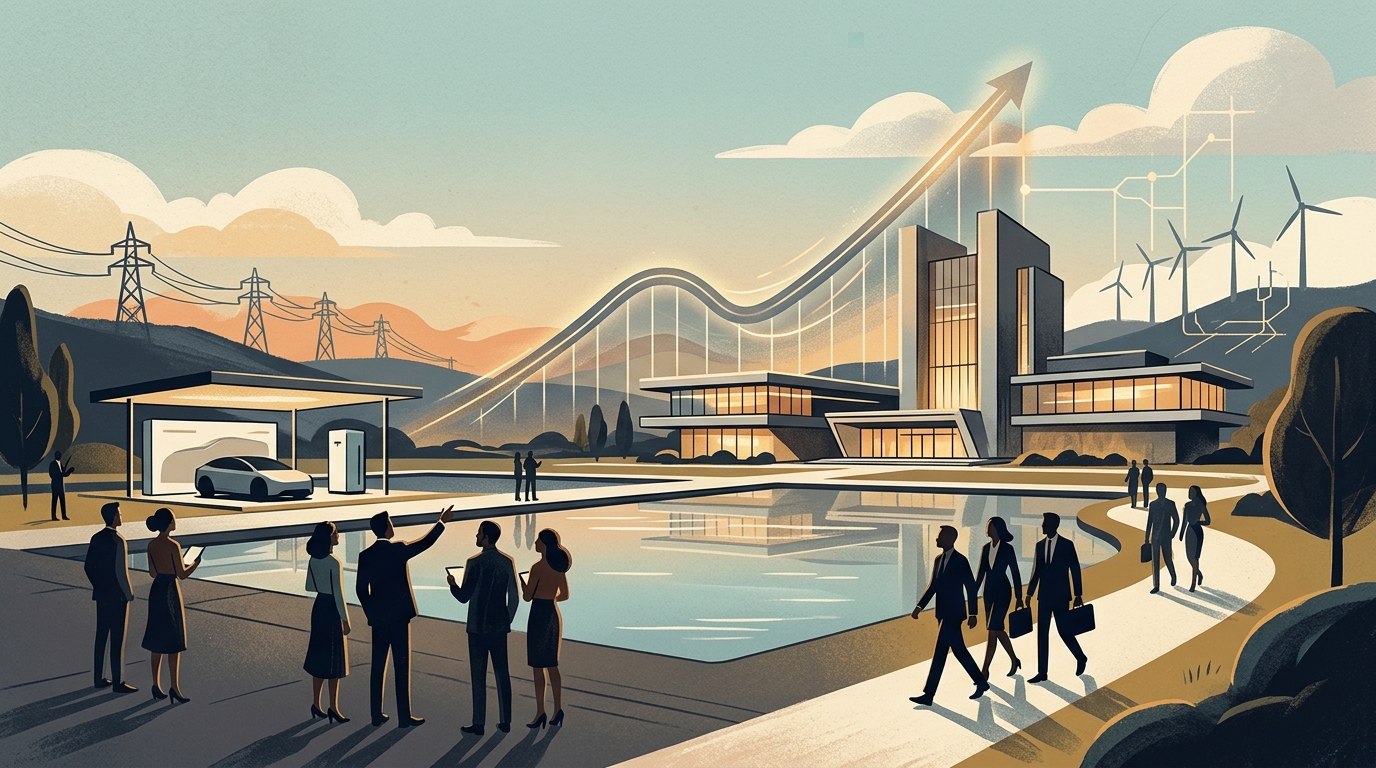
Elon Musk’s Tesla appears to be reclaiming its former glory. After a period of intense scrutiny and shrinking margins driven by a ruthless price war in the global electric vehicle (EV) market, the Q1 2026 financial results serve as a definitive rebuttal to the skeptics. The 17% year-over-year increase in net profit is more than just a number; it is evidence of a strategic pivot from a traditional automaker to an Artificial Intelligence and energy powerhouse.
The Anatomy of Profitability: Beyond Car Sales
A deep dive into the financial data reveals that Tesla is no longer solely reliant on the high-volume sales of the Model 3 or Model Y. While vehicle deliveries stabilized, profitability was significantly bolstered by two main pillars: Full Self-Driving (FSD) software and the Tesla Energy division. The rollout of FSD version 14, which utilizes a unified end-to-end neural network architecture, saw subscription rates soar, providing the company with high-margin recurring revenue.
- Software services revenue grew by 24% year-over-year.
- Record-breaking installations of Megapack units globally.
- Significant reduction in per-unit manufacturing costs via the 'unboxed process'.
Wall Street analysts noted that Tesla managed to reduce manufacturing costs faster than anticipated, effectively offsetting the impact of lower average selling prices. The implementation of new aluminum alloys and further automation at Giga Texas and Giga Berlin played a pivotal role in this operational efficiency.
The Autonomy Bet and the Robotaxi Vision
During the earnings call, Elon Musk was unequivocal: "If you don't believe Tesla will solve autonomy, you shouldn't be an investor." The market seems to be buying into that vision once again. The announcement regarding the acceleration of the 'Cybercab' program—a purpose-built autonomous vehicle without a steering wheel or pedals—acted as a catalyst for the stock's recovery. Tesla is no longer just selling mobility; it is selling the promise of an autonomous vehicle network that functions as an 'Airbnb on wheels'.
"Tesla is transforming into an AI infrastructure provider. The car is simply the hardware that runs the most advanced software in the world," stated a senior analyst at Morgan Stanley.
Challenges and the Eastern Competition
Despite the current euphoria, the road ahead is not without obstacles. Competition from China remains the most potent threat, with companies like BYD and Xiaomi introducing models with impressive specifications at aggressive price points. Tesla’s counter-move is the highly anticipated 'Model 2', a more affordable vehicle expected to enter production late this year. The company's ability to maintain its technological edge while expanding into mass-market segments will be the ultimate test of its longevity.
In conclusion, the first quarter of 2026 marks a new chapter for Tesla. The company has demonstrated its ability to generate robust profits even in a high-interest-rate environment and amidst geopolitical uncertainty. By leaning into innovation and vertical integration, Tesla has shown that it remains the undisputed leader of the energy transition. The stock's recovery is not merely a technical bounce; it is a recognition of Tesla's evolution into a diversified technology titan.