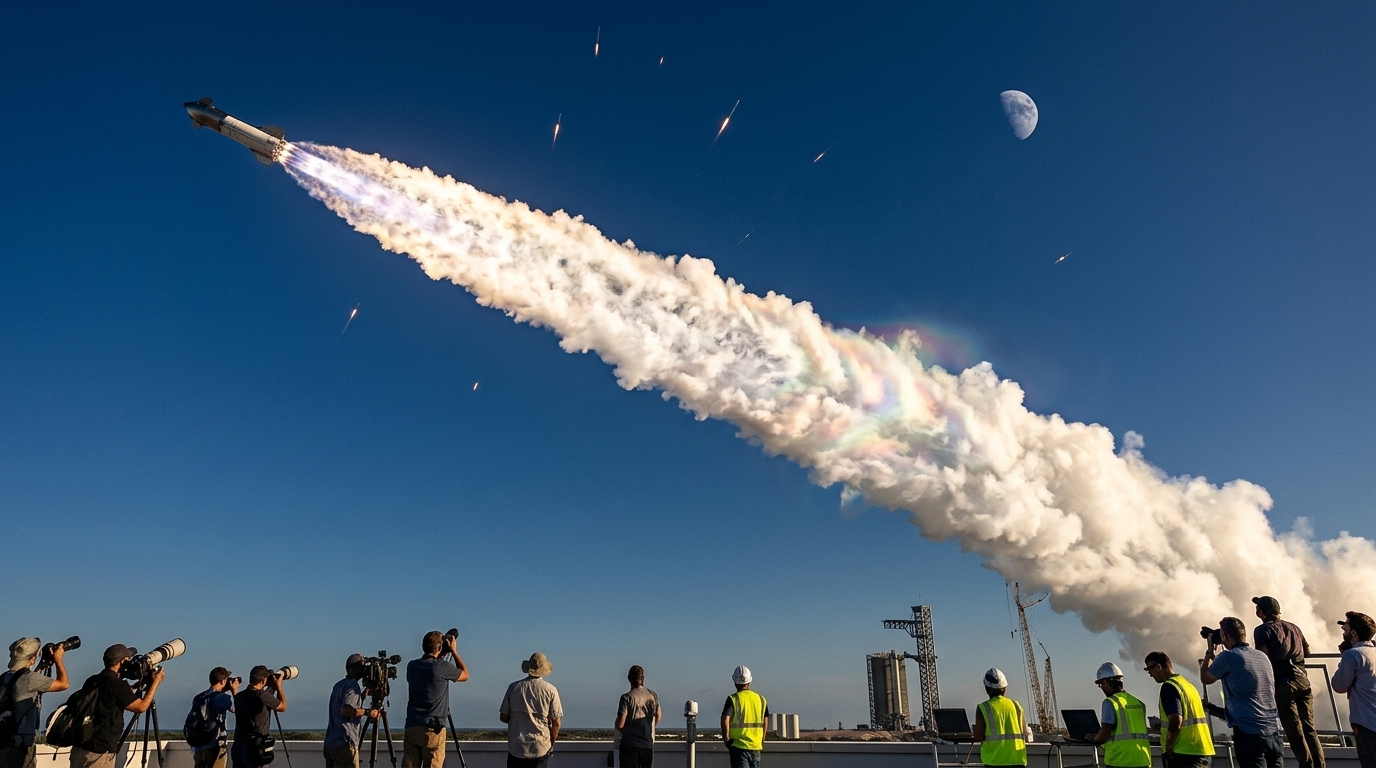
In South Texas, where the salt flats of Boca Chica meet the Gulf of Mexico, the history of humanity turned a new page on the morning of May 23, 2026. SpaceX successfully completed the launch and orbital test of Starship V3, the third and most advanced generation of the largest rocket system ever built. This success is not merely a technical milestone; it is the prelude to the long-awaited public market debut of Elon Musk’s company, in an Initial Public Offering (IPO) expected to reshape the global financial map.
The Technological Superiority of Starship V3
Starship V3 represents the pinnacle of SpaceX’s engineering ingenuity. Standing at a staggering 150 meters, the vehicle features upgraded Raptor 3 engines, providing a 20% increase in thrust compared to their predecessors, while their simplified design drastically reduces maintenance needs between flights. During today’s test, the system achieved full recovery of both the Super Heavy booster and the Starship spacecraft itself, utilizing the "Mechazilla" mechanical arms on the launch tower.
The V3’s capability to transport payloads exceeding 200 tons to Low Earth Orbit (LEO) brings the cost per kilogram to the lowest in history. This does not only serve the vision for Mars colonization but also sets the stage for explosive growth in the space economy, from asteroid mining to the creation of industrial units in microgravity conditions. The reliability demonstrated by the thermal protection system during atmospheric reentry confirms that SpaceX has now resolved the critical issues that plagued earlier versions of the craft.
The Economic Stakes: An IPO to Shake the Foundations
While engineers celebrated in Boca Chica, Wall Street analysts were already revising their estimates. The success of Starship V3 is seen as the "green light" for initiating SpaceX’s IPO proceedings, or at least the spin-off and listing of Starlink. With the company's valuation already touching $250 billion in secondary markets, a public offering could skyrocket its capitalization beyond $500 billion, making it one of the most valuable companies in the world.
- Strategic Dominance: SpaceX now controls over 80% of global cargo launches.
- Starlink Revenue: Income from satellite internet services funds Starship development, creating a self-sustaining cycle of innovation.
- Government Contracts: NASA’s dependence on Starship for the Artemis program ensures steady revenue streams for the next decade.
However, going public brings challenges. The transparency required of a public company may clash with the "fail fast, learn fast" culture Musk has fostered. Shareholders might not possess the same patience as private investors when witnessing multi-million dollar prototypes exploding during testing phases.
Geopolitical Implications and Competition
The success of Starship V3 is not just a US affair. In Beijing and Brussels, pressure is mounting. China is accelerating its Long March 9 program, while Europe struggles to close the gap with Ariane 6, which already appears obsolete compared to SpaceX’s reusability. Musk’s dominance in space is now translating into geopolitical leverage, as SpaceX’s infrastructure becomes essential for the national security of Western allies.
"We are not just building a rocket. We are building the bridge for a multi-planetary civilization and the foundations of a new global economy," a company executive stated following the landing.
In conclusion, today will be remembered as the moment space ceased to be a distant destination for the few and became the next frontier for business and economic activity. Starship V3 is the tool, and the IPO will be the fuel for this new era. Humanity is no longer just gazing at the stars; it is preparing to conquer them on market terms.