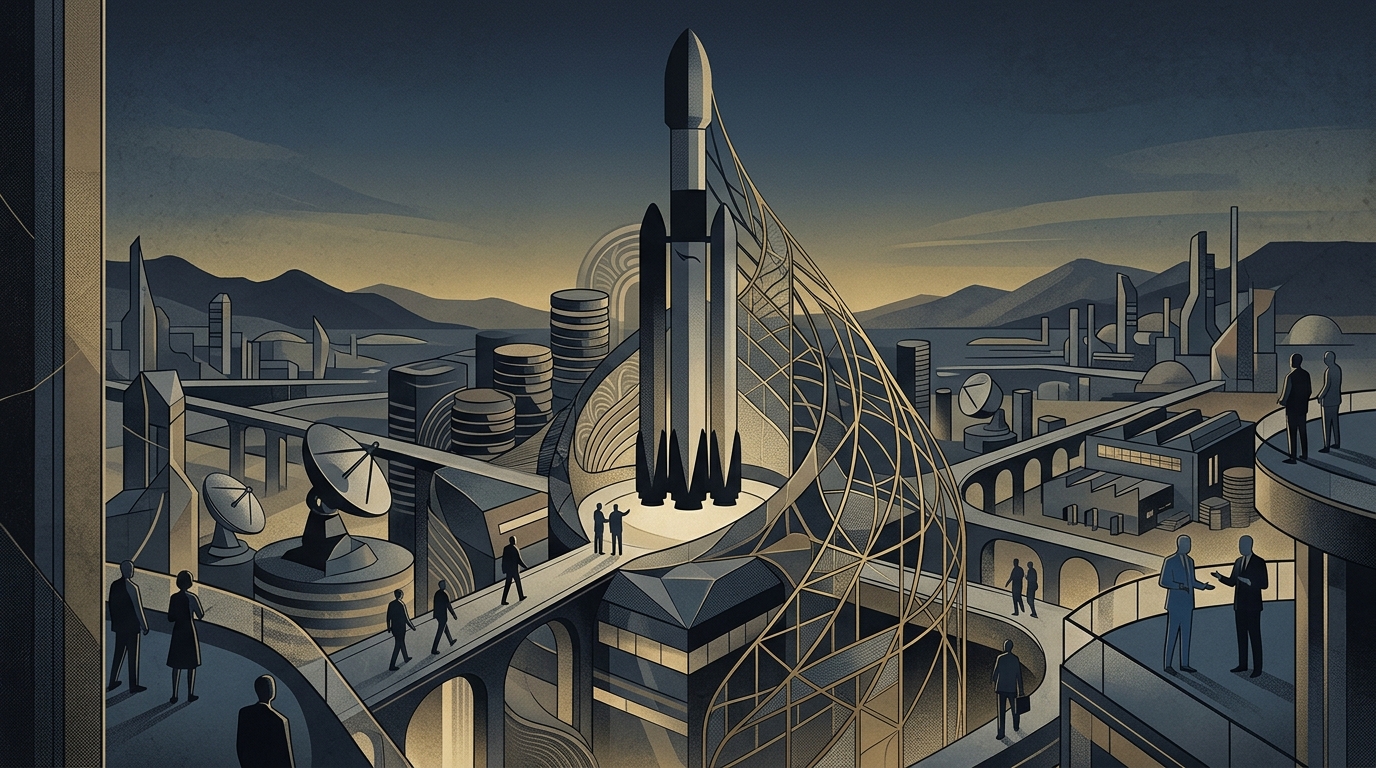
The story of SpaceX is no longer a story about rockets; it is a story about the absolute control of the infrastructure of the future. As reports circulate regarding an imminent public offering or a new valuation that could touch $2 trillion, Elon Musk’s company is not merely a player in the aerospace industry; it is becoming the gatekeeper of global connectivity and the space supply chain. However, behind the staggering numbers lies a complex reality that blends technological brilliance with a dangerous degree of power concentration.
Starlink as the Ultimate Liquidity Machine
The key to skyrocketing SpaceX’s valuation is not the Falcon 9 rockets, but the Starlink satellite constellation. For the first time in the history of space exploration, a private company has managed to create a consumer product with global reach and recurring revenue. Starlink does not just provide internet to remote areas; it forms the backbone of modern military communications and the foundation for the next generation of Space AI.
SpaceX’s ability to launch its own satellites at a fraction of the cost of its competitors gives it an almost unfair advantage. While Boeing and Lockheed Martin struggle with bureaucratic delays and costly contracts, SpaceX operates with the speed of a Silicon Valley software firm. This vertical integration allows for profit margins the industry never imagined, leading Wall Street analysts to compare SpaceX more to Apple or Google than to the traditional defense industry. The recurring revenue from Starlink provides the necessary capital to fund the more ambitious—and expensive—Mars missions.
Starship: The Bet That Will Decide Everything
If Starlink is the cash register, Starship is the vehicle that will unlock the economy of the solar system. The largest rocket ever built promises to reduce the cost of transporting cargo to space by 90% or more. This means that asteroid mining, orbital manufacturing, and a permanent presence on the Moon move from the realm of science fiction to economic reality. The sheer scale of Starship allows for the deployment of massive infrastructure that was previously impossible to launch.
However, the development of Starship is a high-stakes process. Every test flight at Boca Chica, Texas, is watched by the entire world, not just for the spectacle, but because the program's failure could destabilize the $2 trillion edifice. SpaceX has invested billions into developing this system, and its success is essential for fulfilling NASA’s contracts for the Artemis program. The US government’s reliance on a single private entity to return to the Moon represents one of the most significant geopolitical shifts of the 21st century. The "trap" here is that Starship's success is binary—it either revolutionizes the world or becomes a massive sunk cost.
The "Trap": Regulatory Chaos and Political Polarization
Here lies the great trap. SpaceX does not operate in a vacuum. Its immense power has raised alarms among regulators in both the US and Europe. Starlink’s dominance of Earth’s orbits creates issues of "congestion" and interference with astronomy, while its monopolistic position in the launch market raises questions about healthy competition. Furthermore, there is the "Elon Musk factor." His involvement in the political arena and his controversial management of X (formerly Twitter) have made SpaceX a target for political attacks.
Investors worry that SpaceX could become a "hostage" to its founder’s persona. If regulators decide to limit the company’s activities due to Musk’s political stance, or if international allies of the US begin to seek alternatives for national security reasons, the $2 trillion valuation could evaporate quickly. SpaceX is now "too big to fail," but also "too big to ignore" for governments seeking to control the final frontier. The geopolitical sensitivity of satellite internet, as seen in the Ukraine conflict, highlights how SpaceX is now a central actor in global power dynamics.
Conclusion: Toward a New Space Order
SpaceX stands at a crossroads. On one hand, its technological superiority is undeniable, and its ability to innovate remains unmatched. On the other hand, the transition from a private company to a global public infrastructure provider requires a delicate balance that Musk rarely exhibits. The $2 trillion valuation reflects not just the value of rockets, but the value of humanity's future among the stars. Whether SpaceX will remain the leader of this future or buckle under the weight of its own ambitions and political pressures remains to be seen. The space economy is the new El Dorado, but the map to reach it is currently held by a single, unpredictable hand.