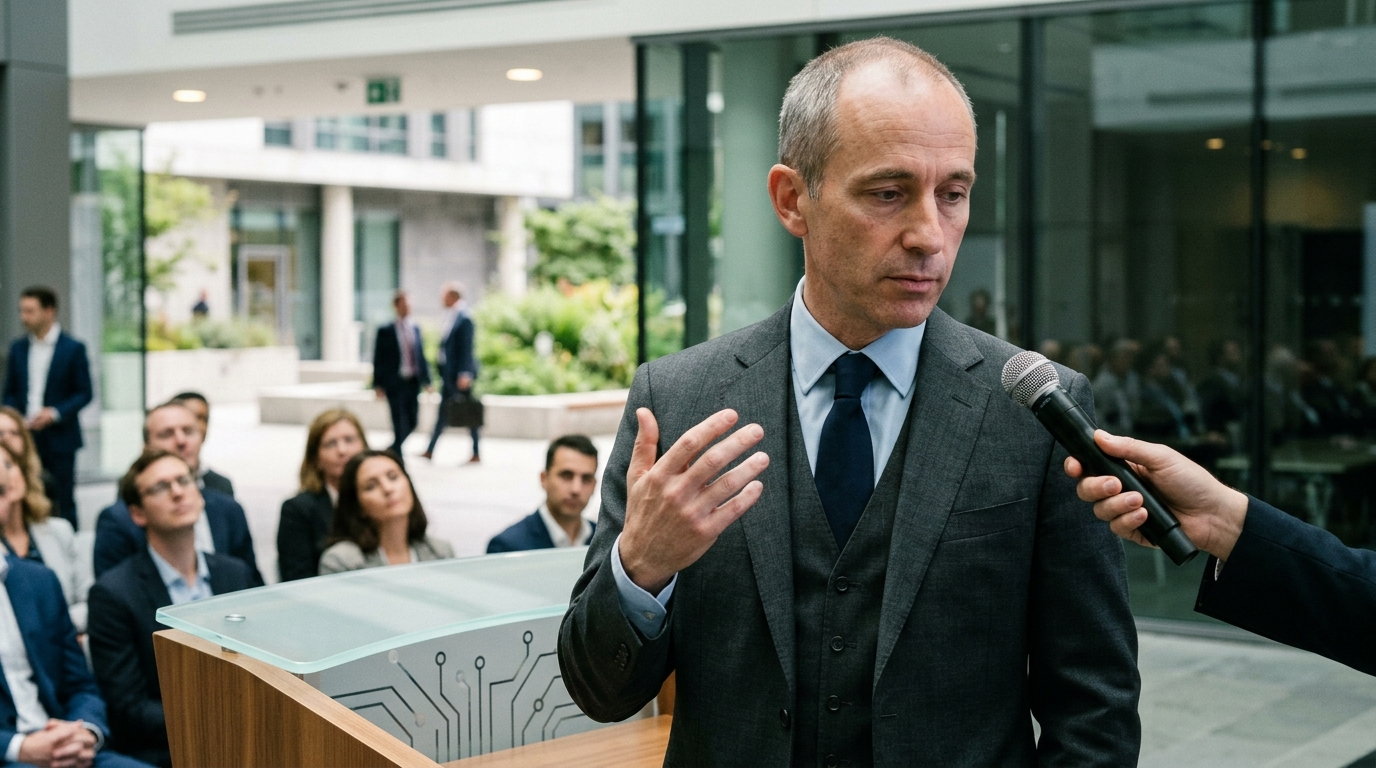
In an era where the global technology market is ravenous for storage capacity driven by the Artificial Intelligence explosion, Seagate Technology Holdings found itself at the center of a financial storm. CEO Dave Mosley’s admission during a JPMorgan conference that the company does not intend to build new factories because the process would “take too long” triggered an immediate sell-off, sending shares down as much as 8.3%. This statement served as a stark reminder of the hard reality governing the digital world’s physical infrastructure: AI may evolve at the speed of light, but the bricks and mortar of manufacturing plants require years of lead time.
The Clash of Expectations and Reality
Seagate, one of the world’s leading manufacturers of hard disk drives (HDDs), is at a difficult crossroads. On one hand, cloud service providers and data centers are desperately seeking higher capacity to train and host Large Language Models (LLMs). On the other hand, Seagate appears to be choosing a conservative path, preferring to optimize existing production lines rather than risking massive capital expenditure (CapEx) on new facilities.
Mosley explained that creating a new semiconductor or storage component facility is not a matter of months, but years. In today’s environment of high interest rates and volatility, committing billions of dollars to projects that will only bear fruit in 2028 or 2029 is viewed by management as high-risk. However, investors interpreted this stance as an inability to capitalize on the AI momentum, potentially leaving the door open for competitors like Western Digital or Micron to gain market share.
The HAMR Technology Gamble
Instead of new factories, Seagate is betting everything on HAMR (Heat-Assisted Magnetic Recording) technology. This innovation allows for significantly more data to be stored on the same physical disk surface by using laser-assisted heating. The company’s strategy is clear: "Do more with what we already have." If Seagate can successfully increase disk density without needing more factory floor space, its profit margins could soar.
However, the market remains skeptical. HAMR technology has faced delays in the past, and AI’s requirements for low latency often favor Solid State Drives (SSDs) over Seagate’s traditional HDDs. While HDDs remain the most cost-effective solution for mass data storage (cold storage), the shift toward AI requires a balance that Seagate is struggling to convince the market it has mastered.
The Memory Cycle and Macroeconomics
The memory and storage industry is notorious for its boom-and-bust cycles—moving from acute shortages to massive oversupply. Mosley seems to fear a repeat of past mistakes, where over-expansion led to a collapse in pricing power. His caution reflects a broader trend in the hardware sector: the AI "bubble" creates an artificial pressure for immediate expansion, but seasoned managers know that demand can level off abruptly.
In conclusion, the drop in Seagate’s stock is a reminder that the AI revolution is not just a matter of code and algorithms, but also of physical constraints. The refusal to build new factories may prove to be a wise move to protect the balance sheet, or a historic blunder that allows competitors to dominate the new digital epoch. One thing is certain: "patience" is not a word Wall Street enjoys hearing in 2026.