In the heart of the technological revolution we are experiencing in 2026, Nvidia continues to dictate a pace that leaves its competitors gasping for air. With the recent unveiling of the new Rubin architecture, succeeding the already triumphant Blackwell, CEO Jensen Huang didn't just present another piece of silicon. He presented a vision of an era where computational power is no longer a finite resource but an unstoppable flow of energy powering the global economy.
The Rubin Architecture: Pushing Beyond Blackwell’s Limits
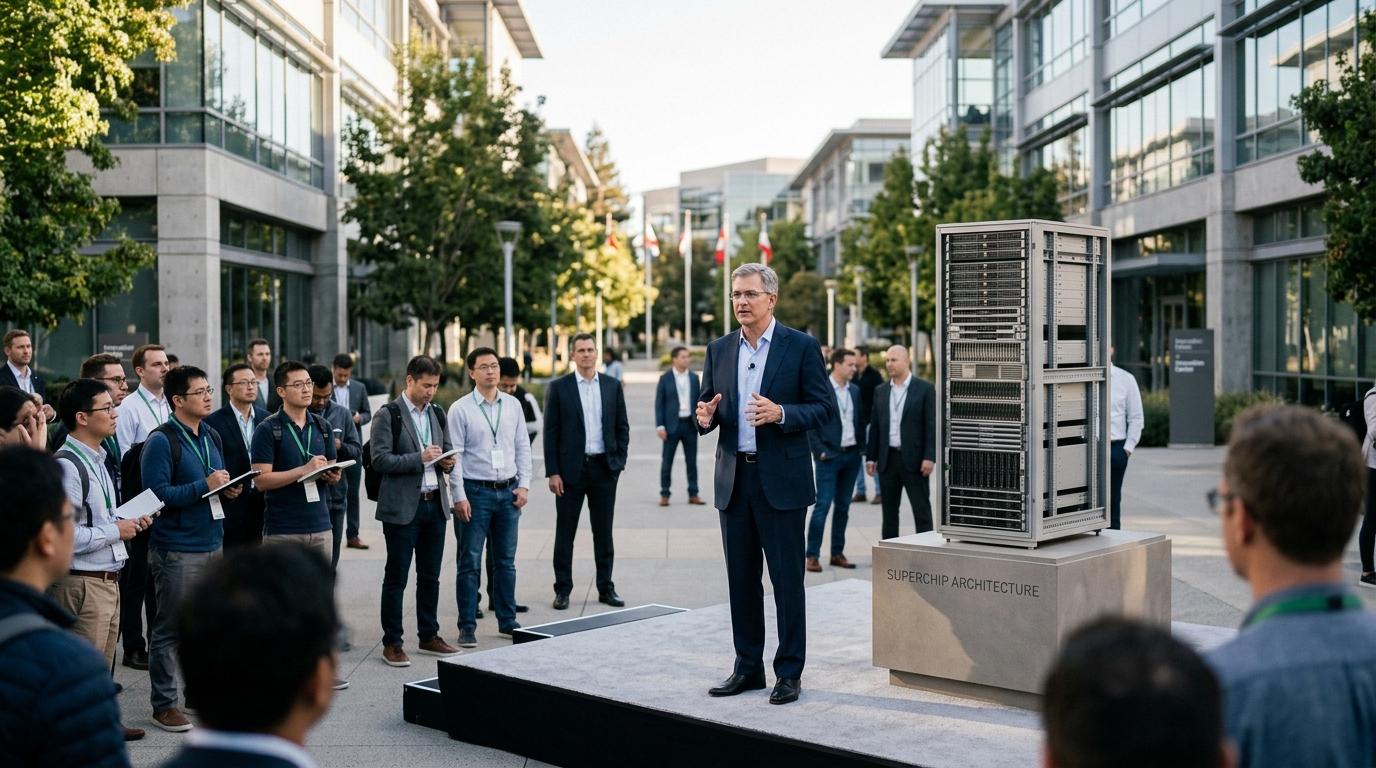
The new Rubin platform, expected to dominate the market in the coming cycles, integrates HBM4 (4th generation High Bandwidth Memory) technology, offering data transfer speeds that were considered theoretical just a year ago. This 'superchip' is not a mere upgrade; it is a radical redesign of how Graphics Processing Units (GPUs) communicate with central memory and CPUs.
According to analysts, Nvidia has now adopted a yearly product cadence, a strategy reminiscent of the rapid rise of smartphones, but on a multi-billion dollar scale. The Rubin architecture includes the new R100 GPUs and the new Vera CPU, creating a holistic ecosystem that makes reliance on Intel or AMD optional for major cloud providers (hyperscalers).
The Clash with Intel and Pat Gelsinger’s Gamble
Intel, under the leadership of Pat Gelsinger, has been struggling for years to regain lost ground. Although the Gaudi 3 series showed signs of cost-performance competitiveness, Nvidia appears to be operating at a different level of abstraction. Intel’s problem isn't just the hardware. It is CUDA, Nvidia’s software stack that has become the de facto standard for every AI developer on the planet.
Nvidia’s strategy of offering not just chips, but entire 'AI Factories,' puts Intel in a difficult position. While Intel focuses on foundry services and regaining CPU supremacy, Nvidia has already transformed the data center into a single, unified computer. Their rivalry is no longer about who has the fastest chip, but who controls the architecture of the future.
Energy Efficiency and the Cost of Progress
One of the most critical points of the new superchip presentation was the promise of a dramatic reduction in power consumption per unit of computation. In a world grappling with the climate crisis, the energy hunger of data centers has become a political issue. Nvidia claims that transitioning to the Rubin architecture will allow companies to train larger models (LLMs) with a fraction of the energy required two years ago.
However, there is a paradox here: as chips become more efficient, the demand for them increases, ultimately leading to higher overall energy consumption—the well-known Jevons Paradox. Nvidia isn't just selling technology; it’s selling the promise that AI will solve the problems that its own existence exacerbates.
The Geopolitics of Silicon
We cannot ignore the fact that these chips are the new 'weapons' on the global geopolitical map. Export restrictions to China and the need for 'Sovereign AI' by nations like France, Japan, and the UAE make Nvidia a diplomatic player. The new Rubin superchip is not just a product for Google or Microsoft; it is a tool of national power.
The global economy's dependence on a single company for critical AI hardware is causing concern among regulators. Nevertheless, the speed of innovation is such that policy struggles to keep up. Nvidia has managed to become the infrastructure upon which the 21st century is being built, leaving Intel and other players searching for a role in a rapidly shifting world.