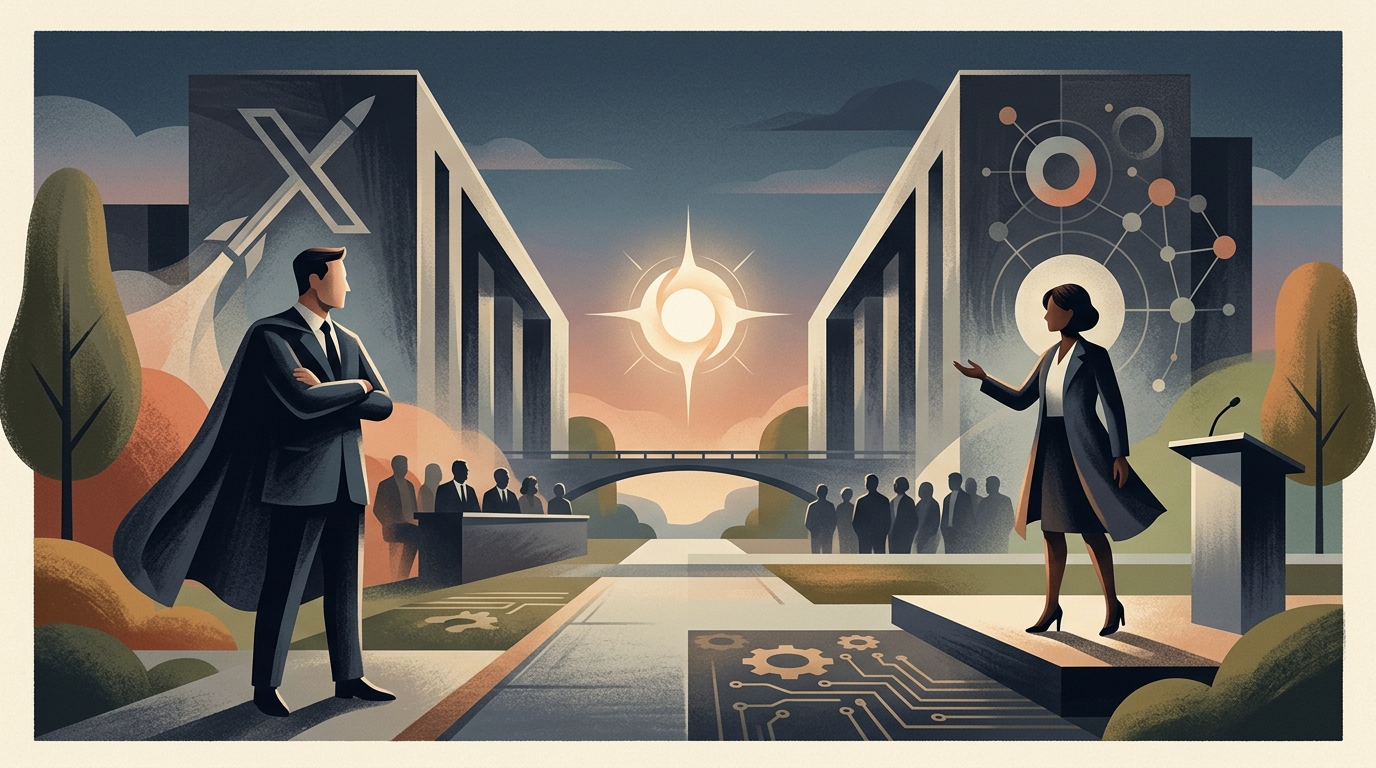
Today, April 27, 2026, the San Francisco courthouse becomes the epicenter of the technological world. The commencement of jury selection in the legal battle between Elon Musk and OpenAI’s leadership, headed by Sam Altman, is more than just a corporate dispute. It is the climax of a multi-year ideological and personal feud that asks a fundamental question: Who owns Artificial Intelligence? Humanity or the shareholders?
The Betrayal of the 'Founding Myth'
Elon Musk, who co-founded OpenAI in 2015, alleges that the company has breached its "Founding Agreement." According to Musk, OpenAI was established as a non-profit organization aimed at developing Artificial General Intelligence (AGI) for the benefit of humanity, insulated from commercial pressures. His lawsuit claims that the close partnership with Microsoft and the transition to a "capped-profit" structure represents a flagrant betrayal of that promise.
For its part, OpenAI, under the guidance of Sam Altman and Greg Brockman, dismisses these claims as the fabrications of a "jealous former associate." The company’s legal team argues that there was never a formal, signed contract binding OpenAI to a perpetual non-profit form, and that the necessity for billions of dollars in compute power made the commercial pivot inevitable.
"OpenAI has been transformed into a closed-source de facto subsidiary of the largest technology company in the world: Microsoft," Musk’s legal filing asserts.
Microsoft’s Shadow and the Governance Crisis
The trial is expected to shed light on the internal processes that led to the dramatic firing and subsequent rehiring of Sam Altman in November 2023. That incident, which sent shockwaves through Silicon Valley, revealed the deep rift between a board concerned with AI safety and a management pushing for faster commercialization. Dorothy Lund, a law professor at Columbia Law School, notes that this case will set a precedent for "corporate governance in hybrid structures."
- The AGI Question: If the court finds that GPT-4 or its successors constitute forms of AGI, Microsoft could potentially lose its licensing rights, as its agreement with OpenAI explicitly excludes AGI.
- Transparency and Open Source: Musk is demanding that OpenAI’s code be made accessible to the public, as originally envisioned.
- Financial Restitution: Although Musk claims he is not motivated by money, the trial could lead to the return of donations or a redistribution of profits.
Implications for the AI Ecosystem
The outcome of this trial will affect every AI startup in the world. If Musk prevails, it will create a formidable legal barrier for companies that promise "altruistic goals" to attract talent and donations, only to pivot to profit-driven models later. If OpenAI wins, it will solidify the model of "controlled commercialization," where ethics take a backseat to the capital requirements of scaling massive models.
At a time when the European Union and the United States are scrambling to regulate AI, this trial acts as a mirror to the industry’s contradictions. The Musk-Altman battle is not just about billions; it is about who holds the "key" to the most powerful technology humans have ever created. As the jurors take their seats, the history of technology is being written in a courtroom.