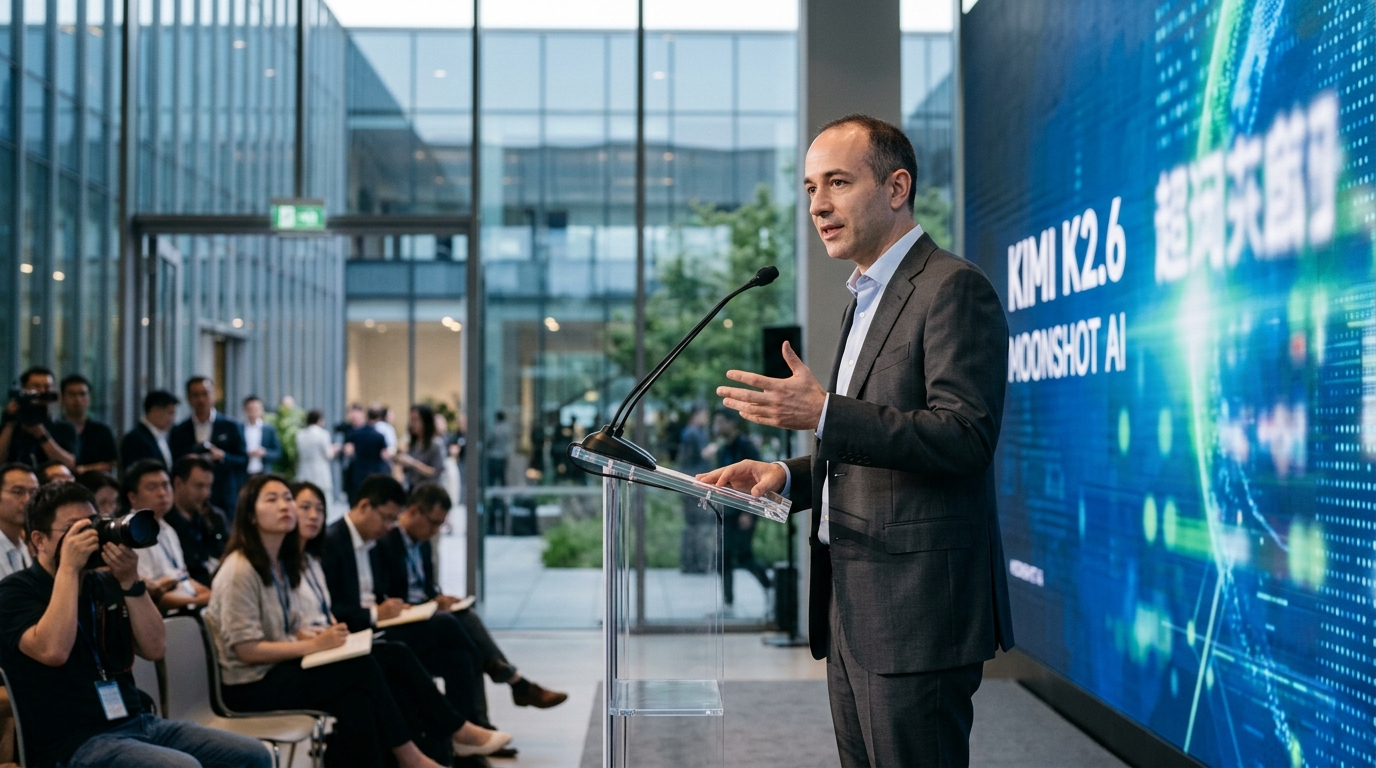
The global geopolitical landscape of artificial intelligence is no longer a one-sided affair dominated by Silicon Valley. With the official unveiling of Kimi K2.6, Moonshot AI—the Chinese unicorn founded by the prodigy Yang Zhilin—is sending a clear message: the gap between American and Chinese Large Language Models (LLMs) has effectively closed. Kimi K2.6 is not merely an upgrade; it is a strategic challenge to Anthropic and its Claude series, which until recently were considered the gold standard for context window management and ethical alignment.
The Technical Prowess of Kimi K2.6
Moonshot AI’s core advantage since its inception has been its mastery of massive context windows. While OpenAI and Anthropic struggled to maintain coherence across texts of tens of thousands of words, Kimi pioneered the processing of millions of characters without memory loss. With version K2.6, this capability is now paired with an unprecedented reasoning engine that matches, and in some benchmarks exceeds, the performance of Claude 3.5 Sonnet and GPT-4o.
Analysts note that K2.6 exhibits a unique capacity for "multimodal synthesis." It can simultaneously analyze complex financial data, legal documents spanning thousands of pages, and audiovisual content, deriving conclusions that require deep conceptual understanding. This makes it a formidable tool for the enterprise sector, particularly in fields like biotechnology and cryptography, where precision is a matter of survival.
The Rivalry with Anthropic and the Western Model
Anthropic, backed by Amazon and Google, has built its reputation on "Constitutional AI," emphasizing safety and the avoidance of harmful outputs. However, Moonshot AI follows a different philosophy, focusing on "scaling efficiency." Despite US export restrictions on advanced chips (such as Nvidia’s H100s) to China, Yang Zhilin’s team has managed to optimize their algorithms to produce superior results with significantly less raw computing power.
This "algorithmic frugality" is what worries Western investors. If Moonshot can compete with Anthropic using inferior hardware, what happens when China develops its own domestic production of cutting-edge semiconductors? Kimi K2.6 is no longer just a productivity tool; it is a symbol of technological autonomy. The model's ability to handle long-form reasoning without the massive energy overhead typical of Western models suggests a breakthrough in architecture that could redefine the industry's scaling laws.
Market Strategy and the Ecosystem
Moonshot AI has successfully attracted massive funding, with its valuation soaring past $3 billion. Backing from giants like Alibaba and Tencent provides not just capital, but access to vast datasets and robust cloud infrastructure. The company’s strategy of offering Kimi for free or at very low price points for developers in Asia has fostered an application ecosystem that threatens to isolate Western models from the Eastern market.
- Enhanced coding proficiency across more than 20 programming languages.
- Integration of advanced real-time search tools for up-to-the-minute accuracy.
- A 40% reduction in hallucinations compared to the previous iteration.
- Custom fine-tuning capabilities for specific industrial requirements.
Conclusion: A New Bipolar Reality
The launch of Kimi K2.6 confirms that AI is entering a phase of intense competition where the geographical origin of the code matters. While Anthropic remains a leader in ethics and safety, Moonshot AI demonstrates that raw computational intelligence and large-scale data management are fields where China can now claim leadership. For users, this competition means faster innovation; for governments, it signifies a new arms race where the weapons are parameters and neural networks. As we move further into 2026, the question is no longer whether China can catch up, but whether the West can keep pace with Moonshot's rapid iteration cycle.