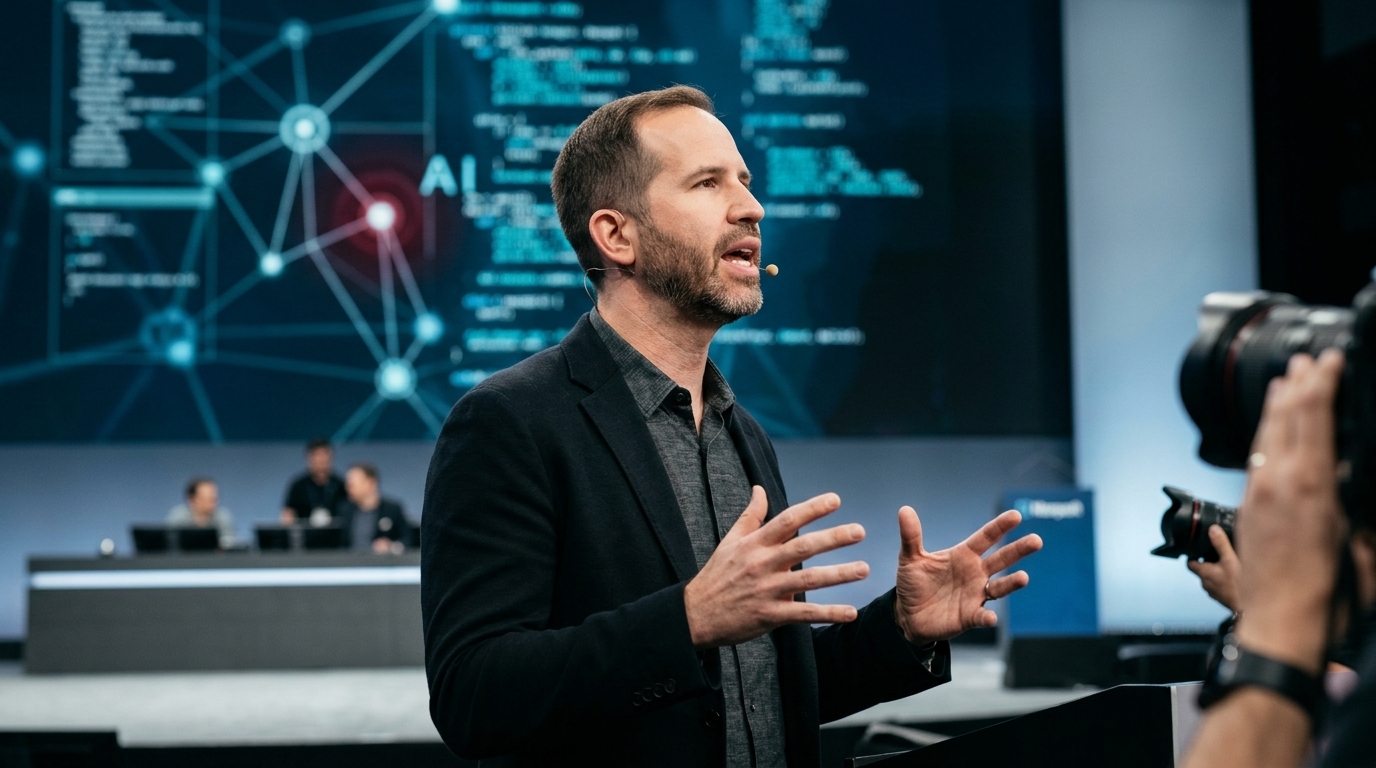
In the heart of San Francisco, where the pulse of the technological revolution beats louder than ever, Satya Nadella took the stage at the Build 2026 conference with a mission that transcends simple product announcements. Microsoft, the software giant that successfully transformed from a clunky monopoly into an agile cloud leader, is now seeking to redefine its position as the "center of gravity" for the entire Artificial Intelligence ecosystem. After three years of intense competition with Google, Meta, and Apple, the Redmond company appears to be moving from the era of "Copilots" to the era of "Autonomous Agents."
The Transition from Assistance to Autonomy
Nadella's core message was clear: AI is no longer a tool waiting for instructions, but a system that acts proactively. At Build 2026, Microsoft unveiled the next generation of Copilot+, which is deeply integrated into the Windows kernel. Unlike previous versions, these new agents can perform complex tasks without constant human supervision.
- Automated supply chain management via Dynamics 365.
- Proactive real-time code error detection in development environments.
- Orchestration of multi-layered projects in Microsoft 365, where AI assigns tasks to various digital assistants.
This shift toward autonomy represents Nadella's big bet. As he emphasized in his keynote, "We are not just building software; we are building the fabric upon which the global economy of the future will run." This strategy aims to make Azure the indispensable infrastructure for any business looking to develop its own AI models, while simultaneously reducing dependence on external providers.
The OpenAI Paradox and Internal Development
One of the most discussed aspects of Nadella's presence in San Francisco was the delicate balance between the partnership with OpenAI and the strengthening of Microsoft's internal capabilities. While Sam Altman remains a close ally, Microsoft has begun to boldly promote its own "Phi-4" and "MAI-1" models. This is a move toward strategic autonomy. Microsoft realizes that to remain the center of gravity, it cannot rely exclusively on third-party intellectual property.
"Dominance in AI requires vertical integration: from the silicon of our own Maia chips to the operating system and the end-user application," a Microsoft executive noted on the sidelines of the conference.
Investing in its own AI processors and optimizing software for them allows Microsoft to offer lower costs and higher speeds—the "holy grail" for developers deciding which platform to call home.
The Battle for Developers
Build is traditionally a developer conference, and this year the battle for their loyalty was fiercer than ever. With Google regaining ground with Gemini and Apple integrating "Apple Intelligence" into billions of devices, Microsoft had to prove its ecosystem remains the most productive. The introduction of new tools in GitHub Copilot that allow the creation of entire applications through natural language is a powerful lure. Microsoft doesn't just want us to use its tools; it wants the next big AI innovation to be written, trained, and hosted on its infrastructure.
Conclusion: The Hegemon Returns
Satya Nadella closed his speech with a reference to the responsibility that technology carries. However, behind the rhetoric of ethics and safety lies the raw market reality: Microsoft is laying the groundwork for a new decade of dominance. If 2023 was the year of hype and 2024-2025 the years of implementation, 2026 is the year of consolidation. Microsoft no longer seeks to be part of the AI revolution; it seeks to be the very axis around which it revolves.