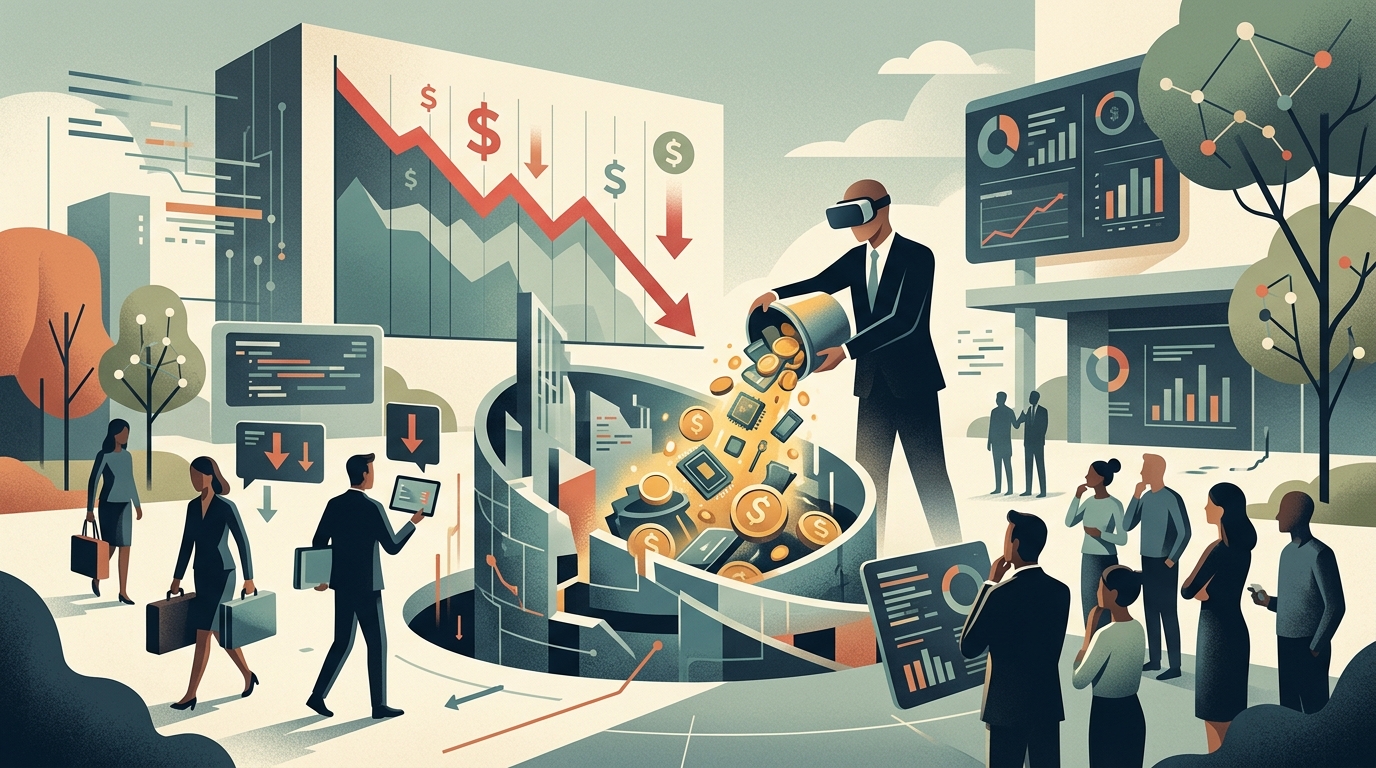
In a move that is sending shivers down the spines of Wall Street investors, Meta Platforms has announced a dramatic increase in its capital expenditure, despite its Metaverse vision already costing the company an astronomical $80 billion. The announcement, coupled with CFO Susan Li's admission that the company "continued to underestimate" its compute needs, marks a new phase in Mark Zuckerberg’s aggressive strategy for Artificial Intelligence (AI) dominance.
The Reality Labs Black Hole and the User Crisis
For years, Meta’s Reality Labs division—responsible for developing virtual and augmented reality technologies—has been the lightning rod for criticism. Since its inception, it has accumulated losses exceeding $80 billion without delivering a mass-market product. However, the most alarming metric isn't just the financial drain, but the rapid decline in the user base. Reports indicate that Meta has lost over 20 million active users across its Metaverse-related platforms, as the public appears to be growing weary of promises that fail to materialize in the physical world.
Despite this hemorrhaging, Zuckerberg remains undeterred. His strategy is now shifting: the Metaverse is no longer viewed as an isolated digital world, but rather the final stage of an infrastructure built entirely on AI. To get there, Meta needs chips—lots of them. The $10 billion spending hike is earmarked almost exclusively for purchasing NVIDIA processors and constructing massive data centers.
Underestimating the Hunger for Compute
Susan Li’s admission that Meta underestimated its compute requirements is a telling sign of how fast the industry is moving. As the company develops Llama 4 and Llama 5, its next-generation large language models, the need for training at a scale of trillions of parameters makes previous forecasts obsolete. Meta is no longer just competing with Google or Microsoft in the advertising space; it is in an arms race for Artificial General Intelligence (AGI).
- CapEx Surge: Total capital expenditures for 2026 are expected to hit record levels, potentially exceeding $40 billion.
- Llama Strategy: Releasing open-source models for free is a calculated move to make Meta’s technology the industry standard.
- Wearables: Smart glasses, developed in partnership with Ray-Ban, represent the new hope for integrating AI into users' daily lives.
Market Reaction and Zuckerberg's Grand Gamble
Shareholders are caught in a paradox. On one hand, Meta remains a cash-printing machine thanks to Instagram and Facebook's advertising dominance. On the other, the fear that Zuckerberg is "burning" the company's profits on an uncertain future is causing significant market volatility. History has often shown Zuckerberg to be right—as seen with the pivot to mobile and the acquisition of Instagram—but the sheer scale of the current investment is unprecedented in corporate history.
"We’re not just building an app; we’re building the operating system of the future," Zuckerberg recently stated, implying that failure in AI would mean the gradual obsolescence of Meta as a global power.
In conclusion, Meta is on an "all-in" trajectory. The loss of 20 million users could be interpreted as a necessary shedding of those not ready for the next evolution, or as the beginning of the end for an empire that has lost touch with reality. What is certain is that the next two years will determine whether the $80 billion was an investment in eternity or the most expensive mistake in the history of capitalism.