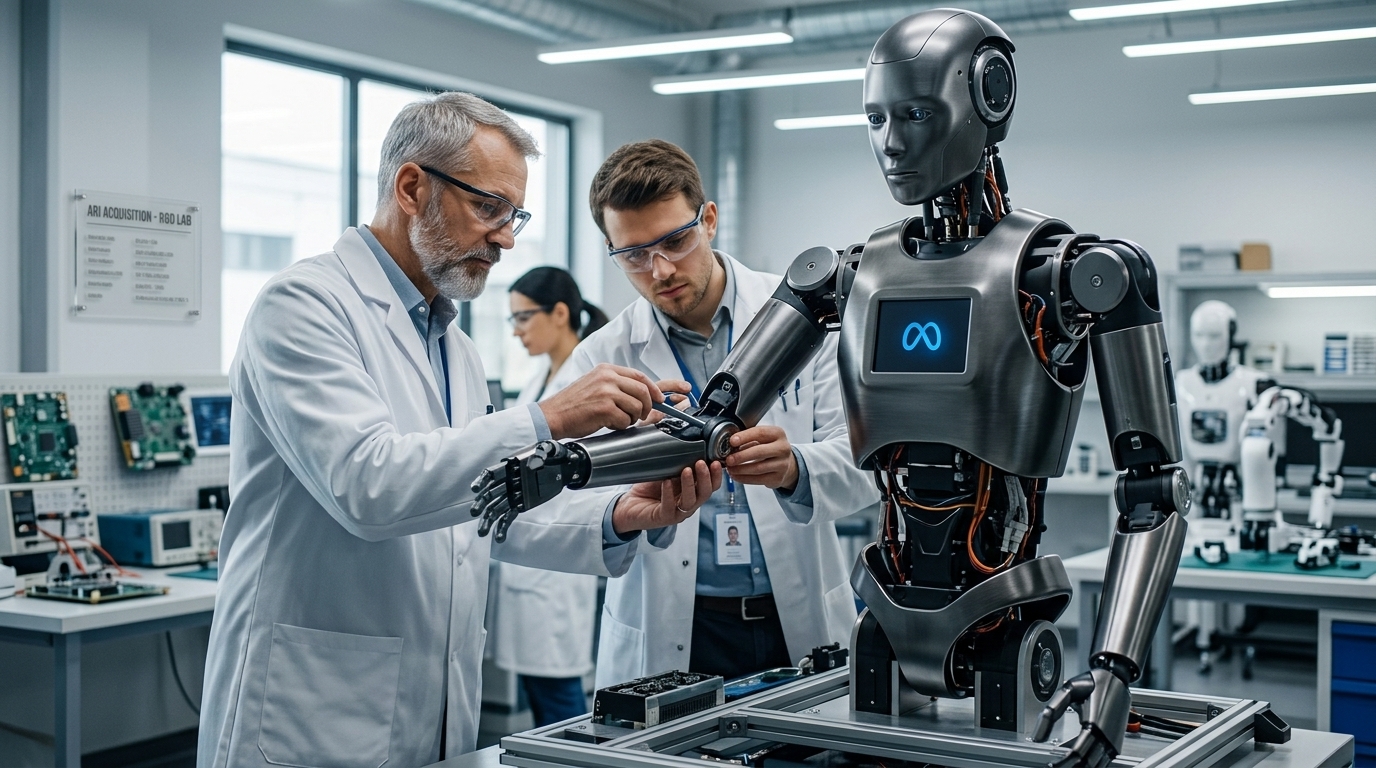
Meta's announcement regarding the acquisition of Assured Robot Intelligence is far more than a routine corporate merger; it marks the official dawn of a new era for Mark Zuckerberg’s tech empire. After years of heavy investment in the Metaverse and virtual reality, Meta is pivoting toward "Embodied AI," seeking to grant its sophisticated large language models, such as Llama, a physical form capable of interacting with the tangible world.
The Strategic Importance of Assured Robot Intelligence
Assured Robot Intelligence, a firm that until recently operated in stealth mode, is widely regarded as a pioneer in low-latency motion control and advanced haptic feedback. Their proprietary technology enables robots to perform delicate manual tasks that were previously considered the exclusive domain of human dexterity. For Meta, acquiring this intellectual property is the key to bridging the gap between digital intelligence and physical execution.
Market analysts suggest that Meta isn't merely interested in building a mechanical human. The ultimate objective is to create an ecosystem where AI learns through physical interaction. Instead of training AI solely on text and images harvested from the internet, the system will now gather data from movement, gravity, and tactile contact, fostering a much deeper and more nuanced understanding of our reality.
Competition with Tesla and OpenAI
This move places Meta on a direct collision course with Elon Musk’s Tesla, which is developing the Optimus robot, and OpenAI, which has significantly backed Figure AI. The humanoid robotics market is projected to reach trillions of dollars over the next decade, as global labor shortages make automation an economic imperative rather than a luxury.
- Tesla Optimus: Focused on mass production and industrial integration within factories.
- Figure AI (OpenAI): Prioritizing linguistic communication and logical reasoning in robotic forms.
- Meta (Assured): Likely focusing on social interaction and assistive robotics for domestic and professional environments.
Challenges and Ethical Dilemmas
Despite the technological excitement, Meta’s foray into robotics raises profound questions regarding privacy and safety. If Meta’s robots enter our homes, what kind of data will they collect? The company, which has faced intense scrutiny over its handling of personal data on social platforms, must prove it can manage the "physical" presence of AI responsibly.
"The transition from pixels to atoms is the greatest challenge we have ever faced," a Meta executive stated during the acquisition's unveiling. "We aren't just building machines; we are building companions that understand the physical environment."
Furthermore, the regulatory landscape remains complex. The European Union, through the AI Act, is expected to impose stringent rules on the deployment of humanoid robots in public spaces. Meta will have to navigate a minefield of legislation, ensuring that its robots do not pose a threat to public safety or labor stability.
The Future of Work and Daily Life
The integration of Assured Robot Intelligence into Meta’s Reality Labs suggests that the first prototypes could be showcased to the public within the next two years. While initial applications might be restricted to controlled environments like warehouses or data centers, Zuckerberg’s vision is clear: a world where AI is not just a voice on our phones, but an entity that can assist with daily chores, care for the elderly, or perform hazardous tasks.
In conclusion, this acquisition is not a random addition to Meta’s portfolio. It is a declaration of dominance. In a world rapidly digitizing, Meta is betting that the next great revolution will occur where technology meets the physical realm—or at least the metal that simulates it.