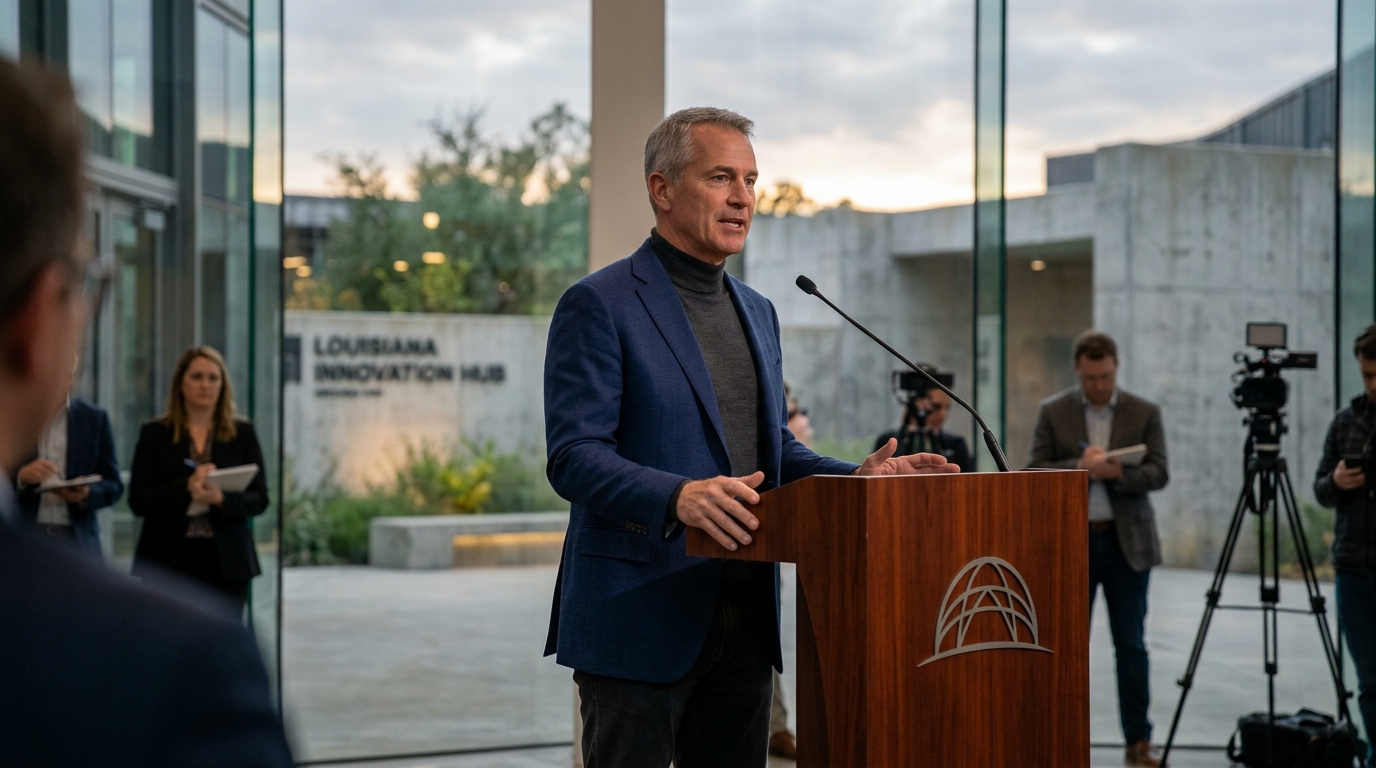
In the heart of rural Louisiana, where fields and traditional industry once reigned supreme, Meta Platforms Inc. is erecting a monument to the digital age. With an investment totaling a staggering $200 billion, Mark Zuckerberg is not merely building a data warehouse; he is constructing the nervous system of tomorrow’s global economy. Yet, the question haunting Wall Street remains relentless: can such an expenditure ever yield the expected returns, or are we witnessing the largest capital bubble of the 21st century?
The Geography of Power: Why Louisiana?
The choice of Louisiana is far from accidental. At a time when Silicon Valley faces saturation and California’s energy grid buckles under the weight of demand, the American South offers what the West cannot: space and energy. Meta’s new data center is expected to be one of the largest in the world, equipped with hundreds of thousands of specialized Nvidia H100 and upcoming Blackwell processors, alongside Meta’s own proprietary MTIA (Meta Training and Inference Accelerator) chips.
The local government of Louisiana provided generous tax incentives, viewing the investment as a catalyst for economic rebirth. However, the scale of the project is awe-inspiring. The facility’s energy requirements are equivalent to the consumption of a mid-sized European city, forcing Meta to enter agreements for the construction of small modular nuclear reactors (SMRs) and massive renewable energy farms in the surrounding region.
The Llama Architecture and the Battle for Dominance
Why does Meta need such immense computing power? The answer lies in its strategy for an "open" AI ecosystem. With the Llama model now serving as a benchmark for developers worldwide, Meta aims to make its technology indispensable to every application, from WhatsApp to Ray-Ban smart glasses. Training subsequent generations (Llama 5 and Llama 6) requires exponentially more power, and Meta is unwilling to depend on the infrastructures of Microsoft or Google.
Analyzing real-time data for billions of users demands an infrastructure that pushes the boundaries of the possible. Meta is transforming from a social media company into an AI infrastructure giant. This transition is painful for balance sheets, as capital expenditures (CapEx) have skyrocketed, squeezing profit margins and forcing shareholders to exhibit a level of patience rarely seen in stock markets.
Wall Street Skepticism and the Specter of a Bubble
Despite Zuckerberg’s optimism, analysts remains divided. The $200 billion cost is larger than the GDP of many sovereign nations. Investors wonder if advertising—Meta’s primary revenue stream—can be improved so dramatically through AI as to justify this cost. Meta argues that AI is already enhancing ad performance and user retention, but the gap between "improvement" and "amortizing $200 billion" is vast.
- The Energy Challenge: The need for stable, 24/7 power supply.
- The Competition: OpenAI and Google are developing equally costly infrastructures.
- Regulation: Potential restrictions on data usage from the EU and the US.
Furthermore, there is the risk of technological obsolescence. If a new chip architecture emerges in two years that renders today’s processors obsolete, Meta could find itself with a massive facility of "dead" hardware. It is a risk the company seems willing to take, betting everything on dominating the physical layer of artificial intelligence.
Conclusion: A New Industrial Revolution
The Louisiana data center is not just a business move; it is a statement of political power. In a world where computing power translates into geopolitical influence, Meta is positioning itself as one of the few players capable of affording the entry fee to the "trillionaire club." If the bet pays off, Zuckerberg will have built the digital empire of the future. If it fails, Louisiana will be left with the most expensive carcass in the history of technology.